- Fungi Including Lichens
- ›Basidiomycete Fungi
- ›Higher Basidiomycetes
- ›Mushrooms, Bracket Fungi, Puffballs, and Allies
- ›Agaricomycetidae
- ›Common Gilled Mushrooms and Allies
- ›Agaricineae
- ›Field Mushrooms and Allies
- ›Leucocoprineae
- ›Leucocoprinus
- ›Denudati
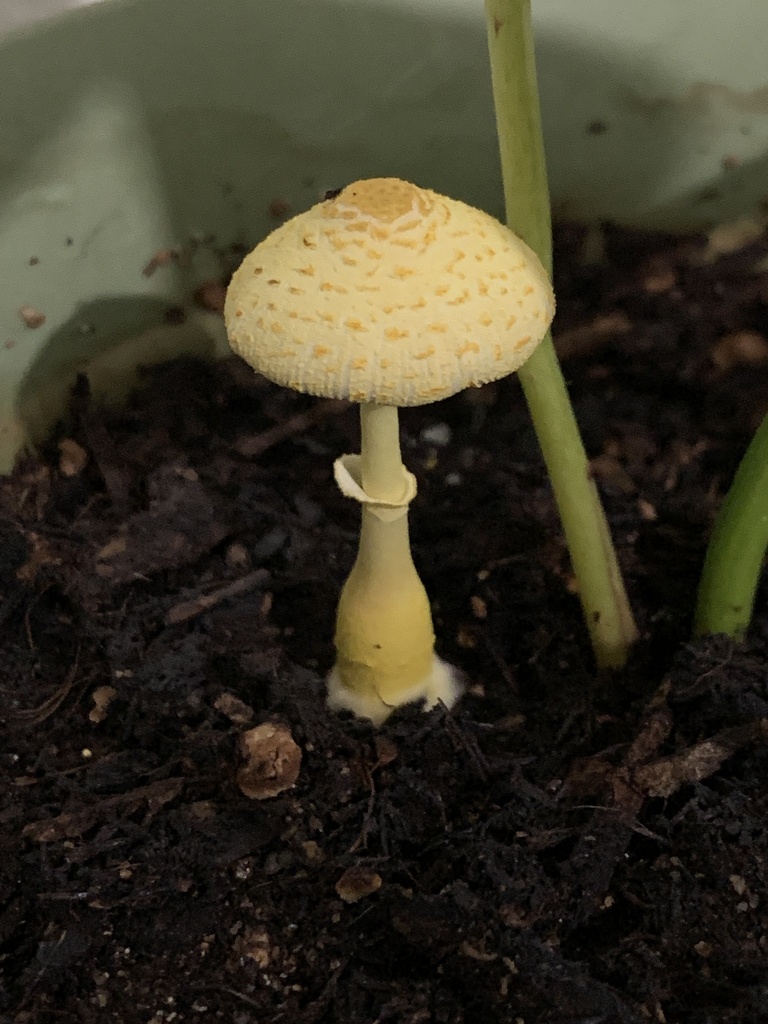
flowerpot parasol
Leucocoprinus birnbaumii
Leucocoprinus birnbaumii, commonly known as the flower pot parasol, yellow parasol, flowerpot parasol, or plantpot dapperling, is a species of gilled mushroom in the family Agaricaceae. It is common in the tropics and subtropics. In temperate regions, it frequently occurs in greenhouses, flowerpots, and indoor terrariums. It is toxic if ingested.
From the article Leucocoprinus birnbaumii on Wikipedia (CC BY-SA), quoted section by section
Description
Leucocoprinus birnbaumii is a small, yellow dapperling mushroom. The fruit bodies are agaricoid (mushroom-shaped) and occur singly or in small clumps. Cap: 2.5–6 cm wide in maturity, starting bulbous to cylindrical before expanding to hemispherical or conical and flattening or sometimes appearing umbonate with age. The surface is lemon yellow to sulphur yellow, smooth or slightly powdery and covered in ragged, fibrous scales which are easily removed. The scales are darker yellow or brownish with age and more densely concentrated towards the centre disc where they often form a patch whilst at the edges they are sparser. The cap edges are striated and grooved (sulcate-striate) with a paler colour present in the grooves whilst the edges curl inwards when young before curving out with age or straightening. The cap flesh is firm when young but becomes softer and more fragile with age, it is a dull whitish colour. Gills: Free and often quite remote from the stem, sulphur yellow, with spacing that can vary from crowded to subdistant at up to 4mm wide. With age the gills may bulge in the middle (ventricose) and the edges can be fringed. Stem: 3–10 cm long and 1.5–5 mm thick at the top tapering to a bulbous or club shaped base which is 4–15mm thick. …
Range & habitat
Like all Leucocoprinus species, L. birnbaumii is a saprotroph, living on very decayed plant matter (humus or compost). The fungus is common throughout the tropics and subtropics, extending into warmer parts of the temperate zones. Rarely, it appears in cooler areas, fruit bodies having been recorded as far north as England, but these seem to be temporary introductions. In these areas (such as North America, Europe, and Australia) it is more usually found in hothouses and plant pots than in the wild. iNaturalist suggests that the mushrooms are most commonly observed in the summer with a peak in July or August, whilst the observations on this site are not always reliable due to misidentification, this seasonality is to be expected from a tropical species that has been introduced into temperate climates. In a 1907 study the American mycologist Andrew Price Morgan documented Lepiota lutea growing in greenhouses in Columbus, Ohio. In 2019 a study documented L. birnbaumii growing from the stump of a dead lemon tree in an orchard near Damietta, Egypt during the autumn.
Wikipedia: “Habitat and distribution”
Toxicity
Leucocoprinus birnbaumii is a toxic mushroom. If eaten it can cause gastroenteritis-like symptoms. North Carolina State University classifies the species as having medium severity poison characteristics whilst the University of Massachusetts Amherst say that the level of toxicity is simply unknown at present.
Where it lives
Recorded sightings
—
geo-referenced records in GBIF, from museums, herbaria and field observers.
Drag the globe to turn it. Dots are where records exist, not a range map; darker means more records.
In the stacks
Searching the stacks…
Every page naming Leucocoprinus birnbaumii in the Biodiversity Heritage Library →
This page is assembled live from iNaturalist, GBIF, Wikipedia, the Source Library and the Internet Archive. It is not yet part of the hand-edited codex. iNaturalist taxon 85398.