- Fungi Including Lichens
- ›Basidiomycete Fungi
- ›Higher Basidiomycetes
- ›Mushrooms, Bracket Fungi, Puffballs, and Allies
- ›Agaricomycetidae
- ›boletes and allies
- ›boletes
- ›Boletoideae
- ›Hortiboletus
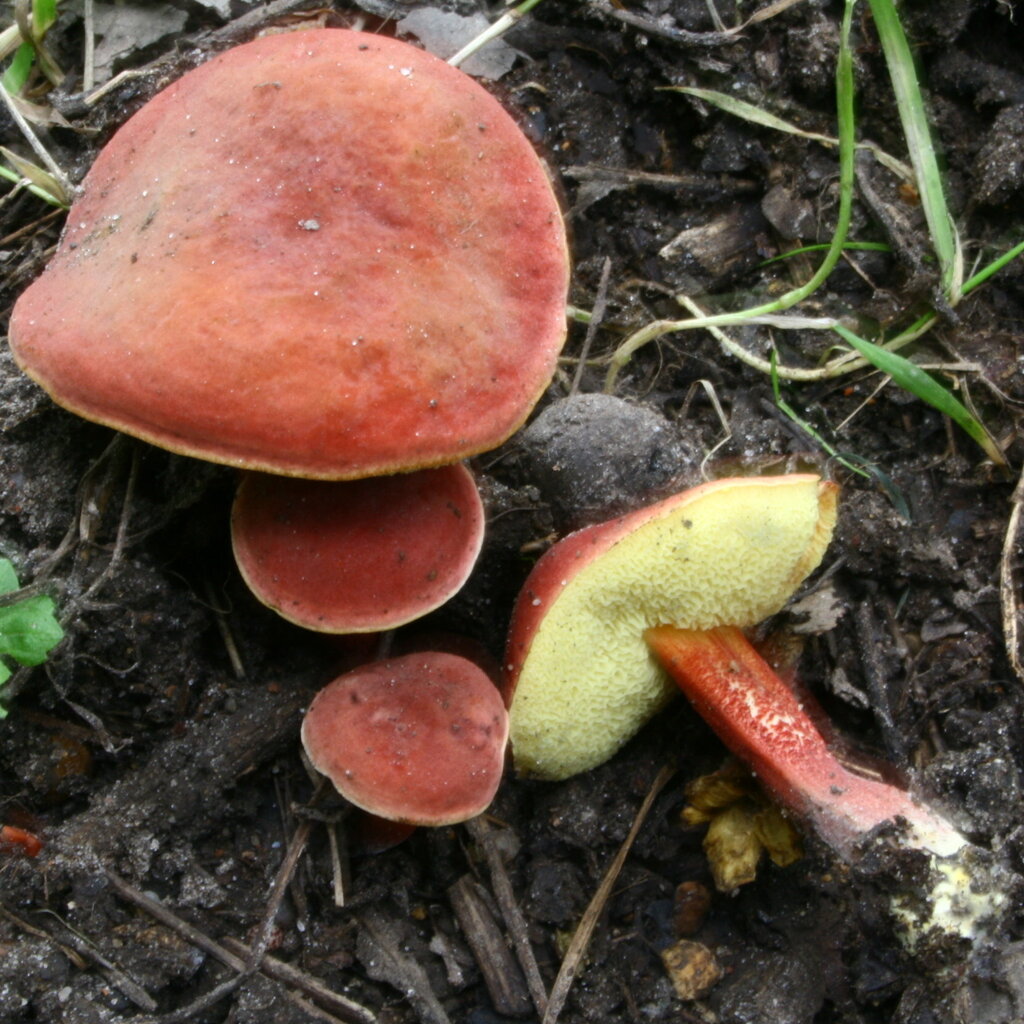
Ruby Bolete
Hortiboletus rubellus
Hortiboletus rubellus, commonly known as the ruby bolete, is a small, dainty, brightly coloured member of the family Boletaceae, with a reddish cap and stipe, and yellow pores. Like many boletes, it stains blue when cut or bruised. It is found in deciduous woodland in autumn. There is some question over its edibility, and it is reportedly of poor quality with a taste of soap. Until 2015, the species was known as Boletus rubellus.
From the article Hortiboletus rubellus on Wikipedia (CC BY-SA), quoted section by section
Description
It is a small bolete, with the cap being rarely over 6 centimetres (2+3⁄8 in) in diameter. This cap is scarlet to raspberry red when young, with a dry velvety texture, often cracking in age. The extreme margin often has a pale yellow or white band around it, and it discolours darker and dirtier with age. The pores are small; pale yellow, and bruise slowly. Sometimes tapering, the stem is slender and long, and may reach 7.5 cm (3 in). It is lemon yellow at the apex, but red elsewhere, and has a tendency to split or sheer vertically. The flesh is straw-coloured in the cap, and stains slowly blue over the tubes when cut. The flesh of the stem is pale yellow at the apex and yellow further down. At the stem base, the flesh may have a distinct spot of brick-red or orange. The tubes and pores are large and lemon-yellow, and may be greenish tinged when older. The spore print is olive. It smells pleasant, but indistinct, and is said to taste slightly soapy. Conflicting information on pore size in notable publications is a possible indication that there may be more than one species involved, both in Britain and in North America.
Range & habitat
Uncommon to rare in Southern England, occurring largely with oak (Quercus). It also appears in Europe, and the Eastern United States and Canada. A similar species noted as "cf versicolor" has been collected from Victoria in southeastern Australia.
Wikipedia: “Distribution and habitat”
At the table
The species is edible, but often maggoty, and some sources describe the taste as soapy.
Wikipedia: “Edibility”
Where it lives
Recorded sightings
—
geo-referenced records in GBIF, from museums, herbaria and field observers.
Drag the globe to turn it. Dots are where records exist, not a range map; darker means more records.
In the stacks
Searching the stacks…
Every page naming Hortiboletus rubellus in the Biodiversity Heritage Library →
This page is assembled live from iNaturalist, GBIF, Wikipedia, the Source Library and the Internet Archive. It is not yet part of the hand-edited codex. iNaturalist taxon 833474.