- Fungi Including Lichens
- ›Basidiomycete Fungi
- ›Higher Basidiomycetes
- ›Mushrooms, Bracket Fungi, Puffballs, and Allies
- ›Agaricomycetidae
- ›Common Gilled Mushrooms and Allies
- ›Agaricineae
- ›Hymenogastraceae
- ›Gymnopilus
- ›Gymnopilus junonius
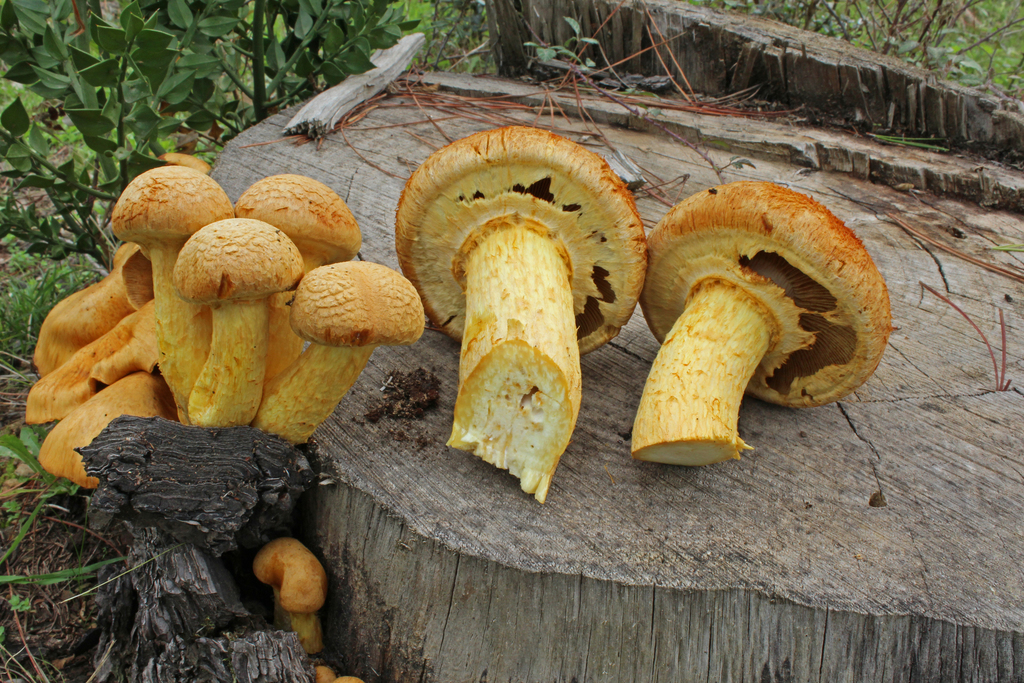
Spectacular Rustgill
Gymnopilus junonius
Gymnopilus junonius is a type of mushroom-forming fungus in the family Hymenogastraceae. Commonly known as the spectacular rustgill, or laughing Jim, this large orange mushroom is typically found growing on tree stumps, logs, or tree bases. It is found in Europe, Australasia and South America. It is inedible and contains some neurotoxins.
From the article Gymnopilus junonius on Wikipedia (CC BY-SA), quoted section by section
Description
The cap ranges from 5–30 cm (2–12 in) across, bun-shaped at first, then is convex to flat; it is bright yellow-orange in younger specimens and orange-brown or reddish brown in older ones, with a dry scaly surface. The flesh is yellow, the odor mild and taste bitter. The stem is 5–25 cm (2–10 in) long, 1–5 cm thick, and often narrows near the base. The frail ring is dusted with rusty orange spores, and the gill attachment to the stem is adnate to sub-decurrent. It stains red with KOH and turns green when cooked. The spore print is rusty brown. Unlike psychoactive relatives in the Psilocybe genus, G. junonius lacks psilocybin and does not stain blue, but smaller specimens occasionally exhibit bruising. This mushroom usually grows in clusters from several to several dozen individuals, but sometimes grows solitary. It is inedible due to its bitter taste.
Similar species. This mushroom is often mistaken for Gymnopilus ventricosus, which also contains no psilocybin, and G. luteus and G. subspectabilis, which do. It also resembles Armillaria mellea and Omphalotus olivascens.
Range & habitat
Gymnopilus junonius is found in Europe, Australasia and South America. It grows in dense clusters on stumps and logs of hardwoods and conifers. This mushroom is most common in moist, lowland wooded areas near rivers. This species does not occur in North America, with similar mushrooms often being misidentified.
Wikipedia: “Distribution and habitat”
Where it lives
Recorded sightings
—
geo-referenced records in GBIF, from museums, herbaria and field observers.
Drag the globe to turn it. Dots are where records exist, not a range map; darker means more records.
In the stacks
Searching the stacks…
Every page naming Gymnopilus junonius in the Biodiversity Heritage Library →
This page is assembled live from iNaturalist, GBIF, Wikipedia, the Source Library and the Internet Archive. It is not yet part of the hand-edited codex. iNaturalist taxon 83196.