- Fungi Including Lichens
- ›Basidiomycete Fungi
- ›Higher Basidiomycetes
- ›Mushrooms, Bracket Fungi, Puffballs, and Allies
- ›Agaricomycetidae
- ›Common Gilled Mushrooms and Allies
- ›Agaricineae
- ›Tubariaceae
- ›Cyclocybe
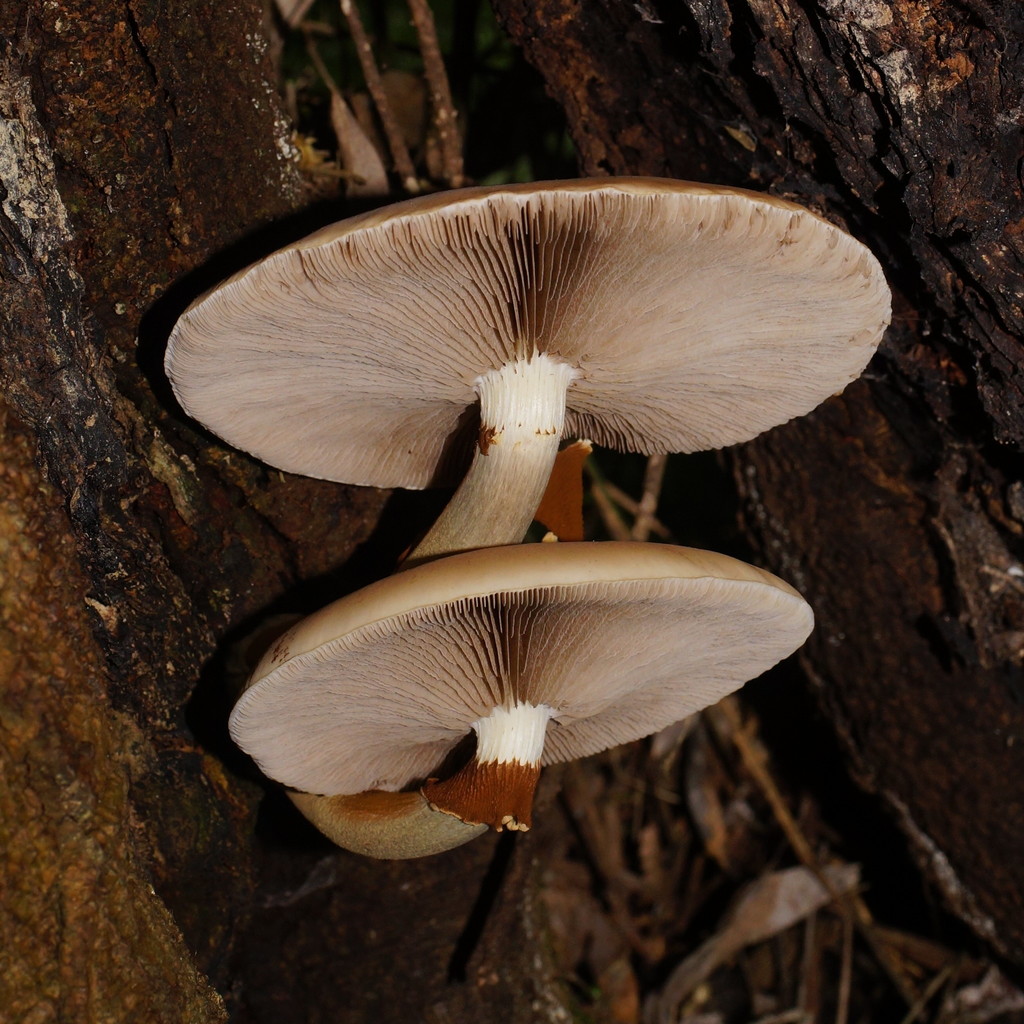
Tawaka
Cyclocybe parasitica
Cyclocybe parasitica, also known as tawaka in te reo or poplar mushroom, is a species of gilled mushroom in the genus Cyclocybe found mostly in New Zealand and Australia. It grows on native and introduced trees where it can cause heart rot, and does not seem to be associated with conifers.
From the article Cyclocybe parasitica on Wikipedia (CC BY-SA), quoted section by section
Description
The cap is centrally attached, buff coloured, and darker at center. The stem is pale with white flesh. The partial veil presses against the pink-to-dark gills and turns into a prominent ring, often striated with dark brown spore deposit upon the stem expansion. The spores are cylindrical and thick walled with a prominent germ pore.
Range & habitat
The species is found mostly in New Zealand and Australia, from November to June. It grows on native and introduced trees where it can cause heart rot, and does not seem to be associated with conifers.
Wikipedia: “Distribution and habitat”
What it does
The species grows parasitically and saprotrophically in hardwood trees such as Beilschmiedia tawa, Hoheria or Plagianthus but can also be found on Nothofagus, birches or poplars. It is native and probably indigenous to New Zealand. Fruiting bodies usually occur in late summer and autumn, sometimes single but usually in clusters.
Wikipedia: “Ecology”
At the table
Tawaka is an edible mushroom with a meaty savoury taste. It can be collected in the wild or cultivated on logs that are inoculated four to eight weeks after cutting and defoliating. According to a study from Lincoln University in 1990, tawaka contains approximately 20% protein in dry mass, which is roughly half of what can be found in the common button mushroom, while the essential amino acid composition is similar. On the other hand, available carbohydrate content is almost three times higher. Tawaka was historically used by Māori people as a traditional medicine.
Wikipedia: “Uses”
Where it lives
Recorded sightings
—
geo-referenced records in GBIF, from museums, herbaria and field observers.
Drag the globe to turn it. Dots are where records exist, not a range map; darker means more records.
In the stacks
Searching the stacks…
Every page naming Cyclocybe parasitica in the Biodiversity Heritage Library →
This page is assembled live from iNaturalist, GBIF, Wikipedia, the Source Library and the Internet Archive. It is not yet part of the hand-edited codex. iNaturalist taxon 815897.