- Fungi Including Lichens
- ›Basidiomycete Fungi
- ›Higher Basidiomycetes
- ›Mushrooms, Bracket Fungi, Puffballs, and Allies
- ›Agaricomycetidae
- ›Common Gilled Mushrooms and Allies
- ›Marasmiineae
- ›Omphalotaceae
- ›Omphalotus
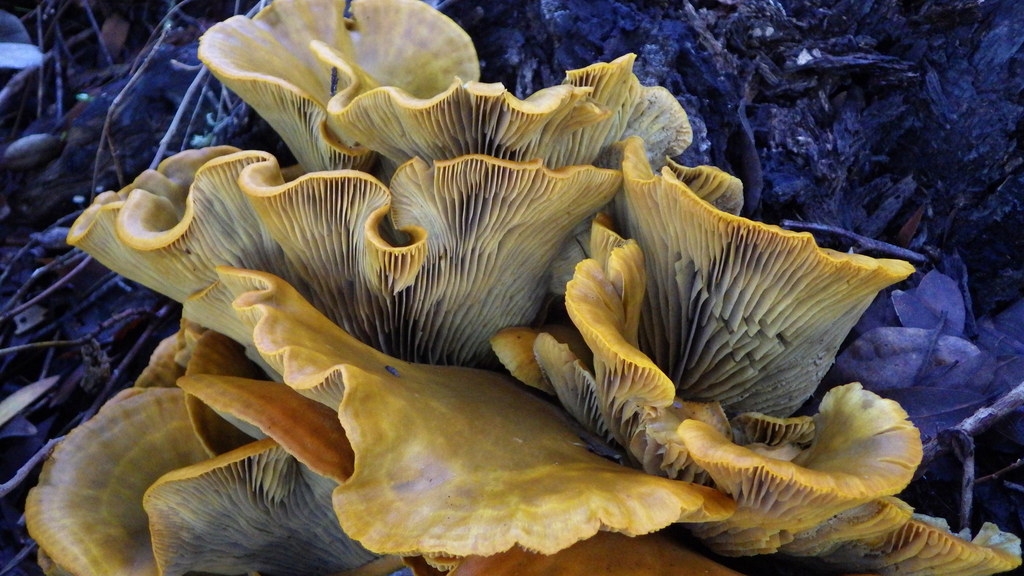
western jack-o'-lantern
Omphalotus olivascens
Omphalotus olivascens, commonly known as the western jack-o'-lantern mushroom, is an orange to brown-colored gilled poisonous mushroom endemic to the North American west coast. It has several lookalikes including Cantharellus cibarius.
From the article Omphalotus olivascens on Wikipedia (CC BY-SA), quoted section by section
Description
The cap is 4–18 cm (1.6–7.1 in) wide. The stalks are 4–15 cm (1.6–5.9 in) long and 1–4 cm (0.39–1.57 in) wide. The spores are white to pale yellow.
Similar species. To an untrained eye, O. olivascens appears similar to Cantharellus cibarius, but the jack-o'-lantern mushroom has true, blade-like gills (rather than ridges) and it can have olive coloration that chanterelles lack; also, Omphalotus species are saprotrophic, grow directly on wood, and are bioluminescent. Several Omphalotus species with similar bioluminescent properties occur worldwide, all of which are presumed poisonous. The best known are the North American jack o'lantern mushroom (O. olearius) and the tsukiyotake (O. japonicus (Kawam.) Kirchm. & O.K. Mill. (formerly known as Lampteromyces japonicus (Kawam.) Sing.), found in Japan and eastern Asia. Molecular analysis shows the jack-o'-lantern to be most closely related to the ghost fungus O. nidiformis, the colours and shades of which most closely resemble O. olivascens. Additionally, O. illudens is similar. Gymnopilus junonius is another similar-looking species.
Range & habitat
It is endemic to the North American west coast, namely the California Floristic Province.
Wikipedia: “Distribution and habitat”
What it does
A saprobe or parasite, O. olivascens is usually found on oak or Eucalyptus, rarely on other hosts. Omphalotus species cause a white rot by breaking down lignin in their tree hosts.
Wikipedia: “Ecology”
Toxicity
The jack o'lantern mushroom is poisonous; while not lethal, consuming this mushroom leads to very severe cramps, vomiting, and diarrhea. The toxic ingredient of many species of Omphalotus is a sesquiterpene compound known as illudin S. This, along with illudin M, have been identified in O. nidiformis. The two illudins are common to the genus Omphalotus and not found in any other basidiomycete mushroom.
Where it lives
Recorded sightings
—
geo-referenced records in GBIF, from museums, herbaria and field observers.
Drag the globe to turn it. Dots are where records exist, not a range map; darker means more records.
In the stacks
Searching the stacks…
Every page naming Omphalotus olivascens in the Biodiversity Heritage Library →
This page is assembled live from iNaturalist, GBIF, Wikipedia, the Source Library and the Internet Archive. It is not yet part of the hand-edited codex. iNaturalist taxon 67752.