- Fungi Including Lichens
- ›Basidiomycete Fungi
- ›Higher Basidiomycetes
- ›Mushrooms, Bracket Fungi, Puffballs, and Allies
- ›Agaricomycetidae
- ›Common Gilled Mushrooms and Allies
- ›Hygrophorineae
- ›Waxcaps and Allies
- ›Hygrophoroideae
- ›Hygrophoreae
- ›Hygrophorus
- ›Hygrophorus
- ›Hygrophorus
- ›Hygrophorus
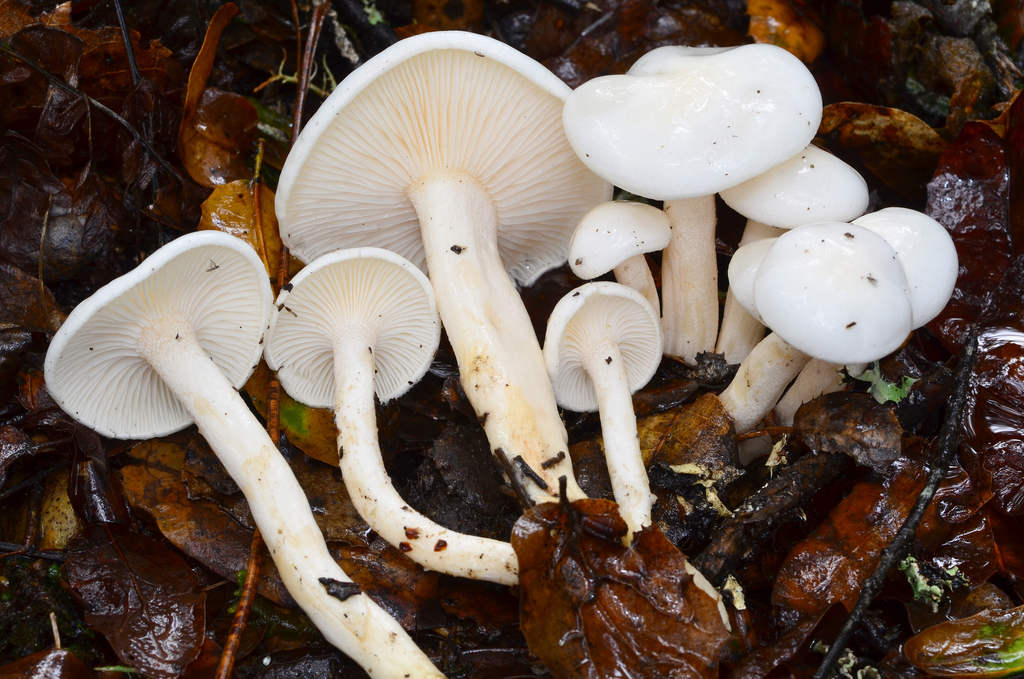
Cowboy's Handkerchief
Hygrophorus eburneus
Hygrophorus eburneus, commonly known as the ivory waxy cap or the cowboy's handkerchief, is a species of edible mushroom in the waxgill family of fungi. Hygrophorus eburneus is the type species of the genus Hygrophorus. The fruit bodies are medium-sized, pure white, and when wet are covered in a layer of slime thick enough to make the mushroom difficult to pick up. The gills are broadly attached to the stem or running down it; as the family name suggests, they feel waxy when rubbed between the fingers.
It is widespread in Europe and North America, and has also been collected in northern Africa. Like all Hygrophorus species, the fungus is mycorrhizal—having a symbiotic association whereby the underground fungal mycelia penetrate and exchange nutrients with tree roots. They are common in a variety of forest types, where they grow on the ground in thickets or grassy areas. A number of biologically active chemicals have been purified from the fruit bodies of the fungus, including fatty acids with bactericidal and fungicidal activity.
From the article Hygrophorus eburneus on Wikipedia (CC BY-SA), quoted section by section
Description
The cap of H. eburneus is 2 to 7 cm (0.8 to 2.8 in) broad, with a shape ranging from convex to flattened, sometimes with an umbo (a raised area in the center of the cap). In age the cap margin sometimes becomes elevated and the center of the cap depressed. The cap is pure white, and depending on the moisture in the environment, may be glutinous to sticky. The cap surface is smooth, the margin is even and in young specimens, rolled inward and covered with short fibrils. The flesh is soft and white, thick in the center of the cap but thinning toward the margin. The odor and taste are mild. The gills are somewhat arcuate-decurrent, meaning they are shaped like a bow, curving upward and then running down the stem for a short distance. In terms of spacing, they are subdistant to distant, so that space can be seen between them. The gills are moderately broad, broadest near the stem, narrowed in front, pure white, slightly yellowish or buff with age or when dried. The stem is 4 to 15 cm (1.6 to 5.9 in) long, 0.2 to 1.5 cm (0.08 to 0.6 in) thick, equal in width throughout its length to somewhat tapered downward or with a greatly attenuated base, and glutinous. Its surface is silky beneath the gluten. The top of the stem is covered with short fibrils, pure white, sometimes becoming grayish or dirty with age. It is initially stuffed with cotton-like mycelia, then later becomes hollow. …
Range & habitat
The fruit bodies of H. eburneus grow on the soil, mostly in coniferous woods, thickets and grassy areas. The fungus prefers soil that is moist, mesic, loamy and calcareous. The fungus is widely distributed in North America. It is also found in Europe (Poland and Portugal), Israel and North Africa.
Wikipedia: “Habitat and distribution”
At the table
The mushroom is edible, although it may not be appealing to many due to its sliminess. In China, a yak milk beverage is made with H. eburneus and yak milk, by lactic acid fermentation with Lactobacillus bulgaricus, Streptococcus thermophilus and Lactobacillus acidophilus as mixed starter.
Bioactive compounds. Several fatty acids with bactericidal and fungicidal activity have been isolated and identified from the fruit bodies of H. eburneus. The bioactive fatty acids are built upon a chemical structure called γ-oxocrotonate. The following gamma-oxocrotonate derivatives have been identified from the mushroom: (2E,9E)-4-oxooctadeca-2,9,17-trienoic acid, (2E,11Z)-4-oxooctadeca-2,11,17-trienoic acid, (E)-4-oxohexadeca-2,15-dienoic acid, (E)-4-oxooctadeca-2,17-dienoic acid, (2E,9E)-4-oxooctadeca-2,9-dienoic acid, (2E,11Z)-4-oxooctadeca-2,11-dienoic acid, (E)-4-oxohexadec-2-enoic acid, and (E)-4-oxooctadec-2-enoic acid. The compound (E)-4-oxohexadec-2-enoic acid has been investigated for potential use as a fungicide against the oomycete species Phytophthora infestans, a causal agent of potato and tomato late blight disease. Additional secondary metabolites discovered in H. eburneus include the ceramide compound named hygrophamide ((2S,3R,4R,2'R)-2-(2'-hydroxy-9'Z-ene-tetracosanoylamino)-octadecane-1,3,4-triol), and the β-carboline alkaloids known as harmane and norharmane. …
Wikipedia: “Uses”
Where it lives
Recorded sightings
—
geo-referenced records in GBIF, from museums, herbaria and field observers.
Drag the globe to turn it. Dots are where records exist, not a range map; darker means more records.
In the stacks
Searching the stacks…
Every page naming Hygrophorus eburneus in the Biodiversity Heritage Library →
This page is assembled live from iNaturalist, GBIF, Wikipedia, the Source Library and the Internet Archive. It is not yet part of the hand-edited codex. iNaturalist taxon 67331.