- Fungi Including Lichens
- ›Ascomycete Fungi
- ›Sac Fungi and Lichens
- ›Leotiomycetes
- ›Helotiales
- ›Cyttariaceae
- ›Cyttaria
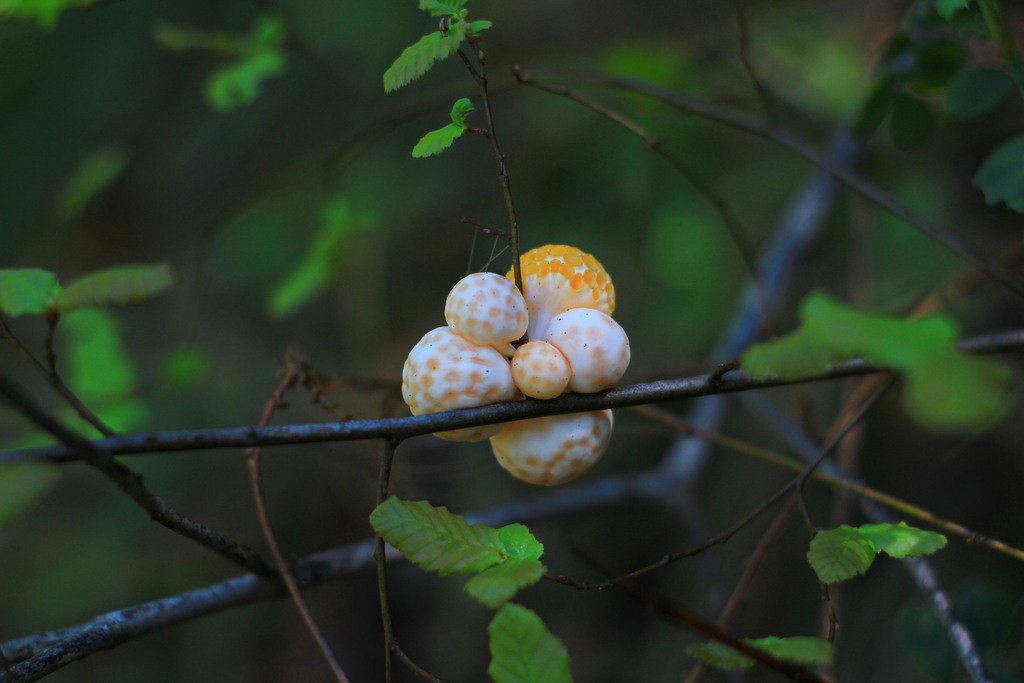
Lihueñe
Cyttaria espinosae
Cyttaria espinosae (Lloyd), also known by its local name Digüeñe, Lihueñe or Quideñe, is an orange-white coloured and edible ascomycete fungus native to south-central Chile. The Digüeñe is a strict and specific parasite of Nothofagus, mainly Nothofagus obliqua trees and cause canker-like galls on branches from which the fruiting bodies emerge between spring and early summer. The pitted surface generates air turbulence, preventing a build-up of static air around the fruitbodies, thus facilitating wind-borne spore dispersal....
From the article Cyttaria espinosae on Wikipedia (CC BY-SA), quoted section by section
Description
The fruiting bodies are whitish orange to orange while juvenile and orange-ochre when mature.
Range & habitat
The species is distributed between Valparaíso Region and Los Lagos Region in Chile. It grows on Nothofagus trees.
Wikipedia: “Distribution and habitat”
At the table
C. espinosae's flavor is described as between sweet and bland. It is the most consumed of the Chilean Cyttaria. In Patagonian cuisine, the digüeñe is usually consumed fresh in salads or fried with scrambled eggs for empanada stuffing. They are traditionally consumed by the Mapuche people.
Wikipedia: “Culinary use”
Where it lives
Recorded sightings
—
geo-referenced records in GBIF, from museums, herbaria and field observers.
Drag the globe to turn it. Dots are where records exist, not a range map; darker means more records.
In the stacks
Searching the stacks…
Every page naming Cyttaria espinosae in the Biodiversity Heritage Library →
This page is assembled live from iNaturalist, GBIF, Wikipedia, the Source Library and the Internet Archive. It is not yet part of the hand-edited codex. iNaturalist taxon 64587.