- Fungi Including Lichens
- ›Basidiomycete Fungi
- ›Higher Basidiomycetes
- ›Mushrooms, Bracket Fungi, Puffballs, and Allies
- ›Agaricomycetidae
- ›boletes and allies
- ›Gomphidiaceae
- ›Gomphidius
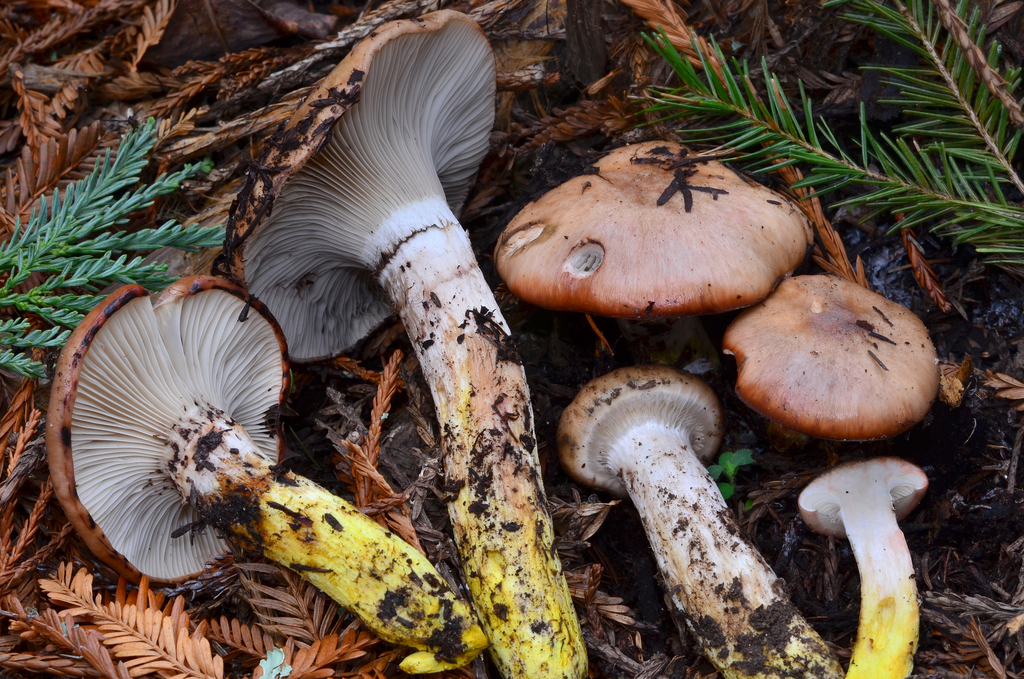
Blackening Slime Spike
Gomphidius oregonensis
Gomphidius oregonensis, commonly known as insidious gomphidius or blackening slime spike, is a species of fungus. With age, the fruiting body becomes murky and "insidious" in appearance, hence its common name. G. oregonensis can be distinguished by its spores which are the shortest in its genus, typically less than 14 μm long. Earlier in its growth, it can be difficult to distinguish from other members of its genus, such as G. glutinosus, the most common and widespread species.
G. oregonensis is found only in western North America, most commonly on the Pacific Coast. It is edible.
From the article Gomphidius oregonensis on Wikipedia (CC BY-SA), quoted section by section
Description
The cap is initially convex and almost peg-like, reaching 2–15 centimetres (3⁄4–6 in) in width. The surface is smooth and slimy when damp. The color can vary from whitish to a dull pinkish or color of salmon flesh when young. With maturity, the cap flattens, possibly becoming depressed, and turns purplish to reddish-brown. The flesh is soft and white or grayish. The gills are decurrent, fairly even, closely spaced and are somewhat waxy in appearance. They are white to grayish in color, turning black as ripening occurs. The stalk is up to 15 cm long and 1–5 cm thick. The diameter may be equal from top to bottom or either tapered or swollen at the base. The color transitions from a whitish shade in the upper portion above the veil to a bright yellow below. The veil is whitish with a thread-like texture, hidden beneath a layer of slime. The veil seems to disappear as it approaches the stalk, where it forms a slimy, almost hairy ring. This ring often blackens as the mushrooms age and the spores begin to release. The spores are smooth, spindle-shaped and elliptical, with each spore measuring 10–14 μm long, the smallest in the genus Gomphidius. The spore print is dark gray to black.
Range & habitat
Gomphidius oregonensis can be found in western North America from October to December, most commonly on the Pacific Coast. It is found on the ground under conifers, particularly Douglas-fir. Mushrooms may be solitary or in clusters and often in colonies with G. glutinosus, and frequently with species from the genus Suillus. It is likely parasitic to Suillus caerulescens and potentially S. ponderosus as well.
Wikipedia: “Habitat and distribution”
At the table
Gomphidius oregonensis is edible, with a mild flavor and odor. Without proper preparation (removing the cap cuticle), the mushroom is slimy in texture. This mushroom also accumulates heavy metals.
== References ==
Wikipedia: “Edibility”
Where it lives
Recorded sightings
—
geo-referenced records in GBIF, from museums, herbaria and field observers.
Drag the globe to turn it. Dots are where records exist, not a range map; darker means more records.
In the stacks
Searching the stacks…
Every page naming Gomphidius oregonensis in the Biodiversity Heritage Library →
This page is assembled live from iNaturalist, GBIF, Wikipedia, the Source Library and the Internet Archive. It is not yet part of the hand-edited codex. iNaturalist taxon 64097.