- Fungi Including Lichens
- ›Basidiomycete Fungi
- ›Higher Basidiomycetes
- ›Mushrooms, Bracket Fungi, Puffballs, and Allies
- ›Agaricomycetidae
- ›Common Gilled Mushrooms and Allies
- ›Sarcomyxineae
- ›Sarcomyxaceae
- ›Sarcomyxa
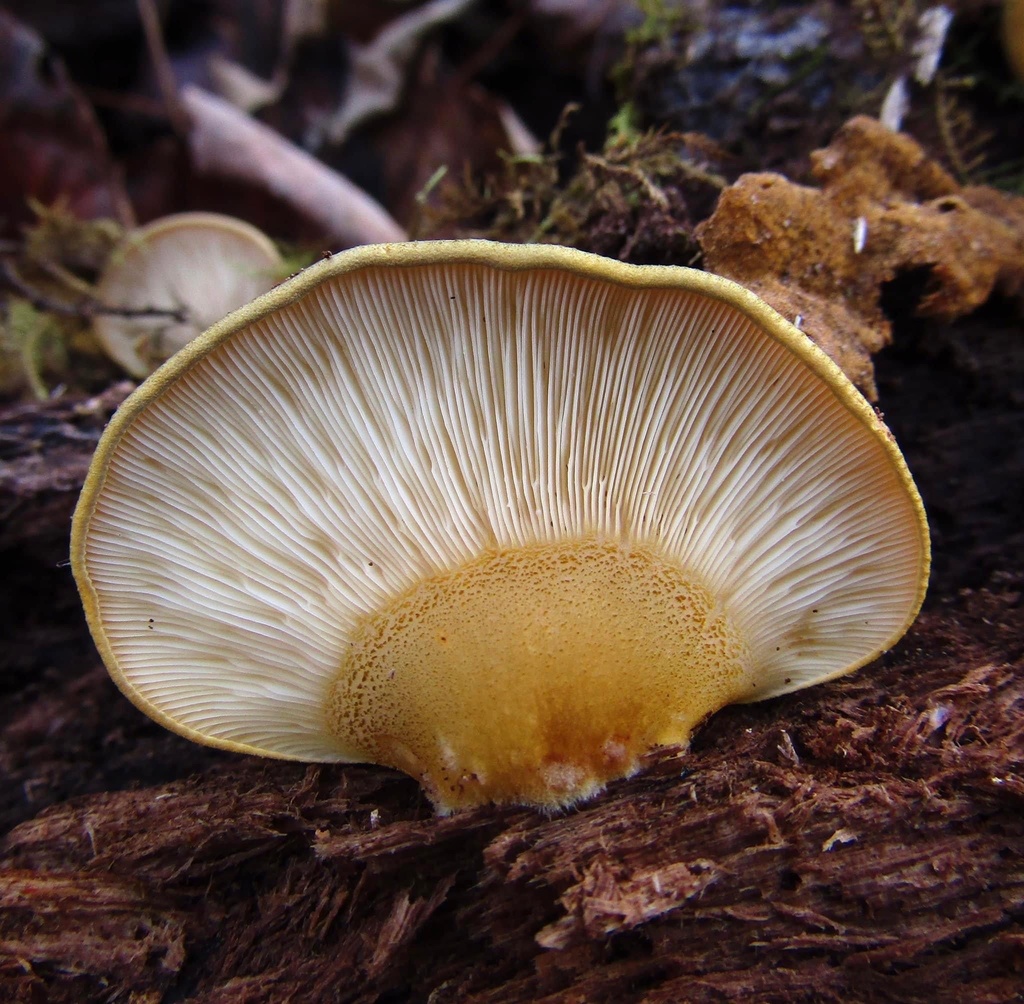
Late Oyster
Sarcomyxa serotina
Panellus serotinus, commonly known as the late oyster, is a species of fungus in the family Mycenaceae. Fruit bodies grow as overlapping fan- or oyster-shaped caps on the wood of both coniferous and deciduous trees. The gills on the underside are closely spaced, bright orange yellow, and have an adnate attachment to the stipe. It produces a yellow spore print; spores are smooth, amyloid, and measure 4–6 by 1–2 µm. The caps are edible, but some people...
From the article Sarcomyxa serotina on Wikipedia (CC BY-SA), quoted section by section
Description
The fruit bodies predominately comprise greenish, overlapping fan- or oyster-shaped caps. The caps are up to 9 centimetres (3+1⁄2 in) wide. The gills on the underside are closely spaced, bright orange yellow, and have an adnate to decurrent attachment to the short and stout stem. The spores are smooth, amyloid, and measure 4–6 by 1–2 μm; they produce a cream to yellow spore print.
Range & habitat
It grows on fallen hardwood and sometimes conifers in cold weather in North America, serving as an indicator that the mushroom season is nearly over.
Wikipedia: “Habitat”
At the table
The species is considered to be either edible but not choice or inedible, with a flavour ranging from mild to bitter. Research has revealed that two separate species exist, Sarcomyxa serotina and S. edulis (unknown in Europe). The latter is cultivated for food in China and Japan.
== References ==
Wikipedia: “Uses”
Where it lives
Recorded sightings
—
geo-referenced records in GBIF, from museums, herbaria and field observers.
Drag the globe to turn it. Dots are where records exist, not a range map; darker means more records.
In the stacks
Searching the stacks…
Every page naming Sarcomyxa serotina in the Biodiversity Heritage Library →
This page is assembled live from iNaturalist, GBIF, Wikipedia, the Source Library and the Internet Archive. It is not yet part of the hand-edited codex. iNaturalist taxon 63585.