- Fungi Including Lichens
- ›Basidiomycete Fungi
- ›Higher Basidiomycetes
- ›Mushrooms, Bracket Fungi, Puffballs, and Allies
- ›Agaricomycetidae
- ›boletes and allies
- ›Suillineae
- ›Suillaceae
- ›Suillus
- ›Douglasia
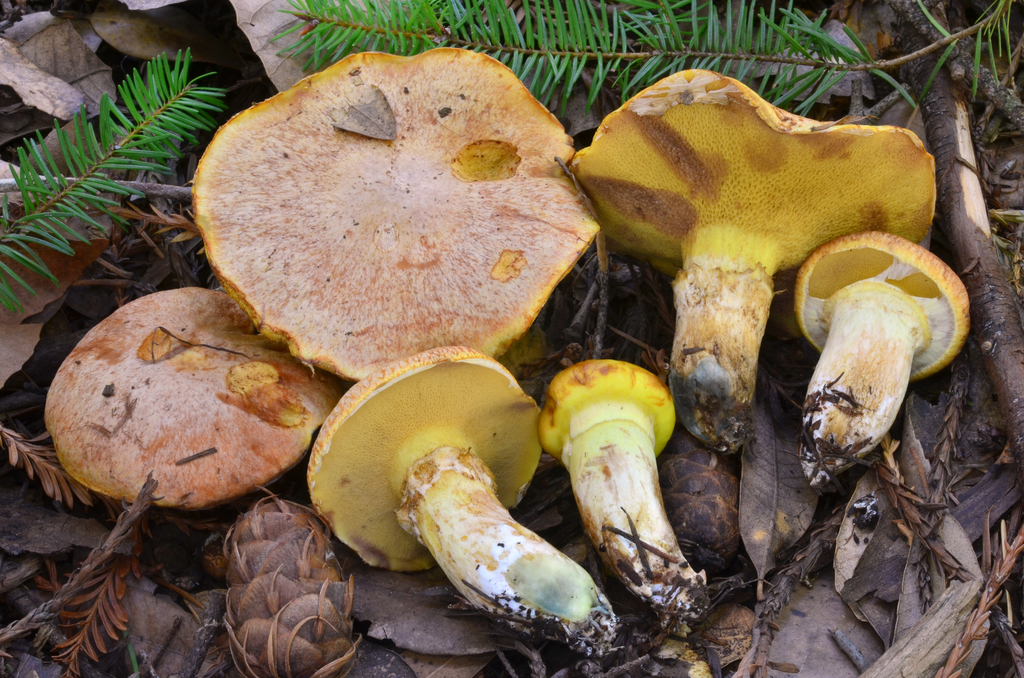
Fat Jack
Suillus caerulescens
Suillus caerulescens is a species of bolete fungus in the family Suillaceae. It was first described scientifically by American mycologists Alexander H. Smith and Harry D. Thiers in 1964.
From the article Suillus caerulescens on Wikipedia (CC BY-SA), quoted section by section
Description
The cap is yellowish to reddish brown, sometimes with streaks from its darker center. It ranges from 4–15 cm (1.5–6 in) in diameter, shaped convex to flat, and viscid when wet, sometimes with veil remnants on the edge. The flesh is yellowish, as are the pores. The stalk is yellowish to brown, darkening with age, 2–8 cm tall, 1–3 cm wide, and bruises bluish to brownish (often slowly), especially at the base. A faint ring may be present. The flesh can have a lemony flavour. The spore print is reddish-brown.
Range & habitat
It can be found growing with Douglas-fir trees in western North America from October to December.
Wikipedia: “Habitat and distribution”
Where it lives
Recorded sightings
—
geo-referenced records in GBIF, from museums, herbaria and field observers.
Drag the globe to turn it. Dots are where records exist, not a range map; darker means more records.
In the stacks
Searching the stacks…
Every page naming Suillus caerulescens in the Biodiversity Heritage Library →
This page is assembled live from iNaturalist, GBIF, Wikipedia, the Source Library and the Internet Archive. It is not yet part of the hand-edited codex. iNaturalist taxon 63505.