- Fungi Including Lichens
- ›Basidiomycete Fungi
- ›Higher Basidiomycetes
- ›Mushrooms, Bracket Fungi, Puffballs, and Allies
- ›Agaricomycetidae
- ›boletes and allies
- ›boletes
- ›Boletoideae
- ›Tylopilus
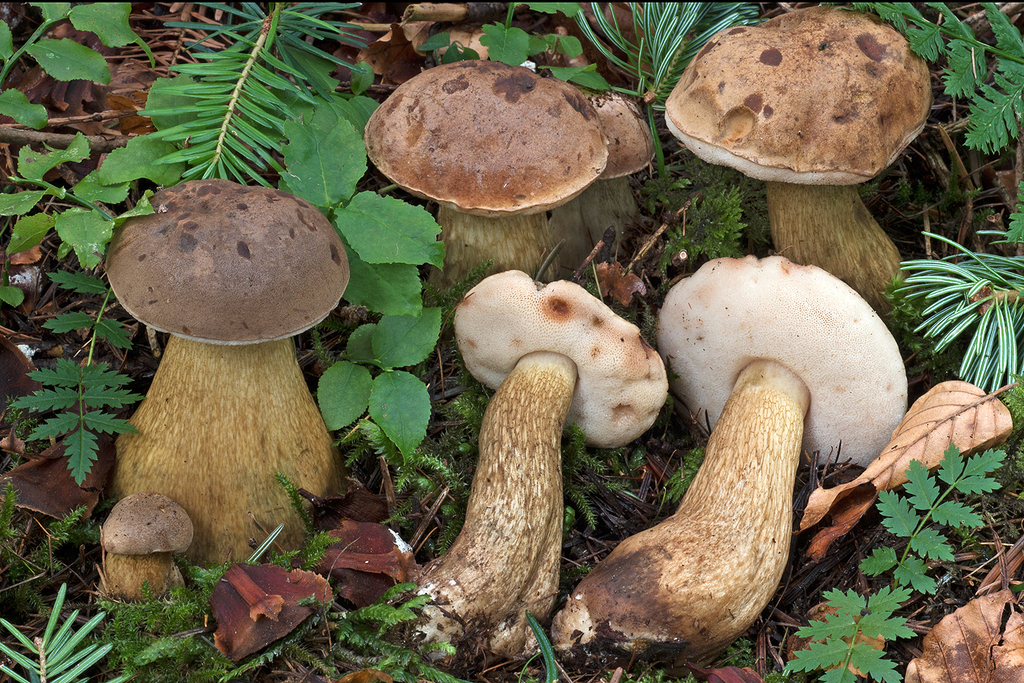
Bitter Bolete
Tylopilus felleus
Tylopilus felleus, commonly known as the bitter bolete or the bitter tylopilus, is a fungus of the bolete family. French mycologist Pierre Bulliard described this species as Boletus felleus in 1788 before it was transferred into the new genus Tylopilus. It is the type species of Tylopilus and the only member of the genus found in Europe.
The fruit bodies have convex to flat caps that are some shade of brown, buff or tan and typically measure up to 15 cm (6 in) in diameter. The pore surface is initially white before turning pinkish with age. Like most boletes it lacks a ring and it may be distinguished from Boletus edulis and other similar species by its unusual pink pores and the prominent dark-brown net-like pattern on its stalk.
From the article Tylopilus felleus on Wikipedia (CC BY-SA), quoted section by section
Description
The cap of this species grows up to 15 cm (6 in) in diameter, though some North American specimens reach 30 cm (12 in) across. Grey-yellow to pale- or walnut-brown, it is slightly downy at first and later becomes smooth with a matte lustre. It is initially convex before flattening out with maturity. The cap skin does not peel away from the flesh. The pores underneath are white at first and become pinkish with maturity. They are adnate to the stalk and bulge downwards as the mushroom ages. The pores bruise carmine or brownish, often developing rusty-brown spots with age, and number about one or two per millimetre. The tubes are long relative to the size of the cap, measuring 2–3 cm (0.8–1.2 in) deep in the middle part of the cap. The stalk is initially bulbous before stretching and thinning in the upper part; the lower part of the stalk remains swollen, sometimes shrinking at the base where it attaches to the substrate. It measures 7–10 cm (2.8–3.9 in)—rarely to 20 cm (7.9 in)—tall, and 2–3 cm (0.8–1.2 in) wide, and can bulge out to 6 cm (2.4 in) across at the base. It is lighter in colour than the cap, and covered with a coarse brown network of markings, which have been likened to fishnet stockings in appearance. …
Range & habitat
Like all Tylopilus species, T. felleus is mycorrhizal. It is found in deciduous and coniferous woodland, often under beech and oak in well-drained acid soils, which can be sandy, gravelly or peaty. If encountered on calcareous (chalky) soil, it will be in moist areas that have become waterlogged and have ample leaf litter. Fruit bodies grow singly or in small groups, and occasionally in small clusters with two or three joined at the base of the stem. Fruit bodies have also been growing in the cavities of old trees, on old conifer stumps, or on buried rotten wood. The fungus obtains most of its nitrogen requirements from amino acids derived from the breakdown of proteins, although a lesser amount is obtained from the amino sugar glucosamine (a breakdown product of chitin, a major component of fungal cell walls). The mycorrhizal plant partner benefits from the fungus's ability to use these forms of nitrogen, which are often abundant in the forest floor. Fruit bodies appear over summer and autumn, anytime from June to October or even November, in many of the northern temperate zones. Large numbers may appear in some years and none in others, generally proportional to the amount of rainfall. …
Wikipedia: “Ecology, distribution and habitat”
At the table
As its common name suggests, it is extremely bitter, though not toxic as such. This bitterness is worsened by cooking. One specimen can foul the taste of a whole meal prepared with mushrooms. Despite this it is sold in markets (tianguis) in Mexico. A local recipe from France, Romania and East Germany calls for stewing it in skimmed milk, after which it can be eaten or powdered and used for flavouring. The mushroom is not bitter for those who lack genetic sensitivity to bitter taste, a trait endowed by the gene TAS2R38 (taste receptor 2 member 38). The compound responsible for the bitter taste has not been identified.
Wikipedia: “Edibility”
Where it lives
Recorded sightings
—
geo-referenced records in GBIF, from museums, herbaria and field observers.
Drag the globe to turn it. Dots are where records exist, not a range map; darker means more records.
In the old herbals & bestiaries

In the stacks
Searching the stacks…
Every page naming Tylopilus felleus in the Biodiversity Heritage Library →
This page is assembled live from iNaturalist, GBIF, Wikipedia, the Source Library and the Internet Archive. It is not yet part of the hand-edited codex. iNaturalist taxon 63489.