- Fungi Including Lichens
- ›Basidiomycete Fungi
- ›Higher Basidiomycetes
- ›Mushrooms, Bracket Fungi, Puffballs, and Allies
- ›Agaricomycetidae
- ›Common Gilled Mushrooms and Allies
- ›Marasmiineae
- ›Mycenaceae
- ›Mycena
- ›Fragilipedes
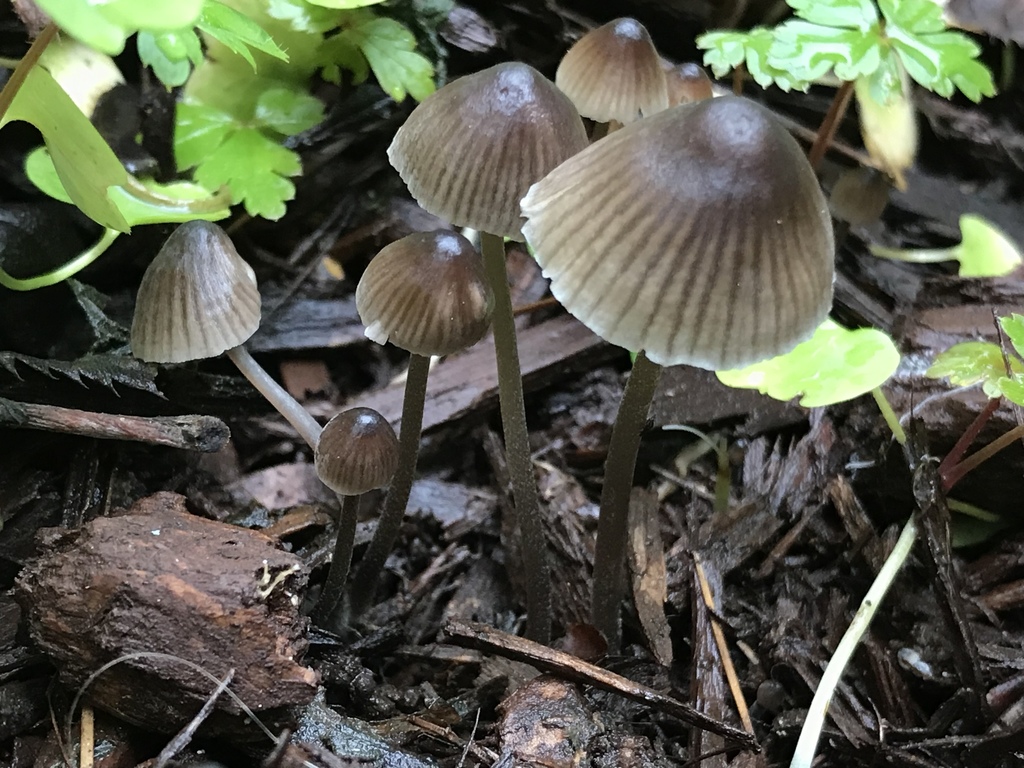
Nitrous Bonnet
Mycena leptocephala
Mycena leptocephala, commonly known as the nitrous bonnet, is a species of fungus in the family Mycenaceae. The mushrooms have conical grayish caps that reach up to 3 cm (1.2 in) in diameter, and thin fragile stems up to 5 cm (2.0 in) long. The gills are gray and distantly spaced. The spores are elliptical, typically measure 7–10 by 4–6 μm, and are white in deposit. When viewed under a light microscope, the gills have abundant spindle-shaped cystidia on the gill edges, but few on the gill faces. Similar species include Mycena alcalina, M. austera, and M. brevipes.
The mushroom is found in North America, Asia, and Europe where it grows singly or in groups on conifer needles, cones and sticks on the forest floor. It has a distinctive odor of bleach; the edibility is unknown.
From the article Mycena leptocephala on Wikipedia (CC BY-SA), quoted section by section
Description
The cap is 1–3 cm (0.4–1.2 in) in diameter, and initially a fat conical shape with the margin pressed close to the stem. As the cap expands, it becomes broadly conic to convex, sometimes broadly bell-shaped, and sometimes convex with a flaring margin. The cap surface has a whitish sheen because of its pruinose coating. The coating gradually sloughs off, leaving the surface smooth and moist. The cap shows radial grooves that outline the position of the gills underneath. Its color is initially dusky brownish-gray to blackish (after the pruinose coating has sloughed off), soon fading from dark to light gray and finally ashy-gray. The flesh is thin and fragile, grayish, and has a slightly sour (acidulous) taste, and a weakly alkaline odor that strengthens in intensity if the flesh is crushed. Its edibility is unknown, but it is too small to be of interest. The gills are narrow, equal in width throughout, ascending-adnate (the gills attach at much less than a right angle, appearing to curve upward toward stem) and toothed. They are subdistantly spaced, with 18–27 gills reaching the stem, and one or two tiers of lamellulae (short gills that do not extend fully from the cap edge to the stem) interspersed between them. …
Range & habitat
Mycena leptocephala is a saprobic species, meaning it derives nutrients from the breakdown of organic matter. Fruit bodies are found growing scattered to gregarious on fallen sticks and on needle carpets under conifers, and are rather common during early summer and again in the autumn. Fruit bodies may be infected by the bonnet mold Spinellus fusiger. In North America, the fungus is found in Canada (British Columbia, Manitoba, Nova Scotia, Prince Edward Island), to Washington and south to California and North Carolina. In South America, the mushroom has been collected in Venezuela. It also grows in the Archipelago of the Recherche, off the southern coast of Western Australia. In Europe, it is known from Britain, Finland, The Netherlands, Norway, and Spain It has also been found in various locations in Asia: the Vindhya Range of India; the Gwangneung Forest Museum in the Korea National Arboretum; and the alpine zone of Changbai Mountain Nature Reserve, Jilin Province, China. The fungus is also known from Arctic and Alpine regions such as Iceland, Greenland, and the Murmansk region.
Wikipedia: “Habitat and distribution”
In human culture
The specific epithet leptocephala is derived from the Greek λεπτος leptos, "thin" and κεφαλη kephale, "head", and refers to the delicate cap. The mushroom is commonly known as the "nitrous bonnet".
Wikipedia: “Etymology”
Where it lives
Recorded sightings
—
geo-referenced records in GBIF, from museums, herbaria and field observers.
Drag the globe to turn it. Dots are where records exist, not a range map; darker means more records.
In the stacks
Searching the stacks…
Every page naming Mycena leptocephala in the Biodiversity Heritage Library →
This page is assembled live from iNaturalist, GBIF, Wikipedia, the Source Library and the Internet Archive. It is not yet part of the hand-edited codex. iNaturalist taxon 63470.