- Fungi Including Lichens
- ›Basidiomycete Fungi
- ›Higher Basidiomycetes
- ›Mushrooms, Bracket Fungi, Puffballs, and Allies
- ›Agaricomycetidae
- ›Common Gilled Mushrooms and Allies
- ›Marasmiineae
- ›Mycenaceae
- ›Mycena
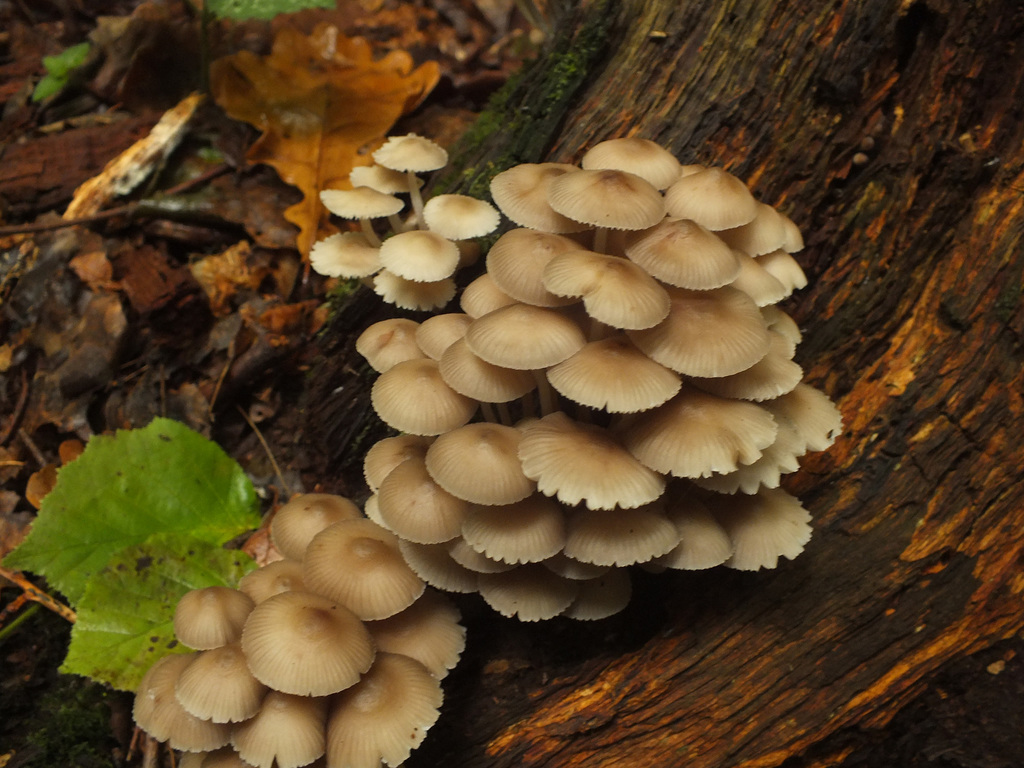
clustered bonnet
Mycena inclinata
Mycena inclinata, commonly known as the clustered bonnet or the oak-stump bonnet cap, is a species of mushroom in the family Mycenaceae. The doubtfully edible mushroom has a reddish-brown bell-shaped cap up to 4.5 cm (1.8 in) in diameter. The thin stem is up to 9 cm (3.5 in) tall, whitish to yellow-brown at the top but progressively becoming reddish-brown towards the base in maturity, where they are covered by a yellowish mycelium that can be up to a third of the length of the stem. The gills are pale brown to pinkish, and the spore print is white. It is a widespread saprobic fungus, and has been found in Europe, North Africa, Asia, Australasia, and North America, where it grows in small groups or tufts on fallen logs and stumps, especially of oak. British mycologist E.J.H. Corner has described two varieties of the mushroom from Borneo. Lookalike species with which M. inclinata may be confused include M. galericulata and M. maculata.
From the article Mycena inclinata on Wikipedia (CC BY-SA), quoted section by section
Description
The cap is light reddish-brown, with a diameter typically ranging from 1 to 4.5 cm (0.4 to 1.8 in). Initially conic to bell-shaped to convex, it flattens during maturity, developing visible surface grooves corresponding to the gills underneath the cap. The margin of the cap has minute but distinct scallops. The surface is moist and smooth, and hygrophanous. The cap frequently develops splits in the margin, or cracks in the disc (the central part of the cap). The flesh of the cap is thick in the center but thin elsewhere, grayish to whitish, fragile, and with a slightly mealy odor and taste. The gills have a decurrent attachment to the stem (that is, running down the length of the stem) and are a pale brownish color with tinges of red. They are broad (between 3 and 6 mm), and have a close to subdistant spacing, with about 26–35 gills reaching the stem. The fragile stem is 3 to 9 cm (1.2 to 3.5 in) long by 0.15 to 0.4 cm (0.06 to 0.16 in) thick and yellow to yellow-brown, becoming reddish-brown to orange-brown in the bottom half in maturity. The lower portion of young stems is covered with white flecks. Roughly equal in thickness at the top and bottom, the base of the stem is covered by a yellowish mycelium that can be up to a third of the length of the stem. …
Range & habitat
Mycena inclinata is a saprobic fungus, deriving its nutrients from decomposing organic matter found in plant litter such as leaves, twigs, bark and branches. It accomplishes this by producing enzymes capable of breaking down the three major biochemical components of plant cell walls found in litter: cellulose, hemicellulose and lignin. The fruit bodies of Mycena inclinata grow in dense groups or clusters on decaying hardwood logs and stumps (especially oak and chestnut) during the spring and autumn. The fungus forms a white, woolly mycelium on the surface of decomposing oak leaves. Occasionally, it can be found growing on a living tree. In eastern North America, it is abundant in the area bounded by Nova Scotia, Ontario, Manitoba, Missouri, North Carolina, and New York. It has been found in Oregon, but the species appears to be generally rare along the Pacific Coast. The range of the fungus also includes Europe, the Canary Islands, North Africa, East Siberia, Japan, Malesia, Turkey, and New Zealand.
Wikipedia: “Habitat and distribution”
Where it lives
Recorded sightings
—
geo-referenced records in GBIF, from museums, herbaria and field observers.
Drag the globe to turn it. Dots are where records exist, not a range map; darker means more records.
In the stacks
Searching the stacks…
Every page naming Mycena inclinata in the Biodiversity Heritage Library →
This page is assembled live from iNaturalist, GBIF, Wikipedia, the Source Library and the Internet Archive. It is not yet part of the hand-edited codex. iNaturalist taxon 63453.