- Fungi Including Lichens
- ›Basidiomycete Fungi
- ›Higher Basidiomycetes
- ›Mushrooms, Bracket Fungi, Puffballs, and Allies
- ›Agaricomycetidae
- ›Common Gilled Mushrooms and Allies
- ›Marasmiineae
- ›Mycenaceae
- ›Mycena
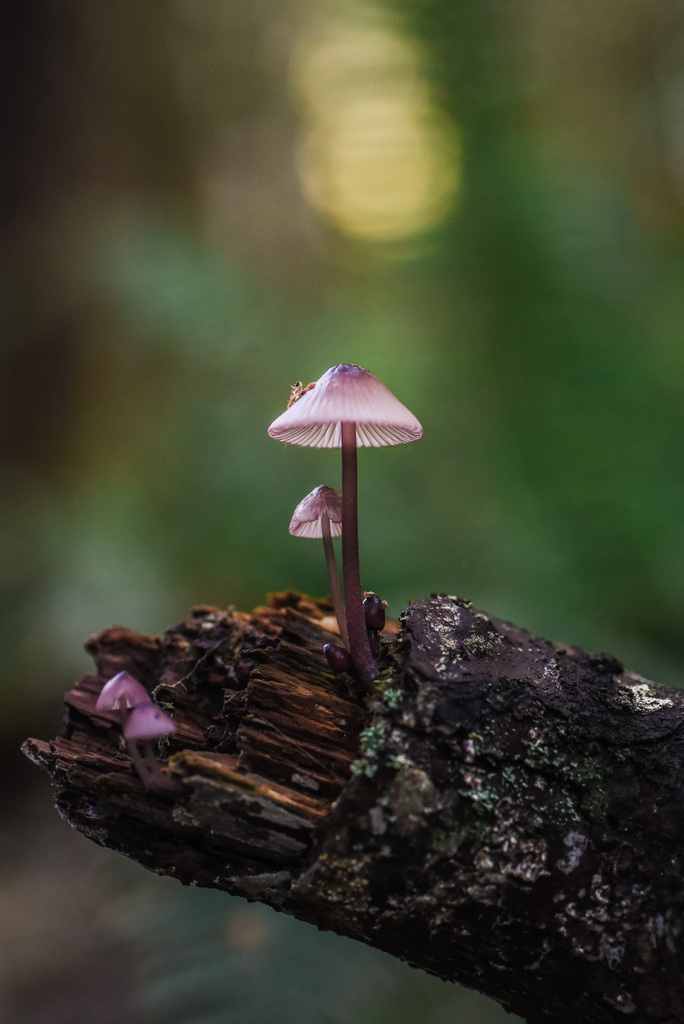
purple-edge bonnet
Mycena purpureofusca
Mycena purpureofusca, commonly known as the purple edge bonnet, is a species of agaric fungus in the family Mycenaceae. First described by Charles Horton Peck in 1885, The mushroom is named for the characteristic dark greyish-purple color of its gill edges.
The fruit bodies have conical to bell-shaped purple caps up to 2.5 cm (1 in) set atop slender stipes up to 10 cm (4 in) long. In the field, the mushrooms can usually be distinguished from similar species by characteristics such as the dark purple gill edges, the deep purple cap center, and its cartilagineous consistency.
From the article Mycena purpureofusca on Wikipedia (CC BY-SA), quoted section by section
Description
The cap is conical to bell-shaped, flattening in age, and reaches a diameter of 0.5–2.5 cm (0.2–1.0 in). The cap margin is usually bent inwards initially. The cap surface is initially covered with tiny white hairs, but later becomes smooth. It is slightly hygrophanous, and when moist, is slightly translucent, so that the outline of the gills underneath are apparent. Its color is dark purple in the center, fading to pale lilac at the margins; older specimens are purplish-gray. The flesh is thin and pliant, with a texture similar to cartilage. It is initially purplish-gray, becoming pale lilac to white in age. The odor is mild and the taste is indistinctive. The narrow gills have an ascending attachment to the stipe and are narrowly adnate. They are somewhat closely spaced, with pallid to grayish face color and dark grayish purple edges that are sometimes fringed. The tubular stipe measures 3–10 cm (1.2–3.9 in) long by 1–3 mm thick. It is tough and cartilaginous, and its base it covered with white hairs. Overall, its color is that of the cap or paler, and often paler near the top. The spores are broadly ellipsoid in shape, amyloid, and have dimensions of either 8–10 by 6–7 μm or 10–14 by 6.7–8.5 μm depending on whether they originated from four-or two-spored basidia (spore-bearing cells), respectively. There are abundant cheilocystidia on the gill edges. …
Range & habitat
The fruit bodies grow singly or in clusters on the decaying wood of conifers, particularly spruce, pine, and Douglas-fir. It is commonly found on decaying pine cones. In a European study, the fungus was found growing on logs in a state of decay where the wood was mostly hard, with most of the bark left, to wood that had decayed to the point that it was mostly soft throughout. In North America, the fungus has been recorded in North Carolina, Tennessee, New York, Michigan, Montana, Idaho, Washington, Oregon, California, Virginia, and South Dakota. In Canada, it has been found in Ontario. Smith noted that collections from Michigan are likely to be found on old hemlock knots lying in the soil, where it usually fruits singly; it tends to grow in clusters on logs and stumps. In Europe, it has been recorded from Britain, Scotland, the Czech Republic, Poland, Germany, Turkey and Austria. In the UK, the fungus is commonly found in Caledonian pine woods, and it is considered an indicator species for that habitat type.
Wikipedia: “Habitat and distribution”
Where it lives
Recorded sightings
—
geo-referenced records in GBIF, from museums, herbaria and field observers.
Drag the globe to turn it. Dots are where records exist, not a range map; darker means more records.
In the stacks
Searching the stacks…
Every page naming Mycena purpureofusca in the Biodiversity Heritage Library →
This page is assembled live from iNaturalist, GBIF, Wikipedia, the Source Library and the Internet Archive. It is not yet part of the hand-edited codex. iNaturalist taxon 63422.