- Fungi Including Lichens
- ›Basidiomycete Fungi
- ›Higher Basidiomycetes
- ›Mushrooms, Bracket Fungi, Puffballs, and Allies
- ›Agaricomycetidae
- ›Common Gilled Mushrooms and Allies
- ›Tricholomatineae
- ›Clitocybaceae
- ›Clitocybe
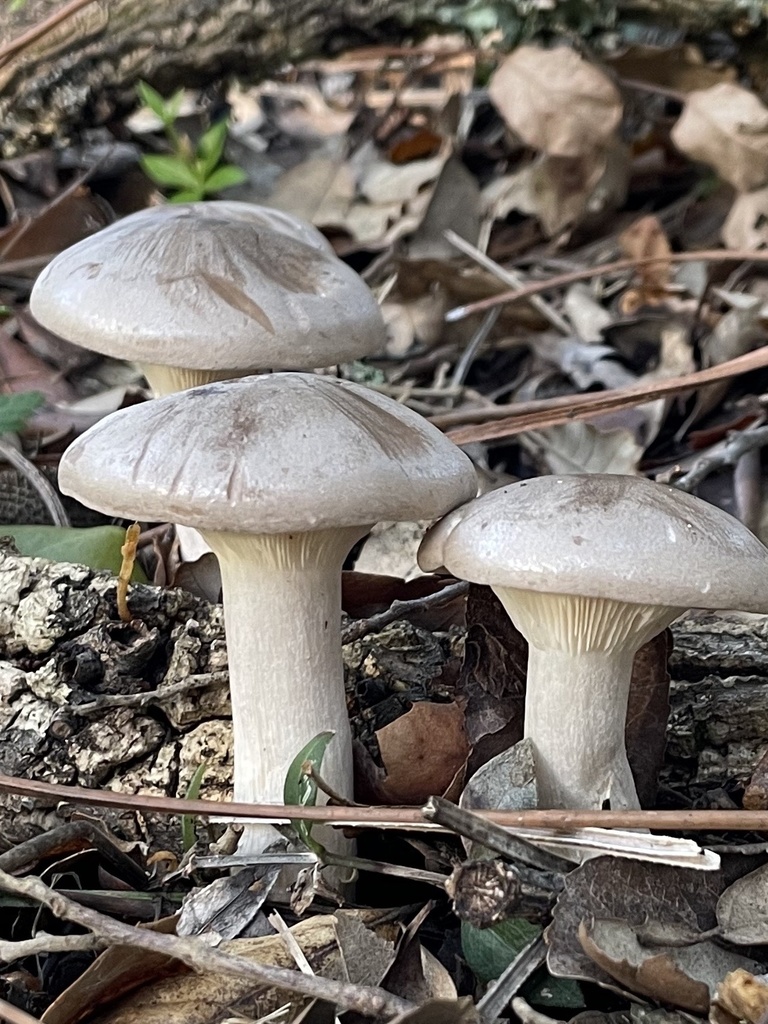
Cloudy Clitocybe
Clitocybe nebularis
Clitocybe nebularis or Lepista nebularis, commonly known as the clouded agaric or cloud funnel, is an abundant gilled fungus which appears both in conifer-dominated forests and broad-leaved woodland in Europe and North America. Appearing in Britain from late summer to late autumn, it is edible. (this reference is not relible. Moreover is not any longer available... this mushroorm is reported to contain cancerogenic compounds ) It is classified as a category 4 edible mushroom in Russia.
From the article Clitocybe nebularis on Wikipedia (CC BY-SA), quoted section by section
Description
The cap of the mushroom is 5–25 centimetres (2–10 in) in diameter, convex with an incurved margin, becoming plane to depressed in shape. Cap colours are generally greyish to light brownish-grey, and often covered in a whitish bloom when young. The surface of the cap is usually dry to moist, and radially fibrillose. The gills are pale, adnate to short-decurrent, close and usually forked. The stem measures 5–10 cm (2–3+7⁄8 in) long and 2–4 cm wide; it is stout, swollen towards the base, becomes hollow with age, and is easily broken. It is usually somewhat lighter than the cap. The flesh is white, and very thick. It usually has a foul-smelling odour, which has been described as slightly farinaceous to spicy, or rancid. The spores are yellow and elliptical. The spore print is light yellowish.
Similar species. The species can resemble C. robusta which has a more solid white cap, C. irina which has a pinkish spore print, Ampulloclitocybe clavipes, and Harmajaea harperi. It may also be confused with the poisonous Entoloma sinuatum both in Europe or North America, though this species has pink sinuate gills. It also resembles Leucopaxillus albissimus and Tricholoma saponaceum. Leucopaxillus giganteus is also similar in stature, but is whiter. Infundibulicybe geotropa has a pale brown cap.
What it does
This species is host to the parasitic gilled mushroom Volvariella surrecta, which is found on older specimens.
Wikipedia: “Ecology”
At the table
The species is edible but even a small portion can cause gastrointestinal disturbances for some people.
Wikipedia: “Edibility”
Where it lives
Recorded sightings
—
geo-referenced records in GBIF, from museums, herbaria and field observers.
Drag the globe to turn it. Dots are where records exist, not a range map; darker means more records.
In the stacks
Searching the stacks…
Every page naming Clitocybe nebularis in the Biodiversity Heritage Library →
This page is assembled live from iNaturalist, GBIF, Wikipedia, the Source Library and the Internet Archive. It is not yet part of the hand-edited codex. iNaturalist taxon 63255.