- Fungi Including Lichens
- ›Ascomycete Fungi
- ›Sac Fungi and Lichens
- ›Common Lichens
- ›Shield Lichens, Sunburst Lichens, Rosette Lichens, and Allies
- ›shield lichens, rim lichens, and allies
- ›shield lichens and allies
- ›typical shield lichens
- ›Nesolechia
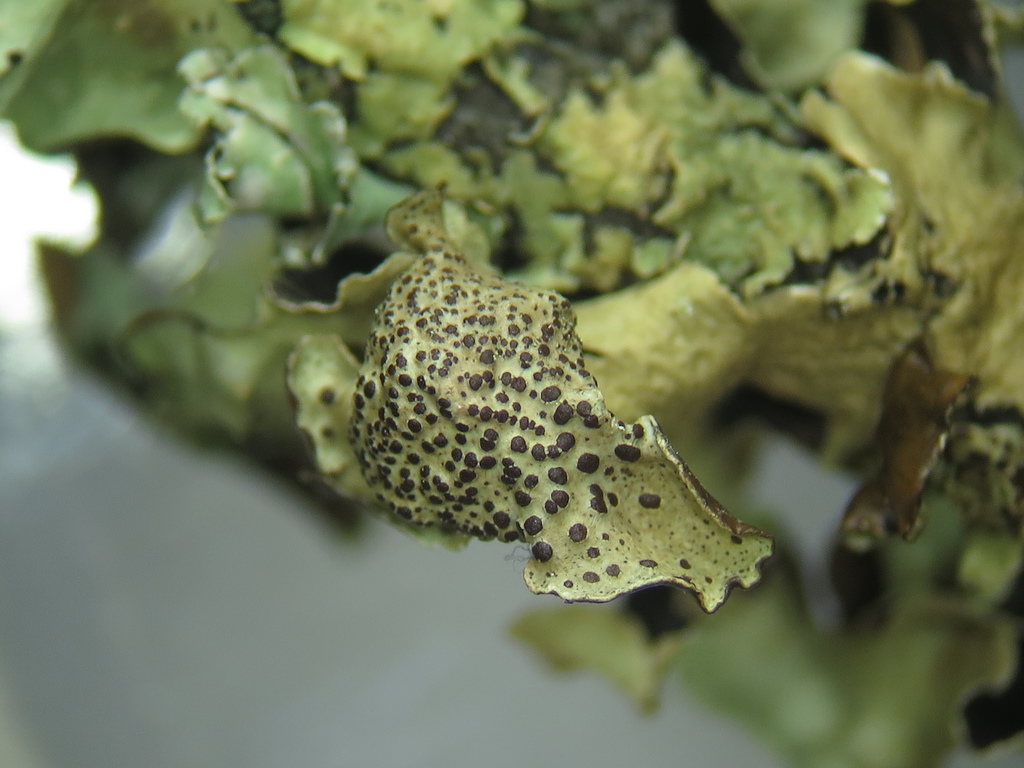
Nesolechia oxyspora
Nesolechia oxyspora is a species of lichenicolous (lichen-dwelling) fungus in the family Parmeliaceae that parasitizes various foliose and fruticose lichens worldwide. First described in 1852, it has undergone numerous taxonomic reclassifications, with ongoing debate about its proper generic placement. The fungus produces spindle-shaped spores and forms small, dark fruiting bodies that develop within the host lichen's tissue before breaking through the surface. Studies have revealed significant morphological variations depending on the host lichen species, suggesting it may represent a complex of closely related species adapted to specific hosts. This cosmopolitan species is known to parasitize at least 63 different lichen species across 19 genera, occasionally inducing gall formations on its hosts.
From the article Nesolechia oxyspora on Wikipedia (CC BY-SA), quoted section by section
Description
The spores, measuring 14–22 by 5–7 μm, are spindle-shaped. The epithecium is chestnut brown, and the hymenium turns blue when treated with iodine (J+). The ascomata (fruiting bodies), which are 0.1–0.4 mm in size, form dense clusters. Initially, they develop inside the lichen thallus, but eventually break through the cortex and slightly protrude. The disc starts off flat with a fine margin, then becomes slightly convex and marginless, with a dull black-brown colour. Studies have revealed considerable variation in spore morphology depending on the host lichen species. When growing on different genera of parmelioid lichens, the fungus produces spores with statistically significant differences in their length-to-breadth ratios. For example, spores from specimens on Parmelia saxatilis have an average length-to-breadth ratio of 3.12, while those on Platismatia glauca average only 2.25. This variation suggests that N. oxyspora may represent a complex of closely related species or strains, each adapted to specific host genera. The colour of the hypothecium (the tissue layer beneath the spore-producing cells) also varies from very pale tan to brown depending on the thickness of the sections examined, and rarely stains positively with iodine. The morphological features of N. oxyspora can be measured in detail across different host species. …
Range & habitat
This fungus species appears to be cosmopolitan in distribution. It is found on the thalli of various foliose (leaf-like) and fruticose (shrub-like) lichens, where it sometimes induces the formation of galls.
== References ==
Wikipedia: “Habitat and distribution”
Where it lives
Recorded sightings
—
geo-referenced records in GBIF, from museums, herbaria and field observers.
Drag the globe to turn it. Dots are where records exist, not a range map; darker means more records.
In the stacks
Searching the stacks…
Every page naming Nesolechia oxyspora in the Biodiversity Heritage Library →
This page is assembled live from iNaturalist, GBIF, Wikipedia, the Source Library and the Internet Archive. It is not yet part of the hand-edited codex. iNaturalist taxon 590608.