- Fungi Including Lichens
- ›Basidiomycete Fungi
- ›Higher Basidiomycetes
- ›Mushrooms, Bracket Fungi, Puffballs, and Allies
- ›Agaricomycetidae
- ›Common Gilled Mushrooms and Allies
- ›Agaricineae
- ›Verrucosporaceae
- ›Lepiota
- ›Cristatae
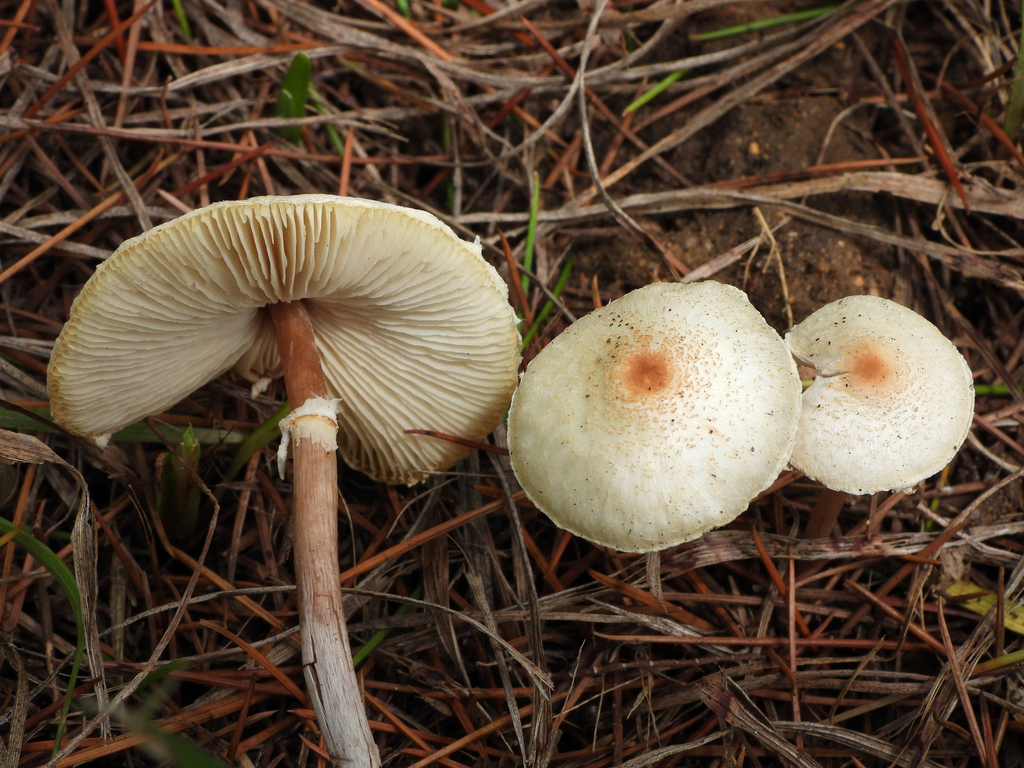
Stinking Dapperling
Lepiota cristata
Lepiota cristata, commonly known as the stinking dapperling, brown-eyed parasol, or the stinking parasol, is an agaric mushroom in the family Agaricaceae. It produces fruit bodies characterized by the flat, reddish-brown concentric scales on the caps, and an unpleasant odour resembling burnt rubber. Similar Lepiota species can sometimes be distinguished from L. cristata by differences in cap colour, stipe structure, or odour, although some species can only be reliably distinguished through the use of microscopy.
A common and widespread species—one of the most widespread fungi in the genus Lepiota—it has been reported from Europe, northern Asia, North America, and New Zealand. It fruits on the ground in disturbed areas, such as lawns, path and road edges, parks, and gardens. It may be poisonous.
From the article Lepiota cristata on Wikipedia (CC BY-SA), quoted section by section
Description
The fruit body produced by Lepiota cristata has a cap with a white to cream base colour, covered with concentrically arranged reddish-brown scales; at maturity the cap diameter ranges from 1–5 cm (0.4–2.0 in) across. The center of the cap is a darker reddish-brown than the rest of the cap. The cap is initial bell-shaped to convex, then later flattens out and develops an umbo. The crowded gills of Lepiota cristata are white to cream, free from attachment to the stipe, and darken/become brownish as the mushroom ages and the spores mature. The stipe is usually between 2–6 cm (0.8–2.4 in), and 0.2–0.7 cm (0.1–0.3 in) thick. With a stipe which is nearly smooth and a pale white-tinged flesh colour, L. cristata also has a transient ring, which is membranous and deciduous. The flesh is thin and white. The dorsal spur on the spores of Lepiota cristata gives them a triangular or wedge shape; they measure 7–8.5 by 3–4 μm. These spores are slightly dextrinoid, meaning they stain deep red to reddish brown with the application of Melzer's reagent. The cystidia on the gill edge (cheilocystidia) in L. cristata are club-shaped and measure about 15–25 by 8–14 μm; there are no cystidia on the gill face (pleurocystidia); the pileipellis is a hymeniform layer of hyphal cells about 30–50 by 10–25 μm. …
Range & habitat
Lepiota cristata is a saprobic species, deriving nutrients through decomposing dead or decayed organic material. saprobic behaviour by L. cristata has been observed on the soil of broadleaved and conifer (Pinopsida) trees. L. cristata can be found growing either singly or in small groups and in multiple habitats including woodlands, gardens (especially shady and damp ones), garden waste, short grass, leaf litter, paths, ditches, and other areas of disturbed ground. Lepiota cristata is one of the most widely distributed Lepiota species, and can be found in North America (north of Mexico), throughout Europe, and northern Asia. It is also found in New Zealand.
Wikipedia: “Ecology, habitat and distribution”
Toxicity
Whilst it is unknown for sure whether the species is poisonous to humans or not, mycologists at least regard it as suspect.This suspicion comes from the fact that many other small species of Lepiota are poisonous. It has been said that L. cristata causes gastrointestinal symptoms. Up until recently, there was a potentially injurious confusion pertaining to the toxicity of L. cristata, as in Great Britain dapperlings were commonly referred to as parasols. A parasol mushrooms is one from the parasol family (Macrolepiota, or sometimes used specifically to refer to Macrolepiota procera) and these are, unlike L. cristata, edible. This frequent misidentification may have added to the incidence of poisoning.
Where it lives
Recorded sightings
—
geo-referenced records in GBIF, from museums, herbaria and field observers.
Drag the globe to turn it. Dots are where records exist, not a range map; darker means more records.
In the stacks
Searching the stacks…
Every page naming Lepiota cristata in the Biodiversity Heritage Library →
This page is assembled live from iNaturalist, GBIF, Wikipedia, the Source Library and the Internet Archive. It is not yet part of the hand-edited codex. iNaturalist taxon 58694.