- Fungi Including Lichens
- ›Basidiomycete Fungi
- ›Higher Basidiomycetes
- ›Mushrooms, Bracket Fungi, Puffballs, and Allies
- ›Agaricomycetidae
- ›Common Gilled Mushrooms and Allies
- ›Agaricineae
- ›Brittlestems and Allies
- ›Coprinellus
- ›Micacei
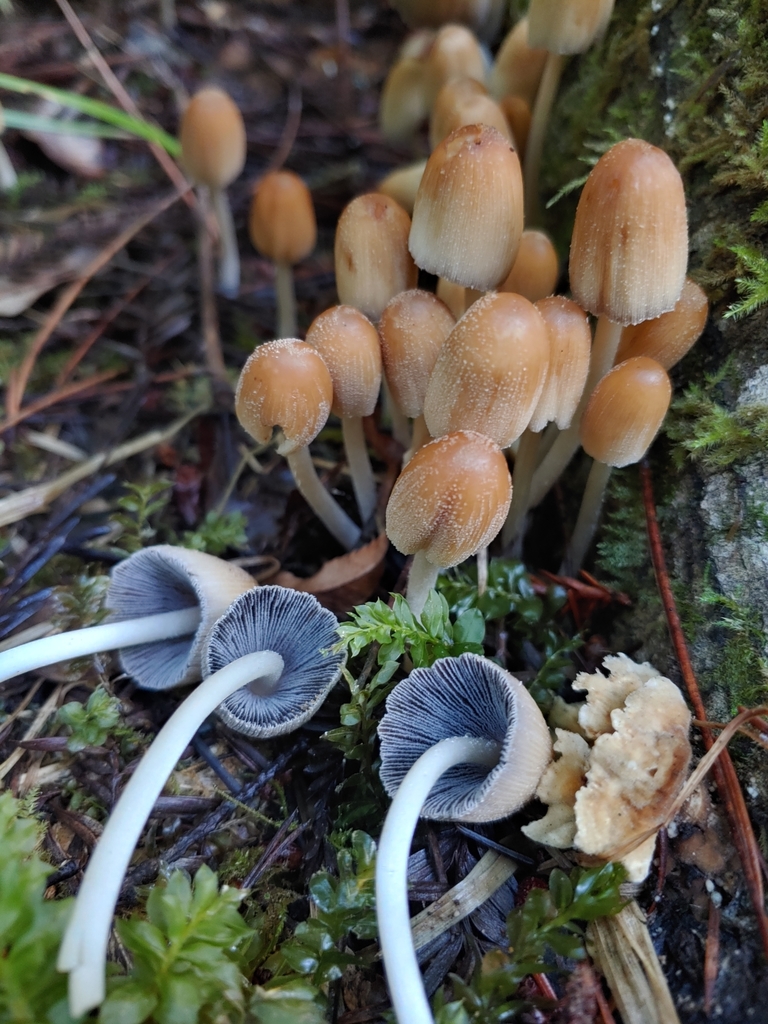
mica cap
Coprinellus micaceus
Coprinellus micaceus, commonly known as the mica cap, glistening inky cap, or shiny cap, is a common species of mushroom-forming fungus in the family Psathyrellaceae.
Formerly known as Coprinus micaceus, the species was transferred to Coprinellus in 2001 as phylogenetic analyses provided the impetus for a reorganization of the many species formerly grouped together in the genus Coprinus. Based on external appearance, C. micaceus is virtually indistinguishable from C. truncorum, and it has been suggested that many reported collections of the former may be of the latter.
From the article Coprinellus micaceus on Wikipedia (CC BY-SA), quoted section by section
Description
The cap is initially 1–2.5 cm (1⁄2–1 in) in diameter, oval to cylindrical, but expands to become campanulate (bell-shaped), sometimes with an umbo (a central nipple-like protrusion); finally it flattens somewhat, becoming convex. When expanded, the cap diameter reaches 0.8–5 cm (1⁄4–2 in) with the margin torn into rays and turned upwards slightly. The color is yellow-brown or tan often with a darker center, then pale yellow or buff from the margin inwards. The cap margin is prominently grooved almost all the way to the center; the grooves mark the positions of the longer gills on the underside of the cap. When young, the cap surface is covered with white or whitish shiny particles, remnants of the universal veil that covers immature specimens. The particles are loosely attached and easily washed away, so that older specimens are often smooth. Coprinellus micaceus is hygrophanous, meaning it assumes different colors depending on its state of hydration. The gills are crowded together closely, and have an adnexed (narrow) attachment to the stipe. Initially white, they change color to dark brown then eventually black as the spores mature. Expansion of the cap causes the gills to split open down their median planes, tearing the cap margin into rays. …
Range & habitat
Coprinellus micaceus is a saprotrophic species, deriving nutrients from dead and decomposing organic matter, and grows in and around stumps or logs of broad-leaved trees or attached to buried wood. It prefers feeding on bark, particularly the secondary phloem, rather than the wood. In the scheme of the succession of fungal species involved in the decomposition of wood, C. micaceus is a late stage colonizer, and prefers to feed on wood that has already decomposed sufficiently to have reached "a friable softened consistency". A 2010 study suggests that the fungus can also live as an endophyte, inhabiting the woody tissue of healthy trees without causing disease symptoms. The fungus is also associated with disturbed or developed ground, such as the sides of roads and paths, gardens, building sites and the edges of parking lots; it has also been noted for growing indoors on rotting wood in humid environments. In one instance it was discovered about 120 m (400 ft) underground in an abandoned coal mine, growing on wooden gangways and props used to support the roof.
Fruit bodies are commonly found growing in dense clusters, but can also be found growing singly or in small clumps, especially in forested areas. In North America, C. micaceus is one of the first edible mushrooms to appear in the spring, and fruits from April to September. In Europe, it fruits from May to December. …
Wikipedia: “Ecology, habitat and distribution”
At the table
Coprinellus micaceus is an edible species, and cooking inactivates the enzymes that cause autodigestion or deliquescence—a process that can begin as soon as one hour after collection. It is considered good for omelettes, and as a flavor for sauces, although it is "a very delicate species easily spoiled by overcooking". The flavor is so delicate that it is easy to overpower and hide with almost anything. The fungus also appeals to fruit flies of the genus Drosophila, who frequently use the fruit bodies as hosts for larvae production. A study of the mineral contents of various edible mushrooms found that C. micaceus contained the highest concentration of potassium in the 34 species tested, close to half a gram of potassium per kilogram of mushroom. Because the species can bioaccumulate detrimental heavy metals like lead and cadmium, it has been advised to restrict consumption of specimens collected from roadsides or other collection sites that may be exposed to or contain pollutants.
Wikipedia: “Edibility”
In human culture
The specific epithet micaceus is derived from the Latin word mica, for "crumb, grain of salt" and the suffix -aceus, "like, similar"; the modern application of "mica" to a very different substance comes from the influence of micare, "glitter". The mushroom is commonly known as the "shiny cap", the "mica cap" or the "glistening inky cap", all in reference to the mealy particles found on the cap that glisten like mica.
Wikipedia: “Etymology”
Where it lives
Recorded sightings
—
geo-referenced records in GBIF, from museums, herbaria and field observers.
Drag the globe to turn it. Dots are where records exist, not a range map; darker means more records.
In the stacks
Searching the stacks…
Every page naming Coprinellus micaceus in the Biodiversity Heritage Library →
This page is assembled live from iNaturalist, GBIF, Wikipedia, the Source Library and the Internet Archive. It is not yet part of the hand-edited codex. iNaturalist taxon 56318.