- Fungi Including Lichens
- ›Basidiomycete Fungi
- ›Higher Basidiomycetes
- ›Mushrooms, Bracket Fungi, Puffballs, and Allies
- ›Agaricomycetidae
- ›boletes and allies
- ›Sclerodermatineae
- ›Sclerodermataceae
- ›Scleroderma
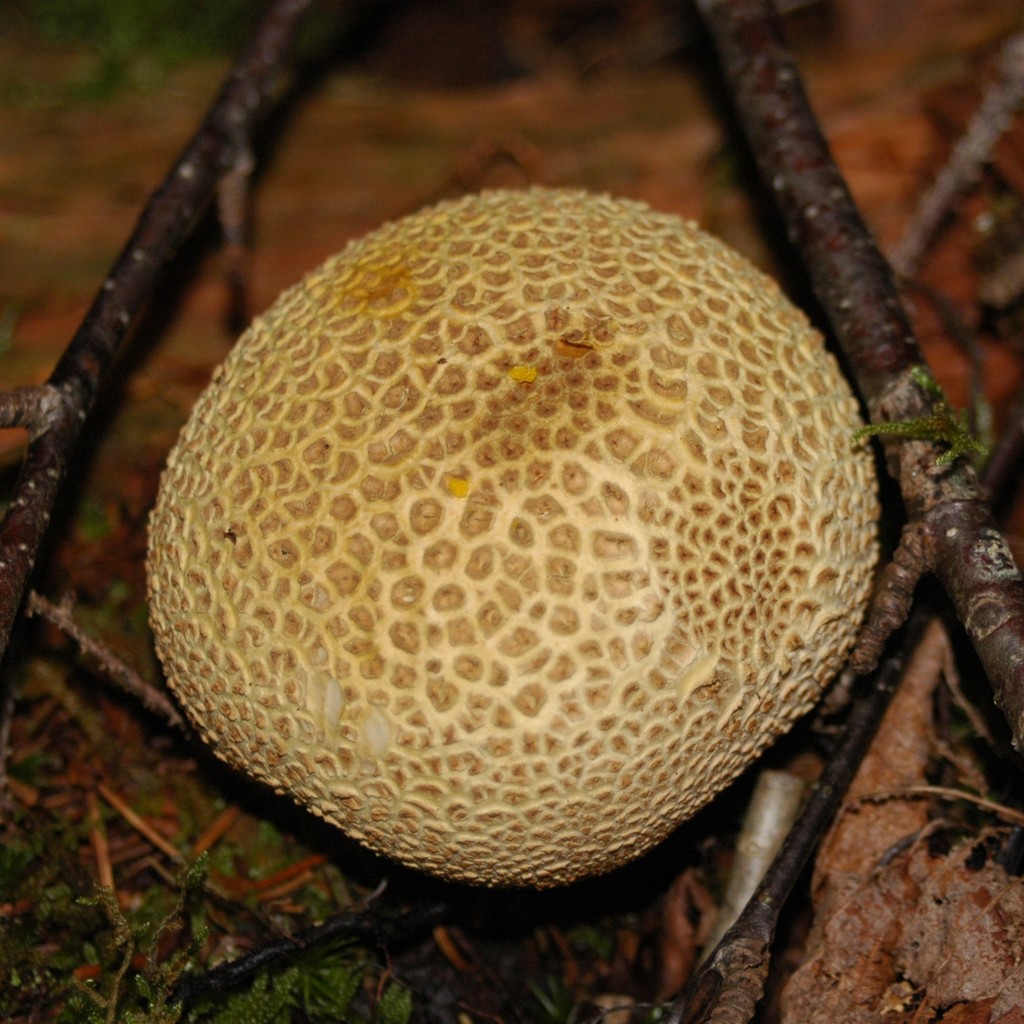
common earthball
Scleroderma citrinum
Scleroderma citrinum, commonly known as the common earthball, pigskin poison puffball, or common earth ball, is the most common species of earthball in the UK and occurs widely in woods, heathland and in short grass from autumn to winter. Scleroderma citrinum has two synonyms, Scleroderma aurantium (Vaill.) and Scleroderma vulgare Horn.
From the article Scleroderma citrinum on Wikipedia (CC BY-SA), quoted section by section
Description
The fruit bodies grow to 10 centimetres (4 in) broad and 6 cm high with a yellowish peridium, or outer skin. Earthballs are superficially similar to, and considered look-alikes of, the edible puffball (particularly Apioperdon pyriforme), but whereas the puffball has a single opening on top through which the spores are dispersed, the earthball just breaks up to release the spores. Moreover, S. citrinum has much firmer flesh and a dark gleba (interior) much earlier in development than puffballs. Scleroderma citrinum has no stem but is attached to the soil by mycelial cords. The peridium is thick and firm, usually ochre yellow externally with irregular warts.
Range & habitat
Found in Europe and in North America, it is the most common species of earthball fungus in the United Kingdom and occurs widely in woods, heathland and in short grass from autumn to winter. S. citrinum has two synonyms, S. aurantium (Vaill.) and Scleroderma vulgare Horn.
Wikipedia: “Distribution and habitat”
What it does
Scleroderma citrinum is an ectomycorrhizal fungus with a symbiotic relationship with tree species, and can influence the diversity of soil bacterial communities under some tree species. The earthball may be parasitized by Pseudoboletus parasiticus.
Wikipedia: “Ecology”
Toxicity
Scleroderma citrinum is poisonous and can be mistaken with truffles by inexperienced mushroom hunters. Ingestion of S. citrinum can cause gastrointestinal distress in humans and animals. Some individuals may experience lacrimation, rhinitis and rhinorrhea, and conjunctivitis from exposure to its spores. Pigments found in the fruiting body of S. citrinum Pers. are sclerocitrin, norbadione A, xerocomic acid, and badione A.
Where it lives
Recorded sightings
—
geo-referenced records in GBIF, from museums, herbaria and field observers.
Drag the globe to turn it. Dots are where records exist, not a range map; darker means more records.
In the stacks
Searching the stacks…
Every page naming Scleroderma citrinum in the Biodiversity Heritage Library →
This page is assembled live from iNaturalist, GBIF, Wikipedia, the Source Library and the Internet Archive. It is not yet part of the hand-edited codex. iNaturalist taxon 55927.