- Fungi Including Lichens
- ›Basidiomycete Fungi
- ›Higher Basidiomycetes
- ›Mushrooms, Bracket Fungi, Puffballs, and Allies
- ›Agaricomycetidae
- ›Common Gilled Mushrooms and Allies
- ›Marasmiineae
- ›Mycenaceae
- ›Mycena
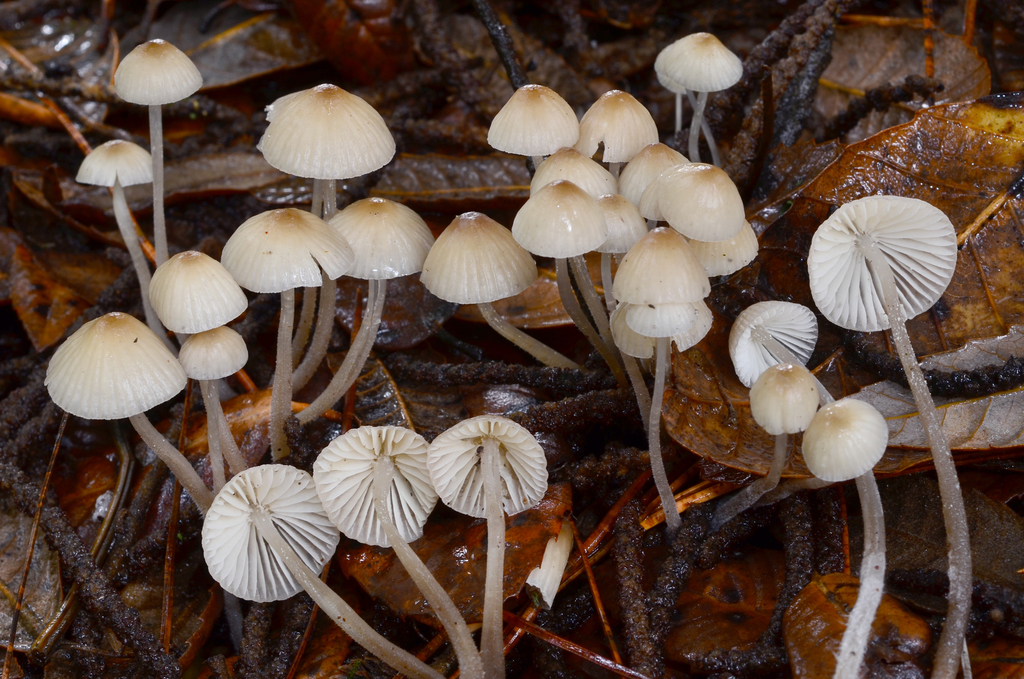
Milking Bonnet
Mycena galopus
Mycena galopus, commonly known as the milky mycena, milking bonnet or milk-drop mycena, is an inedible species of fungus in the family Mycenaceae of the order Agaricales. It produces small mushrooms that have grayish-brown, bell-shaped, radially-grooved caps up to 2.5 cm (1 in) wide. The gills are whitish to gray, widely spaced, and squarely attached to the stem. The slender stems are up to 8 cm (3 in) long, and pale gray at the top, becoming almost black at the hairy base. The stem will ooze a whitish latex if it is injured or broken. The variety nigra has a dark gray cap, while the variety candida is white. All varieties of the mushroom occur during summer and autumn on leaf litter in coniferous and deciduous habitats.
Mycena galopus is found in North America and Europe. The saprobic fungus is an important leaf litter decomposer, and able to utilize all the major constituents of plant litter. It is especially adept at attacking cellulose and lignin, the latter of which is the second most abundant renewable organic compound in the biosphere. The mushroom latex contains chemicals called benzoxepines, which are thought to play a role in a wound-activated chemical defense mechanism against yeasts and parasitic fungi.
From the article Mycena galopus on Wikipedia (CC BY-SA), quoted section by section
Description
The cap of M. galopus is egg-shaped when young, later becoming conic to somewhat bell-shaped, and eventually reaching a diameter of 0.5 to 2.5 cm (0.2 to 1.0 in). In age it often has a margin curved inward, and a prominent umbo. The cap surface has a hoary sheen (remnants of the universal veil that once covered the immature fruit body) that soon sloughs off, leaving it naked and smooth. The cap margin, which is initially pressed against the stem, is translucent when moist, so that the outline of the gills underneath the cap may be seen, and has deep narrow grooves when dry. The color is largely fuscous-black except for the whitish margin that fades to pale gray; the umbo remains blackish or becomes dark gray, sometimes with a very pale ashy gray over all when moist, and opaque and ashy gray after drying. The flesh is thin, soft, and fragile, without any distinctive odor and taste. The gills are subdistantly spaced, narrow, ascending-adnate, whitish to gray, usually darker in age, with edges that are pallid or grayish. The stem is 4 to 8 cm (1.6 to 3.1 in) (rarely up to 12 cm) long, 1–2 mm thick, equal in length throughout, smooth, and fragile. The lower portion of the stem is dark blackish-brown to a dark ashy color. The apex of the stem is pallid, and the whitish base covered with coarse, stiff hairs. When broken it exudes a white milk-like liquid. …
Range & habitat
Mycena galopus is a saprobic fungus, and plays an important role in forest ecosystems as a decomposer of leaf litter. It has been estimated in the UK to account for a large portion of the decomposition of the autumn leaf litter in British woodlands. It is able to break down the lignin and cellulose components of leaf litter. Grown in axenic culture in the laboratory, the fungus mycelium has been shown to degrade (in addition to lignin and cellulose) hemicelluloses, protein, soluble carbohydrates, and purified xylan and pectin using enzymes such as polyphenol oxidases, cellulases, and catalase. It is particularly adept at breaking down lignin, which is the second most abundant renewable organic compound in the biosphere, after cellulose. Research also suggests that the fungus weathers soil minerals, making them more available to mycorrhizal plants. Phosphorus, an important macronutrient influencing plant growth, typically occurs in primary minerals like apatite, or other organic complexes, and its low solubility often results in low phosphorus availability in soil. The biological activity of M. galopus mycelium can increase the availability of phosphorus and other nutrients, both as a result of soil acidification due to cation uptake and via the release of weathering agents such low molecular mass organic acids. …
Wikipedia: “Ecology, habitat, and distribution”
Where it lives
Recorded sightings
—
geo-referenced records in GBIF, from museums, herbaria and field observers.
Drag the globe to turn it. Dots are where records exist, not a range map; darker means more records.
In the stacks
Searching the stacks…
Every page naming Mycena galopus in the Biodiversity Heritage Library →
This page is assembled live from iNaturalist, GBIF, Wikipedia, the Source Library and the Internet Archive. It is not yet part of the hand-edited codex. iNaturalist taxon 55923.