- Fungi Including Lichens
- ›Basidiomycete Fungi
- ›Pucciniomycotina
- ›Pucciniomycetes
- ›rust fungi
- ›Uredinineae
- ›Pucciniaceae
- ›Puccinia
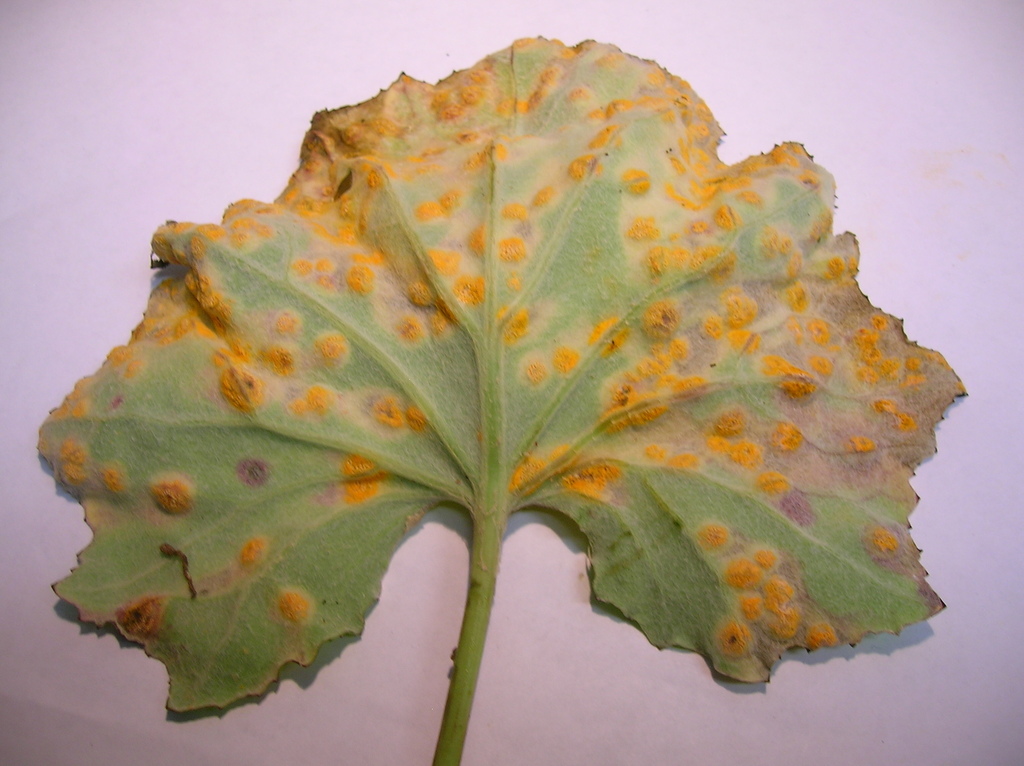
Coltsfoot Gall Rust
Puccinia poarum
Puccinia poarum, a species of fungus, known as the coltsfoot gall rust, or meadow grass rust, is a plant pathogen. This fungal parasite forms a yellow to orange gall, 1–2 cm in diameter, on the underside of leaves of coltsfoot (Tussilago farfara). It also infects but does not gall grasses of the family Poaceae. P. poarum is a genetically diverse species that has been reported on at least seventy plant hosts. It was originally found on Poa fertilis and Poa nemoralis in Denmark in 1877.
From the article Puccinia poarum on Wikipedia (CC BY-SA), quoted section by section
Description
On Tussilago farfara (coltsfoot), infection by P. poarum results in large, circular, yellow or orange-red spots that protrude from the undersides of the leaves. The spots often have a purple margin, and sometimes a central hole. On the lower leaf surface, 20-30 cup-shaped aecia of the fungus form on each gall. On the upper surface of the leaf, infection results in a yellow circle with no swelling. Spermogonia may also be present. On Tussilago farfara, the rust is necrotrophic, obtaining nutrients from dead cells and plant tissues.
Identification. Puccinia poarum may be confused with a different rust on Tussilago farfara (coltsfoot), Coleosporium tussilaginis. Coleosporium tussilaginis usually appears later in the season and does not form galls or aecia, but instead forms diffuse uredinia with powdery orange spores on the lower leaf surface; it is less obvious on the upper leaf surface, and lacks the purple margin and central hole characteristic of P. poarum.
Wikipedia: “Characteristics”
Range & habitat
In the United Kingdom, this rust is locally common, and widely distributed. Northern hemisphere to South America.
Wikipedia: “Distribution”
Where it lives
Recorded sightings
—
geo-referenced records in GBIF, from museums, herbaria and field observers.
Drag the globe to turn it. Dots are where records exist, not a range map; darker means more records.
In the stacks
Searching the stacks…
Every page naming Puccinia poarum in the Biodiversity Heritage Library →
This page is assembled live from iNaturalist, GBIF, Wikipedia, the Source Library and the Internet Archive. It is not yet part of the hand-edited codex. iNaturalist taxon 559228.