- Fungi Including Lichens
- ›Basidiomycete Fungi
- ›Higher Basidiomycetes
- ›Mushrooms, Bracket Fungi, Puffballs, and Allies
- ›Agaricomycetidae
- ›Common Gilled Mushrooms and Allies
- ›Agaricineae
- ›Hydnangiaceae
- ›Laccaria
- ›Amethystinae
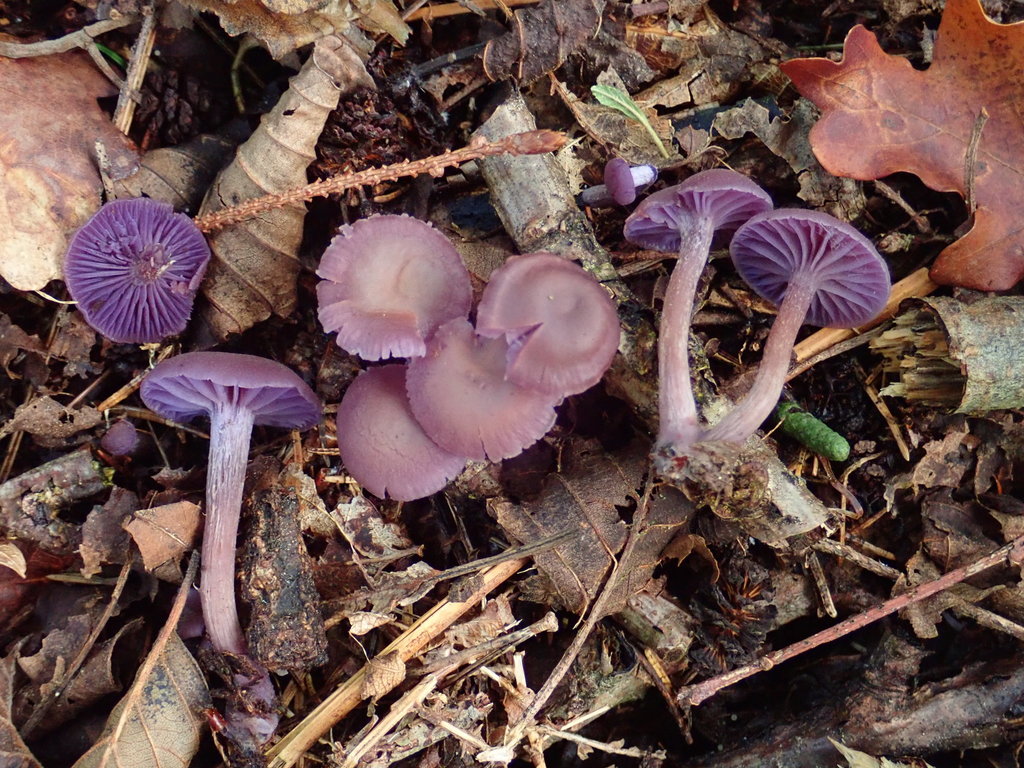
Amethyst Deceiver
Laccaria amethystina
Laccaria amethystina, commonly known as the amethyst deceiver, or amethyst laccaria, is a small brightly colored mushroom. Because its bright amethyst coloration fades with age and weathering, it becomes difficult to identify, hence the common name "deceiver". This common name is shared with its close relation L. laccata, which also fades and weathers. Recently, some of the other species in the genus have been given the common name of "deceiver".
It is found mainly in Northern temperate zones, in deciduous and coniferous forests, though it is reported to occur in tropical Central and South America as well. The mushroom is edible, but can absorb arsenic from the soil.
From the article Laccaria amethystina on Wikipedia (CC BY-SA), quoted section by section
Description
The cap is up to 6 centimetres (2+1⁄4 in) in diameter, and is initially convex, later flattening, typically with a central depression (navel). When moist it is a deep purplish lilac, which fades upon drying out. It is sometimes slightly scurfy at the center, and has pale striations at the margin. The stem is the same colour as the cap, and has whitish fibrils at the base, which become mealy at the top. It is fibrous, hollow, fairly tough when rolled in the fingers, with dimensions of 0.6 to 7 cm (1⁄4 to 2+3⁄4 in) long by 0.1 to 0.7 cm (1⁄16 to 1⁄4 in) thick. The flesh is without a distinctive taste or smell, and is thin, with pale lilac coloration. The gills are colored as the cap, often quite distantly spaced, and are dusted by the white spores; their attachment to the stem is sinuate—having a concave indentation before attaching to the stem.
Microscopic characteristics. The spores are spherical and hyaline, and bear pointed spines (echinulate) that are long relative to the size of the spore; they typically have dimensions of 7–10 by 7–10 μm. The basidia, the spore-bearing cells, are club-shaped and hyaline, and are 30–64.5 by 8.5–14 μm.
Similar species. There are several purplish species in North America that were formally labeled as L. amethystina before Gregory M. Mueller described them as distinct species in 1984. …
Range & habitat
The species is common in most temperate zones of Europe (June–December), Asia, Central, South, and eastern North America. It grows solitary to scattered with a variety of deciduous and coniferous trees, with which it is mycorrhizally associated, though it most commonly occurs with trees in the Fagales. It appears in late summer to early winter, and often with beech; in Central and South America, it more commonly grows in association with oak. Research has shown that L. amethystina is a so-called "ammonia fungus", an ecological classification referring to those fungi that grow abundantly on soil after the addition of ammonia, or other nitrogen-containing material; the congeneric species Laccaria bicolor is also an ammonia fungus.
Wikipedia: “Distribution and habitat”
At the table
As with other members of the genus, this species is edible, though generally not considered choice. While not inherently toxic, in soils that are polluted with arsenic, it can bioaccumulate a high concentration of that element. The gills of nontoxic specimens should be cleaned thoroughly.
Wikipedia: “Edibility”
Where it lives
Recorded sightings
—
geo-referenced records in GBIF, from museums, herbaria and field observers.
Drag the globe to turn it. Dots are where records exist, not a range map; darker means more records.
In the old herbals & bestiaries

In the stacks
Searching the stacks…
Every page naming Laccaria amethystina in the Biodiversity Heritage Library →
This page is assembled live from iNaturalist, GBIF, Wikipedia, the Source Library and the Internet Archive. It is not yet part of the hand-edited codex. iNaturalist taxon 55899.