- Fungi Including Lichens
- ›Basidiomycete Fungi
- ›Higher Basidiomycetes
- ›Mushrooms, Bracket Fungi, Puffballs, and Allies
- ›Agaricomycetidae
- ›Common Gilled Mushrooms and Allies
- ›Clavariineae
- ›antler and spindle fungi
- ›Ramariopsis
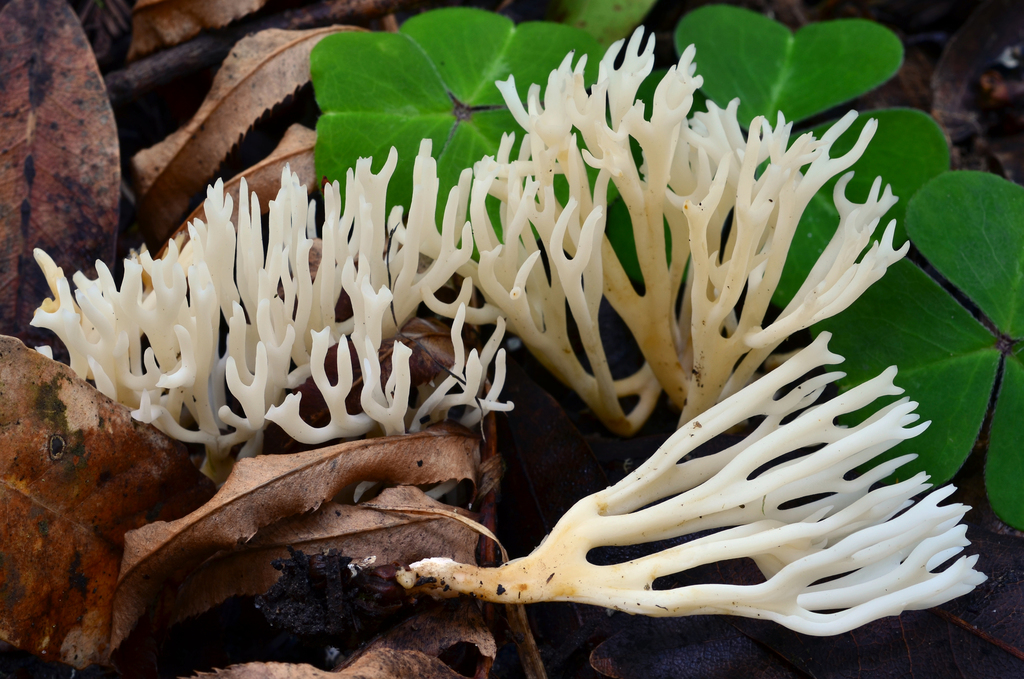
white coral fungus
Ramariopsis kunzei
Ramariopsis kunzei is an edible species of coral fungi in the family Clavariaceae, and the type species of the genus Ramariopsis. It is commonly known as white coral because of the branched structure of the fruit bodies that resemble marine coral.
The fruit bodies are up to 5 cm (2 in) tall by 4 cm (1+1⁄2 in) wide, with numerous branches originating from a short rudimentary stem. The branches are one to two millimeters thick, smooth, and white, sometimes with yellowish tips in age.
From the article Ramariopsis kunzei on Wikipedia (CC BY-SA), quoted section by section
Description
The fruit bodies are white to whitish-yellow in color, and are highly branched structures resembling coral; the dimensions are typically up to 8 cm (3.1 in) tall and 6 cm (2.4 in) wide. Older specimens may have a pinkish tinge. The tips of the branches are blunt, not crested as in some other species of coral fungi, like Clavulina cristata; branches are between 1 and 5 millimeters thick. The branch tips of mature specimens may be yellow. A stem, if present, may be up to 1 cm (0.4 in) long and scurfy—covered with small flakes or scales. The texture of the flesh may range from pliable to brittle. The odor and taste are not distinctive. This mushroom does not change color upon bruising or injury, but a 10% solution of FeSO4 (a chemical test known as "iron salts") will turn it green. In deposit, the spores are white. Viewed with a light microscope, the spores are translucent and have an ellipsoid to roughly spherical shape with spines on the surface, and dimensions of 3–5.5 by 2.5–4.5 μm. Spores are non-amyloid, meaning that they do not absorb iodine when stained with Melzer's reagent. The spore-bearing cells, the basidia, are usually 25–45 μm long by 6–7 μm wide, and 4-spored. Clamp connections are present in the hyphae of this species.
Similar species. The "crested coral" (Clavulina cristata, edible) is similar in appearance to R. …
Range & habitat
The species is thought to be saprobic and is found growing on the ground, in duff, or less frequently on well-decayed wood. Fruit bodies may grow singly, in groups, or clustered together. David Arora has noted a preference for growing under conifers, as well as a prevalence in redwood forests of North America. In contrast, an earlier author claimed this species grows "rarely in coniferous woods." In Europe, Ramariopsis kunzei has been collected in Scotland (specifically, on the islands of Arran, Gigha and Kintyre peninsula), the Netherlands, Norway, former Czechoslovakia, Germany, Poland, and Russia (Zhiguli Mountains). It has also been found in China, India, Iran, the Solomon Islands, and Australia. In North America, the distribution extends north to Canada, and includes the United States (including Hawaii and Puerto Rico).
Wikipedia: “Habitat and distribution”
At the table
The species is edible, but according to David Arora, "fleshless and flavorless".
== References ==
Wikipedia: “Edibility”
Where it lives
Recorded sightings
—
geo-referenced records in GBIF, from museums, herbaria and field observers.
Drag the globe to turn it. Dots are where records exist, not a range map; darker means more records.
In the stacks
Searching the stacks…
Every page naming Ramariopsis kunzei in the Biodiversity Heritage Library →
This page is assembled live from iNaturalist, GBIF, Wikipedia, the Source Library and the Internet Archive. It is not yet part of the hand-edited codex. iNaturalist taxon 55274.