- Fungi Including Lichens
- ›Basidiomycete Fungi
- ›Higher Basidiomycetes
- ›Mushrooms, Bracket Fungi, Puffballs, and Allies
- ›Russulales
- ›Auriscalpiaceae
- ›Auriscalpium
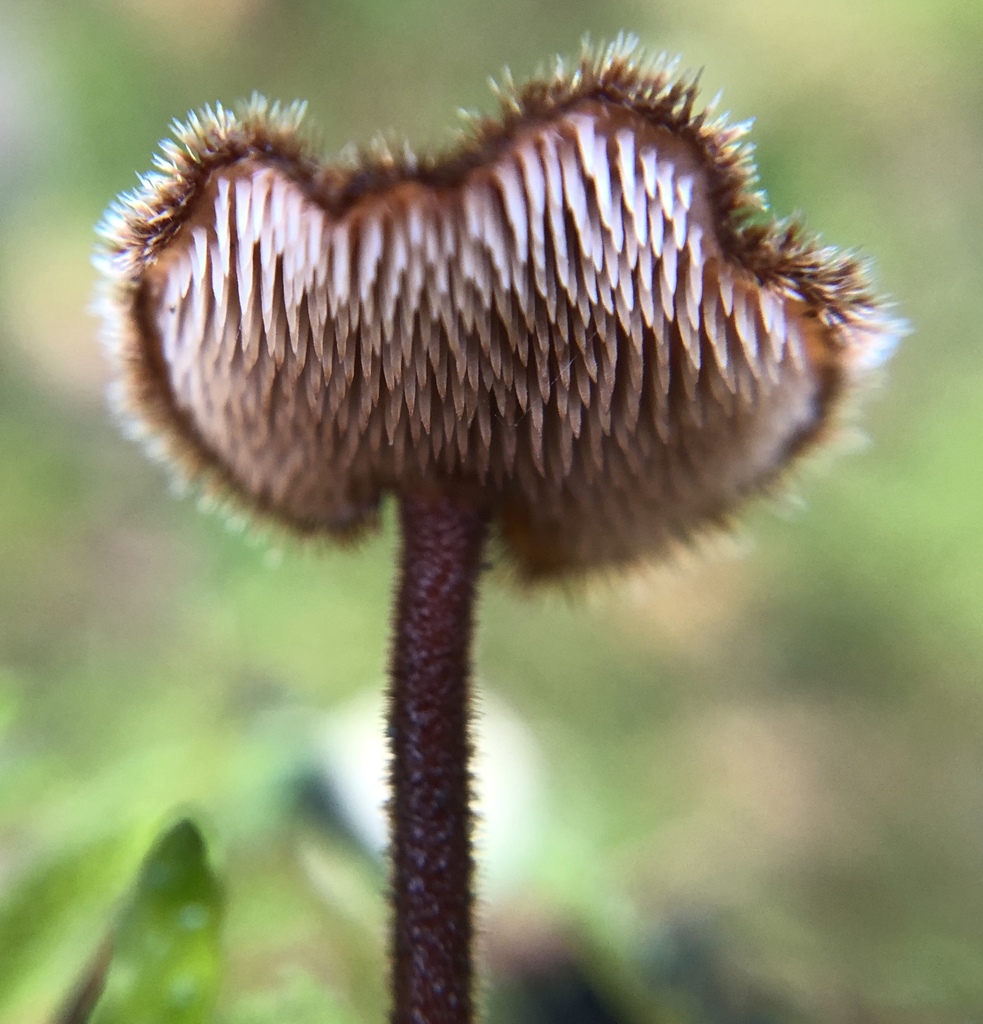
Earpick Fungus
Auriscalpium vulgare
Auriscalpium vulgare, commonly known as the pinecone mushroom, the cone tooth, or the ear-pick fungus, is a species of fungus in the family Auriscalpiaceae of the order Russulales. It was first described in 1753 by Carl Linnaeus, who included it as a member of the tooth fungi genus Hydnum, but British mycologist Samuel Frederick Gray recognized its uniqueness and in 1821 transferred it to the genus Auriscalpium that he created to contain it.
The fruit bodies (mushrooms) grow on conifer litter or on conifer cones that may be partially or completely buried in soil. The dark brown cap of the small, spoon-shaped mushroom is covered with fine brown hairs, and reaches a diameter of up to 2 cm (3⁄4 in). On the underside of the cap are a crowded array of tiny tooth-shaped protrusions ("teeth") up to 3 mm long; they are initially whitish to purplish-pink before turning brown in age. The dark brown and hairy stem, up to 55 mm (2+1⁄8 in) long and 2 mm thick, attaches to one edge of the cap. The mushroom produces a white spore print out of roughly spherical spores.
From the article Auriscalpium vulgare on Wikipedia (CC BY-SA), quoted section by section
Description
The fruit body of A. vulgare is fibrous when fresh and becomes stiff when dry. It is a small species rarely exceeding 5.5 cm (2+1⁄4 in) in height, with a cap usually smaller than an adult's fingernails: 0.5 to 2 cm (1⁄4 to 3⁄4 in)—although it has been known to reach up to 4 cm (1+1⁄2 in). It is semicircular or kidney-shaped, flat on the lower surface and rounded on the top. The surface is at first much like the stem: covered with bristles and dark chestnut brown. It becomes smooth with maturity and can darken to the point of being almost black. The cap margin is usually buff to light brown–roughly the same color as the spines and lighter in color than the center. It becomes rolled inward (revolute) and often wavy in maturity. The spines on the underside of the cap are a few millimeters long and cylindrical down to their sharp tips. White to light brown when young, they later become covered with a white spore mass and then turn an ashy gray. Occasionally, fruit bodies are produced that lack a cap entirely. Auriscalpium vulgare usually has a single stem, but occasionally several stems arise from a thick common base. It attaches to the side of the cap and is cylindrical or slightly flattened with a bulbous base, 2–8 cm tall and 1–3 wide. …
Range & habitat
Auriscalpium vulgare is a saprobic species. Its mushrooms grow solitary or clustered on fallen pine cones, especially those that are fully or partially buried. It typically favors Scots pine (Pinus sylvestris), but has also been reported on spruce cones, and in California grows primarily on Douglas-fir cones. One author noted finding the mushroom on spruce needles on top of squirrel dens where cone bracts were present in the forest floor. In a study conducted in the Laojun Mountain region of Yunnan, China, A. vulgare was found to be one of the most dominant species collected from mixed forest at an altitude of 2,600–3,000 m (8,500–9,800 ft). A study on the effect of slash and burn practices in northeast India showed that the fungus prefers to fruit on burned cones of the Khasi pine, and that the number of fruit bodies on unburned cones increases with cone girth. The fungus is widely distributed in Europe, Central and North America, temperate Asia, and Turkey. In North America, its range extends from Canada to the Trans-Mexican Volcanic Belt south of Mexico City. The mushroom is common, appearing in the summer and autumn, although it is easily overlooked because of its small size and nondescript coloration. A. vulgare is the only representative of its genus in temperate areas of the Northern Hemisphere.
Wikipedia: “Habitat and distribution”
At the table
The mushroom is generally considered inedible because of its toughness and diminutive size. A 1887 textbook claims that it was "commonly eaten in France and Italy".
Wikipedia: “Edibility”
In human culture
Auriscalpium vulgare can be grown in pure culture on agar-containing plates supplemented with nutrients. The colonies that grow are white to pale cream, and cover the agar surface within six weeks from the initial inoculation. The mycelium is made of bent-over hyphae, without any aerial hyphae (hyphae that extend above the surface of the agar). Typically, two indistinct zones develop at about 6 mm and 15 mm from the initial inoculum spot, with each zone roughly 4 mm wide. The zones appear somewhat lighter in color because the hyphae are more closely packed and form crystalline substances that deposit into the agar. The mature mycelium consists of thin-walled, densely packed hyphae that are 1.5–3.2 μm in diameter. They are often gnarled or somewhat spiral (subhelicoid), and frequently branched at an angle of about 45°, with a clamp at the base of the branch. They contain amorphous granules that appear refractive when viewed under phase contrast microscopy, and their walls are often encrusted with tiny granules. Gloeocystidia (thin-walled cystidia with refractive, frequently granular contents) are common; they measure 50–85 by 6.5–8.5 μm, and are club-shaped (sometimes elongated), thin-walled, and often have one or two lobes with rounded tips. Containing foamy and pale yellow contents, they are a refractive yellow color under phase contrast. …
Wikipedia: “Growth in culture”
Where it lives
Recorded sightings
—
geo-referenced records in GBIF, from museums, herbaria and field observers.
Drag the globe to turn it. Dots are where records exist, not a range map; darker means more records.
In the stacks
Searching the stacks…
Every page naming Auriscalpium vulgare in the Biodiversity Heritage Library →
This page is assembled live from iNaturalist, GBIF, Wikipedia, the Source Library and the Internet Archive. It is not yet part of the hand-edited codex. iNaturalist taxon 55175.