- Fungi Including Lichens
- ›Basidiomycete Fungi
- ›Higher Basidiomycetes
- ›Mushrooms, Bracket Fungi, Puffballs, and Allies
- ›Phallomycetidae
- ›Gomphales
- ›Clavariadelphaceae
- ›Clavariadelphus
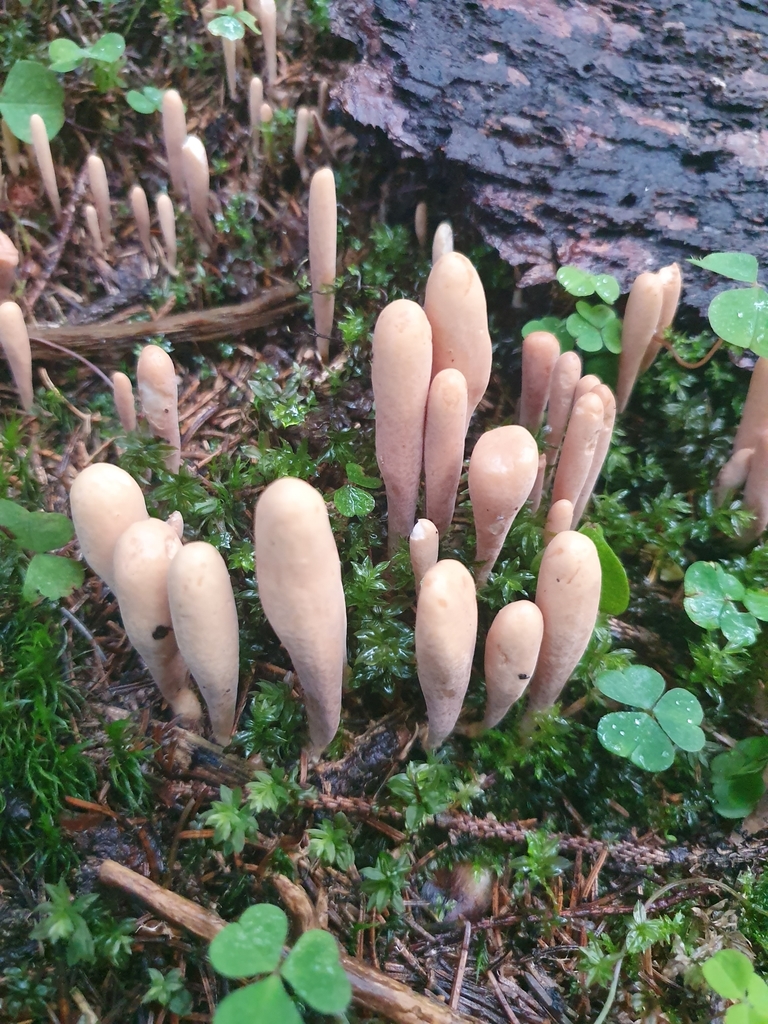
ochre club
Clavariadelphus ligula
Clavariadelphus ligula, commonly known as the strap coral, is an inedible species of fungi in the Gomphaceae family. It produces club-shaped fruit bodies with spongy flesh that grow in groups on the forest floor. It is found in Asia, Europe, and North America.
From the article Clavariadelphus ligula on Wikipedia (CC BY-SA), quoted section by section
Description
The club portion of the fruit body is buff to pale yellow or reddish, straight, and has stiff hairs at the base. The surface is dull and does not have hairs. It is smooth at first then later becomes somewhat wrinkled. It is club-shaped to spoon-shaped and up to 12 cm (4.7 in) tall by 2 cm (0.8 in) wide at the thickest part. The stipe is not distinct except for the hairs at the base. The flesh is whitish, and does not change color with bruising. It is somewhat spongy in the upper part, but firm below. The flesh has no odor, and its taste is slightly bitter. The surface tissue turns green upon the application of a solution of ferric sulphate, and yellow with a dilute solution of potassium hydroxide. The spores are pale yellowish orange ("light buff") in deposit. Additional features may be discerned using light microscopy; they are smooth, narrowly ellipsoid, and measure 8–15 by 3–6 μm. The hyphae are monomitic, and clamp connections are present. Cystidia are absent. One field guide lists the species as edible, while others say it is inedible.
Similar species. Clavariadelphus sachalinensis is macroscopically identical to C. ligula and can be distinguished only by its larger spores, measuring 16–24 by 4–6 μm, and longer basidia. However, intermediate forms are often found, and they may represent the same species. …
Range & habitat
The fruit bodies of C. ligula grow gregariously (closely scattered over small areas) on the ground, in forest duff. They are widespread and common in coniferous forests, fruiting in the summer and fall. The species has been collected in the Czech Republic, in Austria (data in), the Magadan region of the Russian Far East as well as the arctic zone of the Urals. It has also been collected in the conifer-dominated forests in Kashmir Valley in India. In North America, the distribution extends north to Canada.
Wikipedia: “Habitat and distribution”
Where it lives
Recorded sightings
—
geo-referenced records in GBIF, from museums, herbaria and field observers.
Drag the globe to turn it. Dots are where records exist, not a range map; darker means more records.
In the stacks
Searching the stacks…
Every page naming Clavariadelphus ligula in the Biodiversity Heritage Library →
This page is assembled live from iNaturalist, GBIF, Wikipedia, the Source Library and the Internet Archive. It is not yet part of the hand-edited codex. iNaturalist taxon 55162.