- Fungi Including Lichens
- ›Basidiomycete Fungi
- ›Higher Basidiomycetes
- ›Mushrooms, Bracket Fungi, Puffballs, and Allies
- ›Agaricomycetidae
- ›boletes and allies
- ›boletes
- ›Austroboletoideae
- ›Austroboletus
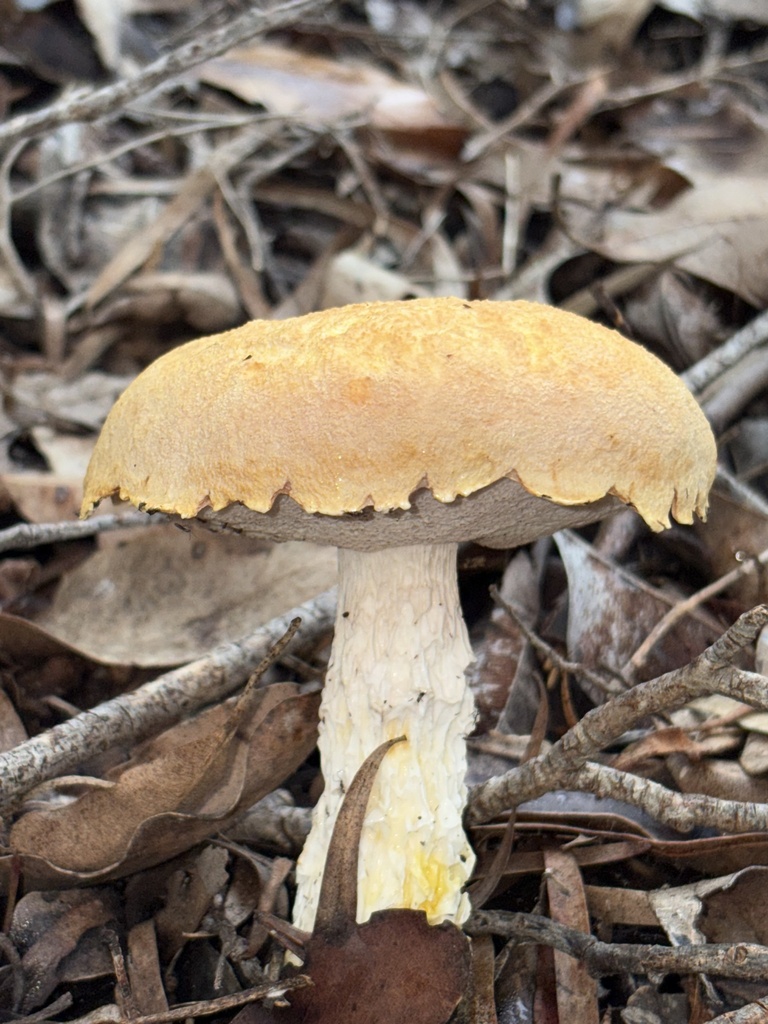
Austroboletus occidentalis
Austroboletus occidentalis, commonly known as the ridge-stemmed bolete, is a species of bolete fungus found in Australia. It was described as new to science in 1986 by mycologists Roy Watling and Norma M. Gregory. The species name occidentalis is derived from the Latin occidens "west"..
The fruit body has a 5.5–10 cm diameter cap that has a texture reminiscent of suede or chamois and can be sticky/slimy when young. Initially orange- or pinkish-brown, it is subconical with a thickened margin, and flattens with age and fades an ochre colour. Like other boletes, it has tubes under the cap instead of gills. These are white in young specimens maturing to pink. The cylindrical white stipe is 7–16 cm tall and 1.7–2.5 cm wide, marked with deep lacunae. The white flesh bruises yellowish and has a bitter taste. The edibility is unknown. The spore print is brown, the spores are cylindrical, 15–19 x 5–6.5 μm and covered entirely with warty lumps.
Where it lives
Recorded sightings
—
geo-referenced records in GBIF, from museums, herbaria and field observers.
Drag the globe to turn it. Dots are where records exist, not a range map; darker means more records.
In the stacks
Searching the stacks…
Every page naming Austroboletus occidentalis in the Biodiversity Heritage Library →
This page is assembled live from iNaturalist, GBIF, Wikipedia, the Source Library and the Internet Archive. It is not yet part of the hand-edited codex. iNaturalist taxon 550735.