- Fungi Including Lichens
- ›Basidiomycete Fungi
- ›Pucciniomycotina
- ›Pucciniomycetes
- ›rust fungi
- ›Uredinineae
- ›Sphaerophragmiaceae
- ›Austropuccinia
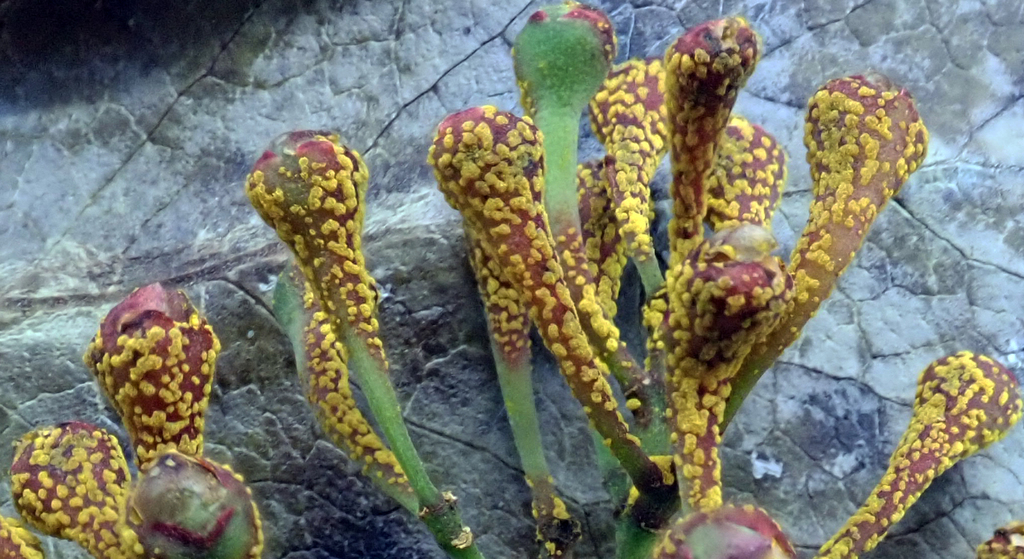
Myrtle Rust
Austropuccinia psidii
Austropuccinia is a monotypic genus of rust (a type of plant pathogen) native to South America with the only species Austropuccinia psidii, commonly known as myrtle rust, guava rust, or ʻōhiʻa rust. It affects plants in the family Myrtaceae. It is a member of the fungal complex called the guava rust (Puccinia psidii) group. The spores have a distinctive yellow to orange colour, occasionally encircled by a purple ring. They are found on lesions on new growth including shoots, leaves, buds and fruits. Leaves become twisted and may die. Infections in highly susceptible species may result in the death of the host plant.
As of late 2013, it is infecting around 179 species in New South Wales and Queensland, from 41 genera (around 46% of genera in the Myrtaceae) in Australia.
From the article Austropuccinia on Wikipedia (CC BY-SA), quoted section by section
What it does
Rust fungi typically have complex life cycles that include stages of sexual and asexual reproduction that occasionally occur on phylogenetically distinct host plants. Austropuccinia psidii's life cycle is quite controversial with one study showing that the rust is autoecious while another study finding it to be heteroecious but with an alternate host that has yet to be found. Looking at the fungus as a polycyclic pathogen, Stage I consists of aeciospores inoculating young leaf/shoot/fruit/flower bud. Once infected, aeciospores germinate and penetrate the host by creating a haustoria. Colonies and urediniosori forms after penetration. In Stage II, the production of urediniospores go back to inoculate young leaf/shoot/fruit/flower bud, important for secondary infection and contributing to the polycyclic nature of the pathogen. Stage II is also where urediniospores germinate, and penetration of the host occurs, resulting in the development of an uridiniosori. In Stage III, urediniospores germinate and the host is penetrated with the development of a haustoria. After penetration, colonies are formed and teliosori are developed. Teliosori produce teliospores which can further germinate. Once they're germinated, basidiospores are developed. In Stage IV, basidiospores are spread, inoculating young leaf/shoot/fruit/flower bud. …
Wikipedia: “Life cycle and disease cycle”
Where it lives
Recorded sightings
—
geo-referenced records in GBIF, from museums, herbaria and field observers.
Drag the globe to turn it. Dots are where records exist, not a range map; darker means more records.
In the stacks
Searching the stacks…
Every page naming Austropuccinia psidii in the Biodiversity Heritage Library →
This page is assembled live from iNaturalist, GBIF, Wikipedia, the Source Library and the Internet Archive. It is not yet part of the hand-edited codex. iNaturalist taxon 549208.