- Fungi Including Lichens
- ›Basidiomycete Fungi
- ›Higher Basidiomycetes
- ›Mushrooms, Bracket Fungi, Puffballs, and Allies
- ›Agaricomycetidae
- ›Common Gilled Mushrooms and Allies
- ›Hygrophorineae
- ›Waxcaps and Allies
- ›Hygrocyboideae
- ›Hygrocybeae
- ›Hygrocybe
- ›Hygrocybe
- ›Chlorophanae
- ›Hygrocybe flavescens
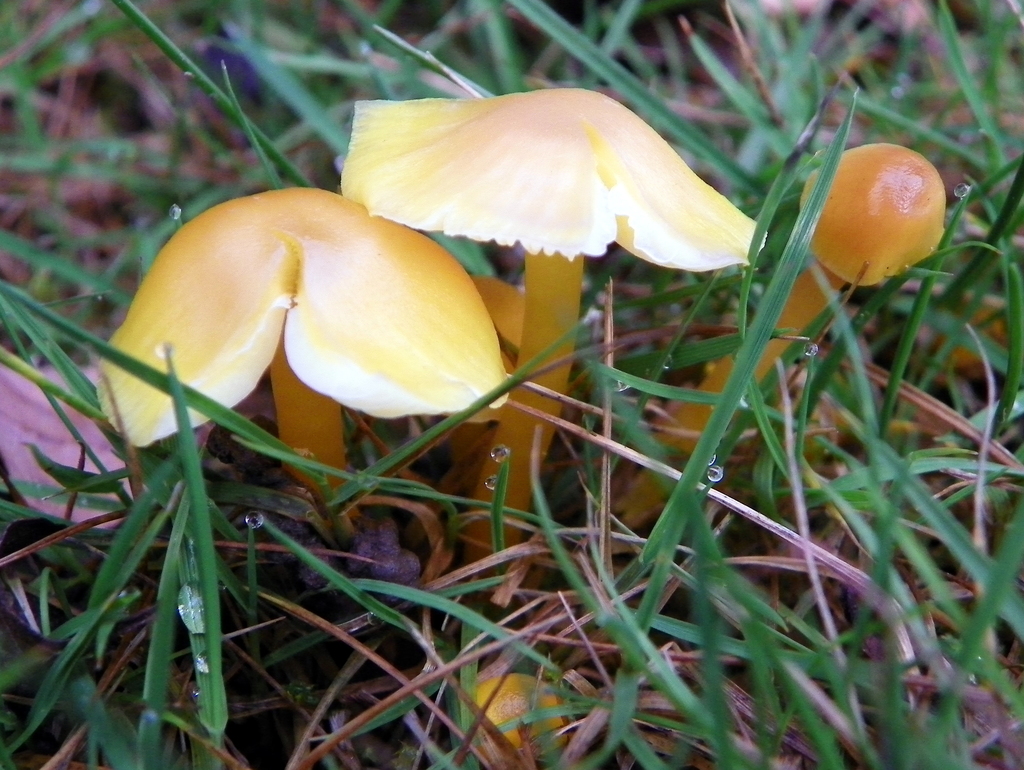
Golden Waxcap
Hygrocybe chlorophana
Hygrocybe chlorophana is a species of agaric (gilled mushroom) in the family Hygrophoraceae. It has been given the recommended English name of golden waxcap in the UK. The species has a largely north temperate distribution, occurring in grassland in Europe and in woodland in North America and northern Asia; it has also been reported from mountainous areas of southern Australia. It typically produces basidiocarps (fruit bodies) in the autumn. In a few European countries, H. chlorophana is of conservation concern, appearing on national red lists of threatened fungi.
From the article Hygrocybe chlorophana on Wikipedia (CC BY-SA), quoted section by section
Description
Basidiocarps are agaricoid, up to 10 cm (4 in) tall, the cap convex at first (never conical), becoming flat when expanded, up to 7.5 cm (3 in) across. The cap surface is smooth, distinctly viscid when damp, bright lemon-yellow to orange-yellow (rarely orange to red). The lamellae (gills) are waxy, pale cap-coloured, and adnexed (narrowly attached to the stipe). The stipe (stem) is smooth, cylindrical or compressed and grooved, cap-coloured, and moist to somewhat viscid when damp. The spore print is white, the spores (under a microscope) smooth, inamyloid, ellipsoid, about 7.5 to 9.0 by 4.0 to 5.5 μm.
Similar species. The North American Hygrocybe flavescens is very similar in appearance, but is said to have a drier stipe. Boertmann (2010) has suggested it may not be distinct from H. chlorophana. Hygrocybe glutinipes is similarly coloured, but is typically smaller with a glutinous, semi-translucent cap and an equally glutinous stipe. Hygrocybe ceracea is also similarly coloured, but has a waxy (not viscid) cap and stipe and broadly attached, almost decurrent gills.
Range & habitat
The golden waxcap is widespread throughout the north temperate zone, occurring in Europe, North America, and northern Asia; it has also been collected from the alpine areas of Mount Wellington in Tasmania, Australia. Like other waxcaps, it grows in old, unimproved, short-sward grassland (pastures and lawns) in Europe, but in woodland in North America and Asia. Recent research suggests waxcaps are neither mycorrhizal nor saprotrophic but may be associated with mosses.
Wikipedia: “Distribution and habitat”
In human culture
In 1997, the species was featured on a postage stamp issued by the Faeroe Islands.
Wikipedia: “Culture”
Where it lives
Recorded sightings
—
geo-referenced records in GBIF, from museums, herbaria and field observers.
Drag the globe to turn it. Dots are where records exist, not a range map; darker means more records.
In the stacks
Searching the stacks…
Every page naming Hygrocybe chlorophana in the Biodiversity Heritage Library →
This page is assembled live from iNaturalist, GBIF, Wikipedia, the Source Library and the Internet Archive. It is not yet part of the hand-edited codex. iNaturalist taxon 53474.