- Fungi Including Lichens
- ›Ascomycete Fungi
- ›Sac Fungi and Lichens
- ›Common Lichens
- ›Shield Lichens, Sunburst Lichens, Rosette Lichens, and Allies
- ›Peltigerales
- ›Vahliellaceae
- ›Vahliella
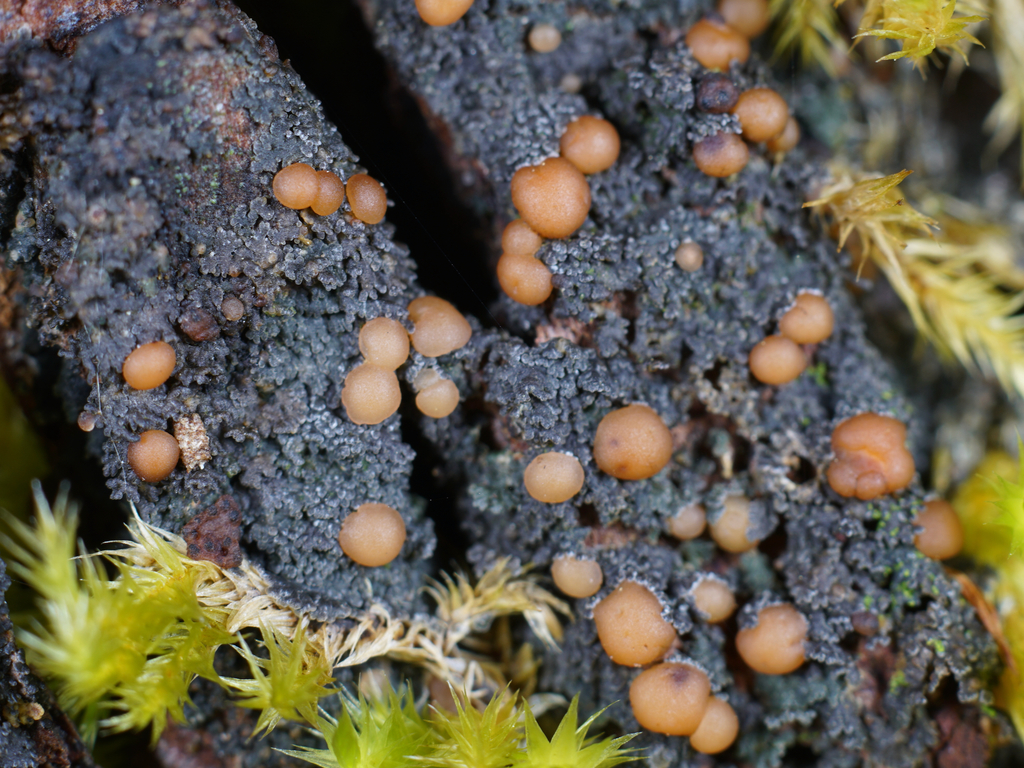
Pink-eyed Shingle Lichen
Vahliella saubinetii
Vahliella saubinetii is a species of squamulose lichen in the family Vahliellaceae.
From the article Vahliella saubinetii on Wikipedia (CC BY-SA), quoted section by section
Description
Vahliella saubinetii forms a thin crust made up of tiny, scale-like lobes (squamules) that are bluish grey to grey-brown and lack any frost-like surface bloom (epruinose). The squamules have finely scalloped margins and are usually 0.2–0.3 mm across, though they occasionally reach 0.5 mm or shrink to as little as 0.1 mm. Internally, the thallus is heteromerous (built in distinct layers): a brickwork-like upper cortex(paraplectenchyma), a loose white medulla that grades into anchoring hyphae (rhizohyphae), and no lower cortex. The photosynthetic partner (photobiont) is a cyanobacterium of the genus Nostoc, with cells clustered in packets. Sexual fruiting bodies (apothecia) are common, 0.3–1.2 mm wide, and sit directly on the thallus surface (sessile). The disc is flat to slightly convex and pale brown-orange to pink-brown, bordered by a paler, persistent rim of fungal tissue (a thin proper margin). Microscopically, the surface film over the disc (epithecium) is brownish, while the spore-bearing layer (hymenium) is colourless to pale yellow-brown and stains blue with iodine (I+). The simple paraphyses (sterile filaments among the spore sacs) are about 2 μm thick and broaden to club-shaped tips. Beneath the hymenium, the supporting tissue (hypothecium) is colourless. The asci (spore sacs) are club-shaped to nearly cylindrical, each containing eight ascospores. …
Where it lives
Recorded sightings
—
geo-referenced records in GBIF, from museums, herbaria and field observers.
Drag the globe to turn it. Dots are where records exist, not a range map; darker means more records.
In the stacks
Searching the stacks…
Every page naming Vahliella saubinetii in the Biodiversity Heritage Library →
This page is assembled live from iNaturalist, GBIF, Wikipedia, the Source Library and the Internet Archive. It is not yet part of the hand-edited codex. iNaturalist taxon 532458.