- Fungi Including Lichens
- ›Ascomycete Fungi
- ›Sac Fungi and Lichens
- ›Common Lichens
- ›Shield Lichens, Sunburst Lichens, Rosette Lichens, and Allies
- ›Peltigerales
- ›Collemataceae
- ›Scytinium
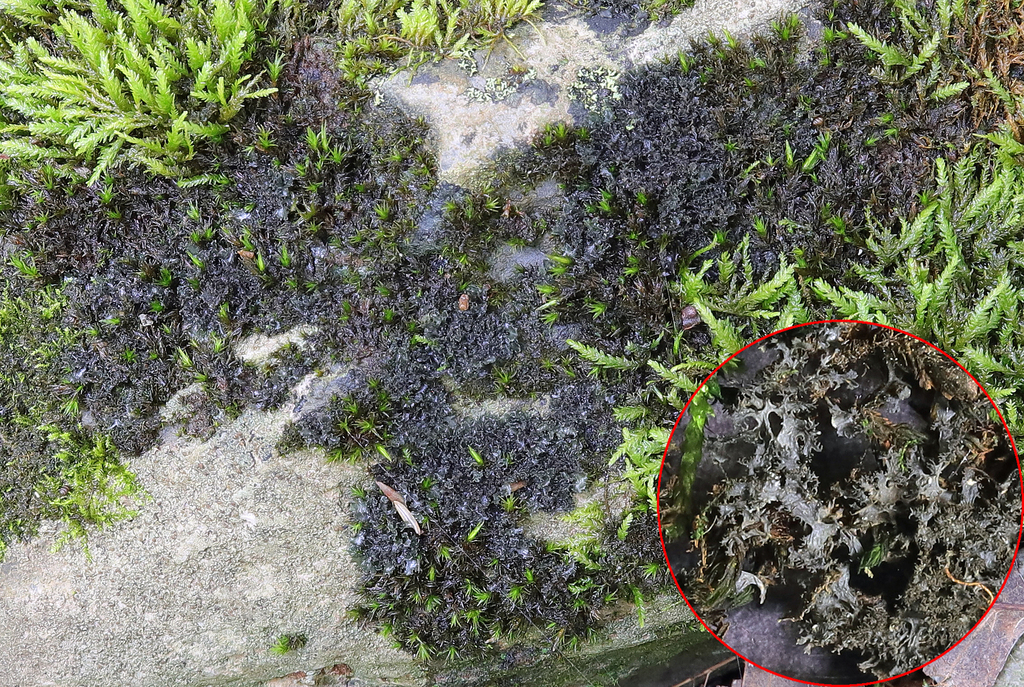
Tattered Jellyskin Lichen
Scytinium lichenoides
Scytinium lichenoides, the tattered jellyskin, is a species of lichen in the family Collemataceae. Originally described by Carl Linnaeus in 1753 as Tremella lichenoides, the species has undergone several taxonomic revisions and was transferred to the genus Scytinium in 2013 following molecular phylogenetics studies. It is characterised by its distinctive fringed appearance, with lobe margins bearing numerous small cylindrical outgrowths that give the lichen a tattered look. The species shows a preference for base-rich substrates and typically grows among moss cushions on rock or thin soil over rock in moist conditions.
From the article Scytinium lichenoides on Wikipedia (CC BY-SA), quoted section by section
Description
Scytinium lichenoides is a jelly lichen with lobes that often look fringed: the lobe margins, and sometimes their surfaces, bear many small cylindrical outgrowths that resemble isidia (minute, finger-like vegetative propagules). These may be simple or branched and can be so dense that the edges appear fibrillose. The upper surface is smooth to wrinkled, sometimes with a few ridges, and typically shiny. The lower surface is usually conspicuously ridged, often with vertically oriented ribs, and may become slightly cobwebby near the base. In section, the thallus shows a distinct cortex of angular cells over a medulla of intertwined fungal hyphae. Fruiting bodies (apothecia) are uncommon and tiny, about 0.3–1 mm across, with a thalline margin that also bears isidia. The ascospores are muriform (divided by internal septa into a brick-like pattern) and typically measure 33–45 μm long (occasionally 26–50 μm) by 12–15 μm wide, usually with around seven transverse septa (range five to nine).
Range & habitat
Scytinium lichenoides typically grows among moss cushions on rock or thin soil over rock, and will also occur on the lower parts of tree trunks in persistently moist climates. Field floras consistently note a preference for base-rich substrates: it is commonly found on mossy calcareous rock in northern Canada, intermixed with moss on outcrops and scree in the Pacific Northwest, and among mosses over rocks in montane forests of the Sonoran Desert region. The species is widespread across the Holarctic, from Arctic and boreal regions of North America through temperate zones extending south to Arizona and Baja California, and is well documented throughout Europe. It occurs from montane to subalpine elevations and is well recorded within the British Isles.
Wikipedia: “Habitat and distribution”
Where it lives
Recorded sightings
—
geo-referenced records in GBIF, from museums, herbaria and field observers.
Drag the globe to turn it. Dots are where records exist, not a range map; darker means more records.
In the stacks
Searching the stacks…
Every page naming Scytinium lichenoides in the Biodiversity Heritage Library →
This page is assembled live from iNaturalist, GBIF, Wikipedia, the Source Library and the Internet Archive. It is not yet part of the hand-edited codex. iNaturalist taxon 526717.