- Fungi Including Lichens
- ›Basidiomycete Fungi
- ›Higher Basidiomycetes
- ›Mushrooms, Bracket Fungi, Puffballs, and Allies
- ›Agaricomycetidae
- ›Common Gilled Mushrooms and Allies
- ›Agaricineae
- ›Hymenogastraceae
- ›Psilocybe
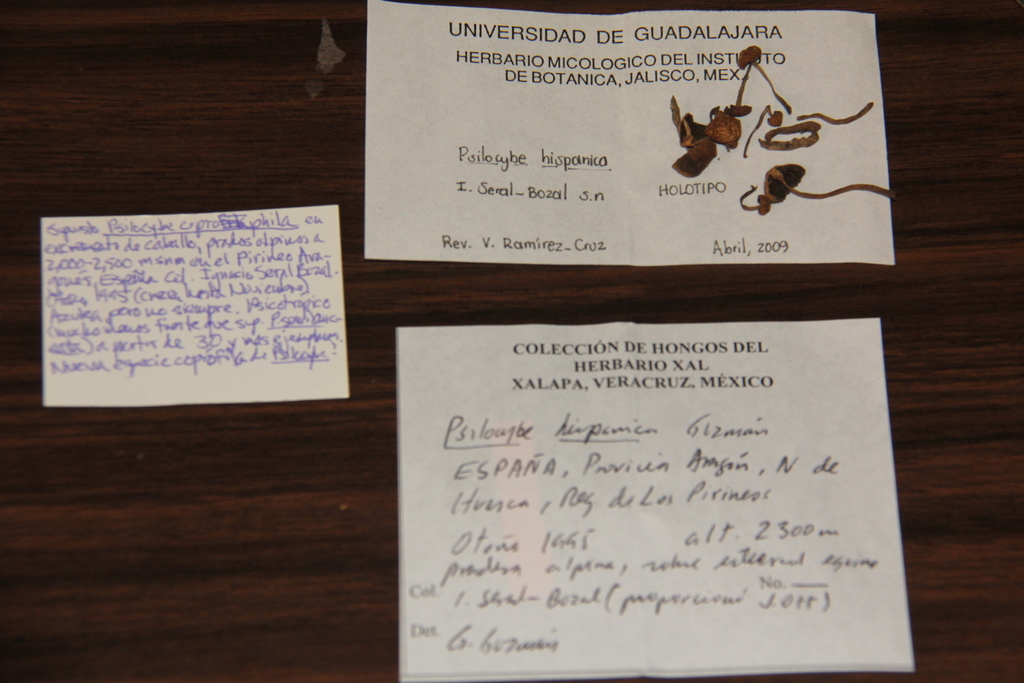
Psilocybe hispanica
Psilocybe hispanica is a species of fungus in the family Hymenogastraceae. It produces small brown mushrooms with conical to convex caps up to 10 mm (0.4 in) in diameter and stems 16 to 25 mm (0.6 to 1.0 in) long by 0.5 to 1 mm (0.02 to 0.04 in) thick. Reported as new to science in 2000, it is only known from the Pyrenees mountain range in northern Spain and southwestern France, where it grows on horse dung in grass fields at elevations of 1,700 to 2,300 m (5,600 to 7,500 ft). The mushroom contains the psychoactive compound psilocybin. The possible depiction of this species in the 6,000-year-old Selva Pascuala rock art suggests that it might have been used in ancient religious rituals—the oldest evidence of such usage in prehistoric Europe.
From the article Psilocybe hispanica on Wikipedia (CC BY-SA), quoted section by section
Description
The cap ranges in shape from somewhat conical to convex, and reaches diameters of 5 to 10 millimetres (0.2 to 0.4 in). Its surface is smooth, somewhat sticky to dry, and brown to brownish-yellow. The gills are somewhat adnate, and brown-violaceous with whitish edges. The stem is 16 to 25 mm (0.6 to 1.0 in) long by 0.5 to 1 mm (0.02 to 0.04 in) thick, cylindrical, and slightly bulbous at the base. It is whitish-yellow, with vinaceous or blue-green to blackish tones towards the base. Mature specimens do not have a veil on the stem. The flesh is whitish, but like most psilocybin-containing species, stains blue when injured. The spores are ellipsoid and measure 12–14.5 by 6.5–8 μm. They have a brownish-yellow wall greater than 1 μm thick and a broad apical germ pore with a short hilar appendix at the base (a region where the spore was once attached to the sterigma). The basidia (spore-bearing cells in the hymenium) are four-spored, hyaline (translucent), and measure 32–44 by 8–12 μm. The cap cuticle is made of a layer 130–150 μm thick, with hyaline, thin-walled gelatinized hyphae measuring 1.5–4 μm broad. The hypodermium (the tissue layer directly under the pileipellis) is made of thin-walled, hyaline hyphae, 2.5–8 μm broad, with a brownish incrusting pigment. Clamp connections are present in the hyphae.
Similar species. Psilocybe semilanceata is roughly similar in appearance to P. …
Range & habitat
Psilocybe hispanica is a coprophilous fungus (dung-loving), and produces fruit bodies that grow solitarily or in dense groups on horse dung; sometimes more than 25 fruit bodies can arise from the same dung. In Guzmán's original report, they were found in a Pyrenean meadow in Aragon, at an elevation of 2,300 metres (7,500 ft). In 2003, the species was reported from Tramacastillo de Tena, a small village in the Pyrenees; it was also reported to have "penetrated the French part of the Pyrenees". Within its restricted range, the mushroom is "very common" at altitudes of 1,700 to 2,300 m (5,600 to 7,500 ft).
Wikipedia: “Habitat and distribution”
At the table
The mushroom is consumed recreationally by Spanish youths for its mind-altering effects; other mushrooms used recreationally in Spain include P. semilanceata and P. gallaeciae. Guzmán and Castro report that a 17th-century medallion found in Tena Valley in the southern Pyrenees had images of a devil and mushrooms carved on it. The mushrooms—possibly either P. semilanceata or P. hispanica, according to Guzmán and Castro—were used in witchcraft, a common practice in the valley during the Middle Ages. It has been argued that prehistoric rock art at a site known as Selva Pascuala near the Spanish town of Villar del Humo offers evidence that P. hispanica was used in religious rituals 6,000 years ago. The rock shelter at Selva Pascuala was discovered in the early 20th century; in the early 21st century it was noticed that objects in one of the murals, which previously had been described as "mushrooms", matched the general morphology of P. hispanica: the mural depicts a row of 13 mushroom-like objects with convex to conical caps, and ringless stems that vary from straight to sinuous (wavy). Additionally, the mural shows a bull, which suggests an association with the coprophilic P. hispanica. Although the hallucinogenic species P. …
Wikipedia: “Uses”
Where it lives
Recorded sightings
—
geo-referenced records in GBIF, from museums, herbaria and field observers.
Drag the globe to turn it. Dots are where records exist, not a range map; darker means more records.
In the stacks
Searching the stacks…
Every page naming Psilocybe hispanica in the Biodiversity Heritage Library →
This page is assembled live from iNaturalist, GBIF, Wikipedia, the Source Library and the Internet Archive. It is not yet part of the hand-edited codex. iNaturalist taxon 519040.