- Fungi Including Lichens
- ›Basidiomycete Fungi
- ›Higher Basidiomycetes
- ›Mushrooms, Bracket Fungi, Puffballs, and Allies
- ›Agaricomycetidae
- ›Common Gilled Mushrooms and Allies
- ›Agaricineae
- ›Hymenogastraceae
- ›Psilocybe
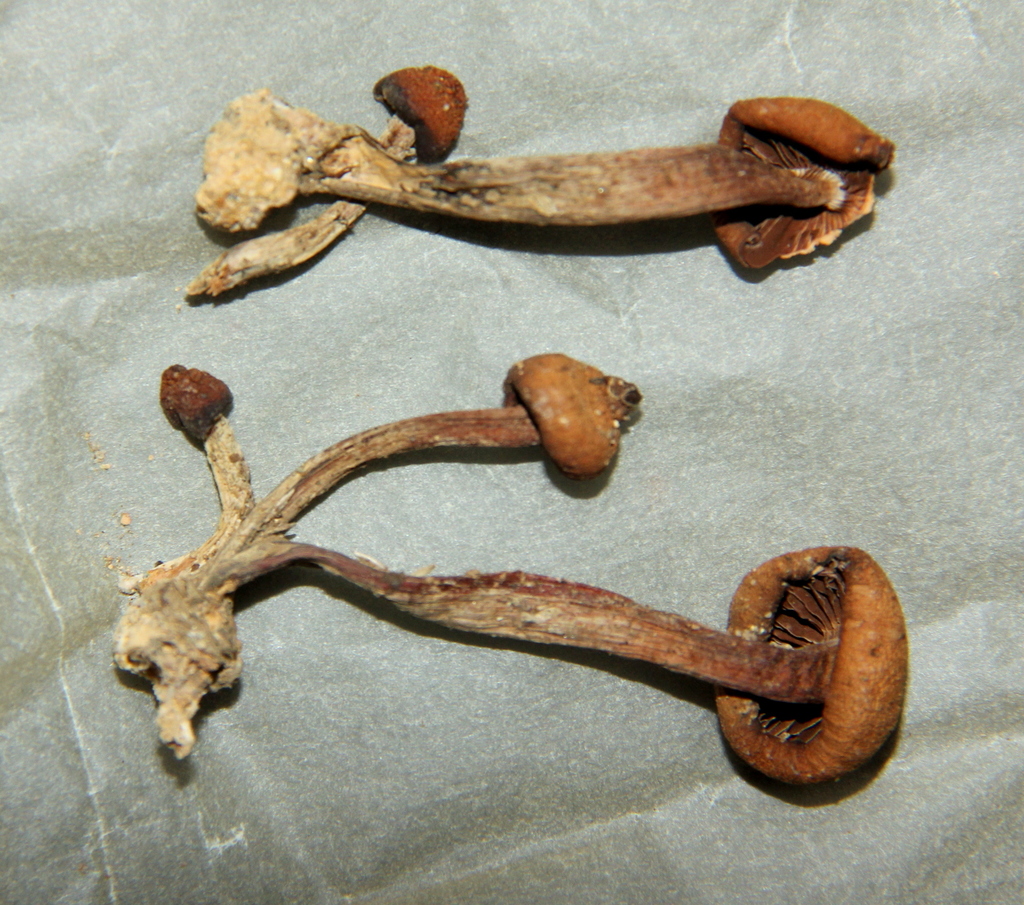
Psilocybe subcaerulipes
Psilocybe subcaerulipes (commonly known as hikageshibiretake in Japanese (kanji : 日陰痺茸, katakana : ヒカゲシビレタケ)) is a species of fungus in the family Hymenogastraceae. It is in the section Zapotecorum of the genus Psilocybe, other members of this section include Psilocybe muliercula, Psilocybe angustipleurocystidiata, Psilocybe aucklandii, Psilocybe collybioides, Psilocybe kumaenorum, Psilocybe zapotecorum, Psilocybe pintonii, Psilocybe graveolens, Psilocybe moseri, Psilocybe zapotecoantillarum, Psilocybe zapotecocaribaea, and Psilocybe antioquiensis. It occurs in east and southeast Asia. Fruit bodies grow on the ground in woody debris, and typically stand 6 to 8 cm (2.4 to 3.1 in) tall with caps that are 2.5 to 5 cm (1.0 to 2.0 in) in diameter. They are chestnut brown (or lighter brown if dry), and stain blue if bruised or handled. The species is a psychoactive mushroom, and contains the hallucinogenic compounds psilocybin and psilocin. There have been reports of poisoning caused by the accidental consumption of this mushroom. It has been used in research, specifically, to test the effects of its consumption of marble-burying in mice, an animal model of obsessive-compulsive disorder.
From the article Psilocybe subcaerulipes on Wikipedia (CC BY-SA), quoted section by section
Description
The fruit bodies of Psilocybe subcaerulipes have caps that are 2.5 to 6 cm (1.0 to 2.4 in) in diameter, initially conic or bell-shaped but expanding to become convex, then finally somewhat flattened in maturity. A well-defined umbo (a rounded elevation resembling a nipple) is typically present. The cap color is chestnut brown when wet, but the species is hygrophanous, and when dried, changes color to become a lighter shade of brown. As is characteristic of psilocybin-containing species, P. subcaerulipes stains blue where it has been bruised or injured. The cap margins of young specimens are usually curved inwards, and have irregular, wavy edges; young specimens may also have fragments of the partial veil hanging off the margin. The whitish partial veil is similar to those of the genus Cortinarius—cobwebby, and made of silky fibrils. When the cap expands and the veil rips, the fibrils remains briefly as an annular zone on the stem, before fading into nothing. The gills have an adnate or adnexed attachment to the stem, which later becomes seceding (pulled away from the stem). The gills are a grayish-orange color initially, later turning purple-brown with whitish edges. The stem is 6 to 8 cm (2.4 to 3.1 in) long and 0.2 to 0.4 cm (0.1 to 0.2 in) thick, and has roughly the same width throughout its length, except for a widening at the base due to the whitish rhizomorphs present. …
Range & habitat
This species grows in groups, or clustered together on the ground on soil that is rich in woody debris. It has been noted to grow near the tree species Cryptomeria japonica (known locally as Sugi),Taiwania, Quercus glauca (Japanese Blue Oak), and Pinus taeda (Loblolly Pine). It has been found in Japan (specifically, in Kyoto, Osaka, Shiga, Saitama, Niigata, and Miyagi), Jeju Province in South Korea, Taiwan and Thailand.
Wikipedia: “Habitat and distribution”
In human culture
The species was first described in 1958 by Japanese mycologist Tsuguo Hongo. It is known as Hikageshibiretake ("shadow numbness mushroom") in Japanese.
Wikipedia: “History”
Where it lives
Recorded sightings
—
geo-referenced records in GBIF, from museums, herbaria and field observers.
Drag the globe to turn it. Dots are where records exist, not a range map; darker means more records.
In the stacks
Searching the stacks…
Every page naming Psilocybe subcaerulipes in the Biodiversity Heritage Library →
This page is assembled live from iNaturalist, GBIF, Wikipedia, the Source Library and the Internet Archive. It is not yet part of the hand-edited codex. iNaturalist taxon 518764.