- Fungi Including Lichens
- ›Basidiomycete Fungi
- ›Higher Basidiomycetes
- ›Mushrooms, Bracket Fungi, Puffballs, and Allies
- ›Russulales
- ›Milkcaps, Brittlegills and Allies
- ›Russula
- ›Tenellae
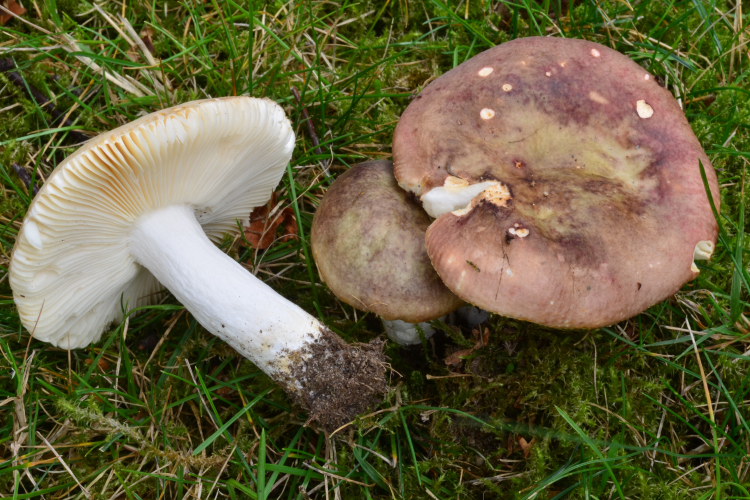
variable brittlegill
Russula versicolor
Russula versicolor, commonly known as the birch brittlegill, is a mushroom in the genus Russula. It is considered inedible.
From the article Russula versicolor on Wikipedia (CC BY-SA), quoted section by section
Description
The cap of Russula versicolor is variable in color, ranging from purplish to greenish to whitish. It can sometimes be a mix of different colors. It is convex to depressed and is about 2–6 centimetres (0.79–2.36 in) in diameter. The gills are adnate to free, and cream-colored. The stipe is white to yellowish, and about 2–5 centimetres (0.79–1.97 in) long and 0.5–1.5 centimetres (0.20–0.59 in) wide. The spore print is creamy to yellowish in color, and the taste is acrid.
Range & habitat
Russula versicolor is often found under planted birch trees in parks. It fruits during late summer and fall. It is known to occur in Europe and the Pacific Northwest. However, genetic studies show that the Pacific Northwestern version may be a distinct species.
Wikipedia: “Distribution and habitat”
Where it lives
Recorded sightings
—
geo-referenced records in GBIF, from museums, herbaria and field observers.
Drag the globe to turn it. Dots are where records exist, not a range map; darker means more records.
In the stacks
Searching the stacks…
Every page naming Russula versicolor in the Biodiversity Heritage Library →
This page is assembled live from iNaturalist, GBIF, Wikipedia, the Source Library and the Internet Archive. It is not yet part of the hand-edited codex. iNaturalist taxon 499741.