- Fungi Including Lichens
- ›Basidiomycete Fungi
- ›Higher Basidiomycetes
- ›Mushrooms, Bracket Fungi, Puffballs, and Allies
- ›Agaricomycetidae
- ›Common Gilled Mushrooms and Allies
- ›Marasmiineae
- ›Porotheleaceae
- ›Scytinotus
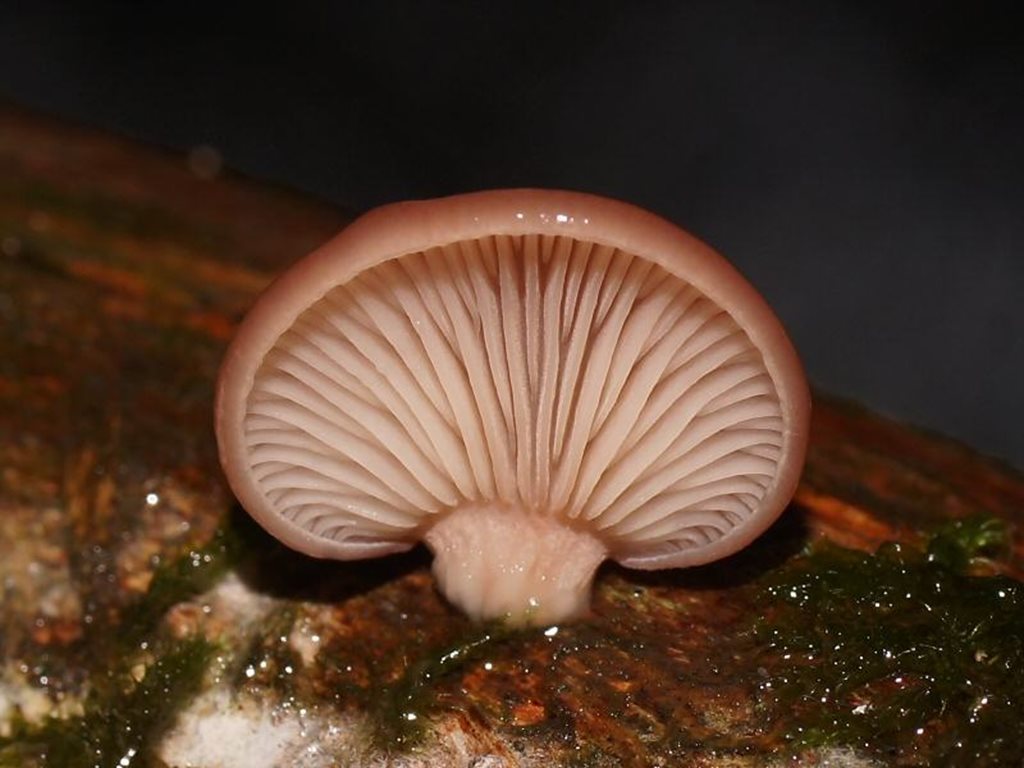
Rosy Oysterling
Scytinotus longinquus
Scytinotus longinquus is a saprotrophic fungus in the family Porotheleaceae, known for its delicate, pink to grey fruiting bodies. It grows on decaying wood in temperate forests and is distributed across the Southern Hemisphere and parts of North America.
From the article Panellus longinquus on Wikipedia (CC BY-SA), quoted section by section
Description
The fruiting bodies of Panellus longinquus are small and delicate, with caps ranging from 30–50 mm (1.2–2.0 inches) in width. The coloration varies from grey to pink as the mushroom ages. Its gelatinous texture suggests an adaptation to moist environments, which are characteristic of its native habitats. The stipe is short and stout, with a velvety to fibrillose surface. The pileus is cream to pale orange-brown, typically growing on the underside of decaying logs. The gills are decurrent, translucent, and widely spaced. Spores are white, smooth, and amyloid, measuring approximately 6.5–9.4 × 3.3–4.5 μm. The spore print is dingy yellowish-cream.
Range & habitat
Panellus longinquus is found in temperate forests, growing on decaying wood. It has been recorded in New Zealand, Australia, Chile, Argentina, and parts of North America including British Columbia and Minnesota. In New Zealand, it is considered indigenous but not endemic.
Wikipedia: “Habitat and distribution”
What it does
As a saprotrophic fungus, Panellus longinquus plays a role in decomposing dead wood, contributing to nutrient cycling in forest ecosystems.
== References ==
Wikipedia: “Ecology”
Where it lives
Recorded sightings
—
geo-referenced records in GBIF, from museums, herbaria and field observers.
Drag the globe to turn it. Dots are where records exist, not a range map; darker means more records.
In the stacks
Searching the stacks…
Every page naming Scytinotus longinquus in the Biodiversity Heritage Library →
This page is assembled live from iNaturalist, GBIF, Wikipedia, the Source Library and the Internet Archive. It is not yet part of the hand-edited codex. iNaturalist taxon 498511.