- Fungi Including Lichens
- ›Basidiomycete Fungi
- ›Higher Basidiomycetes
- ›Mushrooms, Bracket Fungi, Puffballs, and Allies
- ›Shelf Fungi
- ›Bracket Polypores
- ›Fomitopsis
- ›Fomitopsis pinicola
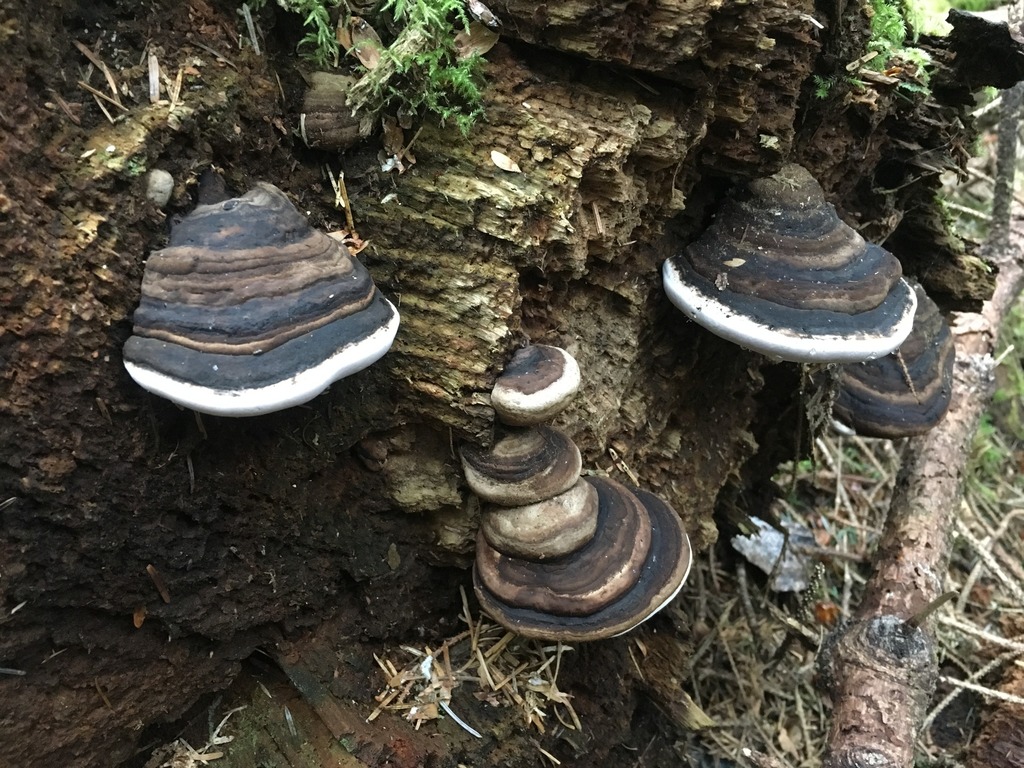
Ochre-banded Conk
Fomitopsis ochracea
Fomitopsis ochracea is a polypore fungus found in North America. It was isolated from Albertan forests, and can be found in British Columbia. It has been isolated as far East as Newfoundland, but prefers Northern climates. It can be isolated throughout the Appalachian range, as far down as Georgia. It is a detritivore on both hardwood trees and conifers, causing a brown cubical rot. It is a member of the genus Fomitopsis, a common group of perennial fungi.
From the article Fomitopsis ochracea on Wikipedia (CC BY-SA), quoted section by section
Description
Fomitopsis ochracea is a fungus that may be shaped like a hoof or flattened in a fan-like manner. It can grow quite large, up to 20 cm in width and 7 cm thick. The top surface of the fungus is smooth and may be coloured white, grey, brown, or black, with parallel lines. It can have black or brown spotting on the surface. The underside is a creamy-white, with even, round pores. It can also become orange with age. If broken open, the context will be woody with a creamy-white colour and no bands. There is no visible bruising upon breaking open the body. There are about 5-6 pores present per millimetre. It can have a faint sweet odour. Historically, this fungus has been misidentified as F. pinicola. When both species are immature, they can look very similar, but can be distinguished by lighting a match next to the surface of the fungus. F. pinicola will boil and melt in heat, while F. ochracea will not. If this test is not available, a simple bruise test can distinguish the two. F. pinicola will bruise a yellow colour when broken open, while F. ochracea will not bruise at all.
== References ==
Where it lives
Recorded sightings
—
geo-referenced records in GBIF, from museums, herbaria and field observers.
Drag the globe to turn it. Dots are where records exist, not a range map; darker means more records.
In the stacks
Searching the stacks…
Every page naming Fomitopsis ochracea in the Biodiversity Heritage Library →
This page is assembled live from iNaturalist, GBIF, Wikipedia, the Source Library and the Internet Archive. It is not yet part of the hand-edited codex. iNaturalist taxon 495903.