- Fungi Including Lichens
- ›Ascomycete Fungi
- ›Sac Fungi and Lichens
- ›Common Lichens
- ›Shield Lichens, Sunburst Lichens, Rosette Lichens, and Allies
- ›shield lichens, rim lichens, and allies
- ›bushy lichens, sea-fog lichens, and allies
- ›Ramalina
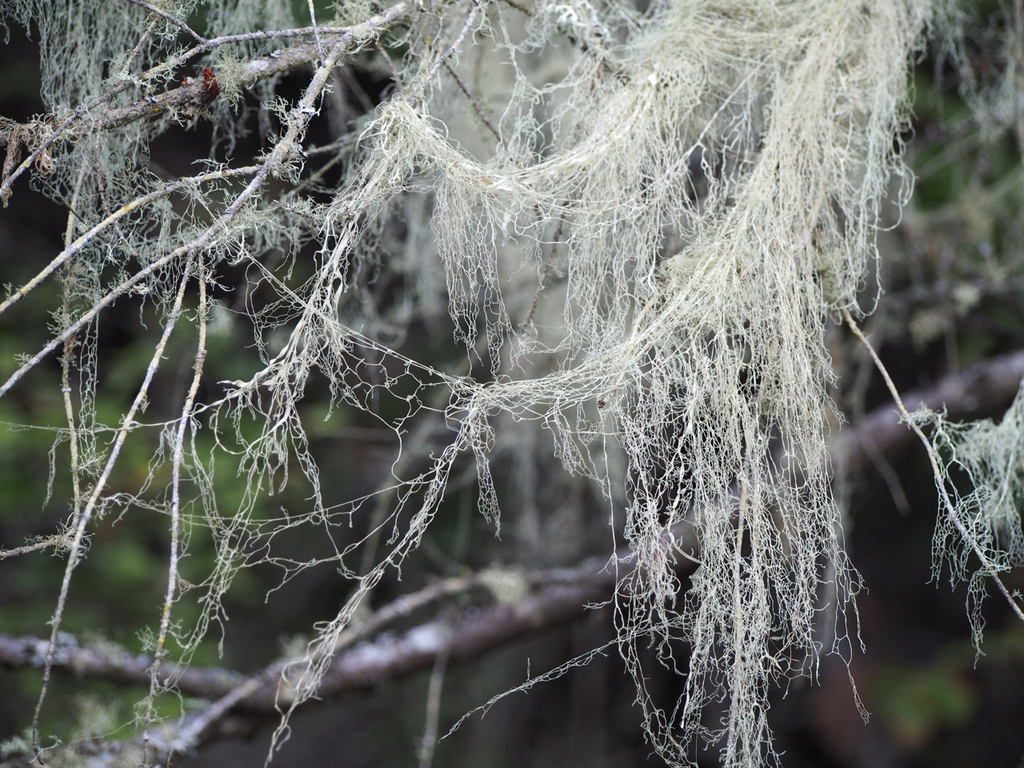
lace lichen
Ramalina menziesii
Ramalina menziesii, the lace lichen or fishnet, is a pale yellowish-green to grayish-green fruticose lichen. It grows up to a meter long, hanging from bark and twigs in a distinctive net-like or lace-like pattern that is unlike any other lichen in North America. It becomes a deeper green when wet. Apothecia are lecanorine. Lace lichen is an important food source for deer in the Coast Range of California, and a source of nest material for birds. It is highly variable in its growth form, with branches sometimes so slender as to appear like strands, sometimes tiny, and sometimes large with broadly flattened branches.
After years of effort, the California Lichen Society was able to convince the state legislature to recognize the lichen as the state lichen of California, the first lichen so honored.
From the article Ramalina menziesii on Wikipedia (CC BY-SA), quoted section by section
Description
Ramalina menziesii is a fruticose epiphytic lichen found on coastal regions of North America that produce a large and conspicuous thallus. Expansion of its perforated tissue from the thallus apex produces its net-like morphology. This morphology ranges from thick nets in sunny regions to thin filaments in foggy regions. Studies have suggested that this morphological variation is a result of both genetic differences between populations, as well as phenotypic plasticity within the species. Lichen spot tests on the cortex are K−, C−, P− and KC+ (dark yellow).
Range & habitat
Ramalina menziesii is found from the Baja California of Mexico to the temperate rainforests of Alaska, with six distinct ecoregions. Throughout their distribution, the occupied habitat differs in relation to the distance from the coast. In Baja California, lace lichen is most common on shrubs in the coastal fog deserts and on cacti, shrubs and trees in the inland chaparral habitats. In coastal California, lace lichen is found in habitats dominated by coastal live oak, tan oak, California laurel, red alder, and willow. In the Californian inland, the habitats are dominated by oak savannas of valley oak, blue oak, and coastal live oak. The northern and southern Californian habitats are geographically separated from the coastal range. As you move towards the Pacific Northwest, lace lichen is found in temperate mixed coniferous forests of Sitka spruce, western hemlock, and some broad-leafed species. Moving inland in their northern distribution, lace lichen quickly disappear. The range of the lichen continues north along the Pacific Coast of British Columbia, extending to Alaska. In the deciduous blue oak (Quercus douglasii) woodlands of central coastal California, Ramalina menziesii has an important role in the annual turnover of biomass. …
Wikipedia: “Distribution and habitat”
At the table
Ramalina menziesii was first documented for its use by indigenous tribes of California. The Kawaiisu people reportedly used it for its magical properties. It would be placed in water to bring rain or placed in fire to repel thunder or lightning. The Kashaya Pomo people in Northern California used it as a sanitary material.
Wikipedia: “Historical uses”
Where it lives
Recorded sightings
—
geo-referenced records in GBIF, from museums, herbaria and field observers.
Drag the globe to turn it. Dots are where records exist, not a range map; darker means more records.
In the stacks
Searching the stacks…
Every page naming Ramalina menziesii in the Biodiversity Heritage Library →
This page is assembled live from iNaturalist, GBIF, Wikipedia, the Source Library and the Internet Archive. It is not yet part of the hand-edited codex. iNaturalist taxon 49578.