- Fungi Including Lichens
- ›Ascomycete Fungi
- ›Sac Fungi and Lichens
- ›Operculate Ascomycetes
- ›Pezizales
- ›Pyronemataceae
- ›Scutellinia
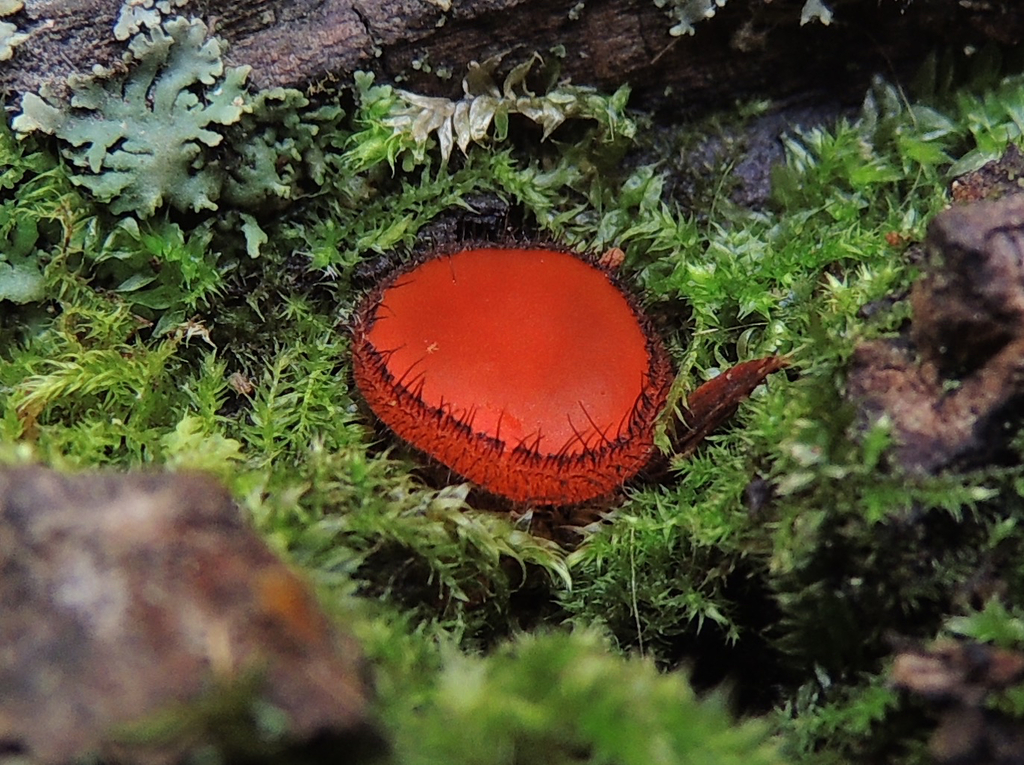
Common Eyelash
Scutellinia scutellata
Scutellinia scutellata, commonly known as the eyelash pixie cup, eyelash cup, the Molly eye-winker, the scarlet elf cap, the eyelash fungus or the eyelash pixie cup, is a small saprophytic fungus in the family Pyronemataceae. It is the type species of Scutellinia, as well as being the most common and widespread. The fruiting bodies are small red cups with distinctive long, dark hairs or "eyelashes". These eyelashes are the most distinctive feature and are easily visible with a magnifying glass.
The species is common in North America and Europe, and has been recorded on every continent. It is found on rotting wood and in other damp habitats, typically growing in small groups, sometimes forming clusters. It is sometimes described as inedible, with its small size also rendering it of no culinary interest. Despite this, it is popular among mushroom hunters due to its unusual "eyelash" hairs, making it memorable and easy to identify.
From the article Scutellinia scutellata on Wikipedia (CC BY-SA), quoted section by section
Description
The fruiting body is a shallow disc shape, typically between 0.2 to 1 centimetre (1⁄8 to 3⁄8 inch) in diameter. The youngest specimens are almost entirely spherical; the cups open up and expand to a disc during maturity. The inner surface of the cup (the fertile spore-bearing surface, known as the hymenium) is bright orange-red, while the outer surface (the sterile surface) is pale brown. The flesh is red and thin. The outer surface is covered in dark coloured, stiff hairs, measuring up to 1 cm (3⁄8 in) in length. At the base, these hairs are up to 40 μm thick, and they taper towards the pointed apices. The hairs form distinctive "eyelashes" on the margin of the cup that are visible to the naked eye. or easily visible through a magnifying glass. S. scutellata is sessile; it does not have a stalk.
Microscopic features. Scutellinia scutellata has asci of approximately 300 μm by 25 μm in size and releases elliptical spores measuring 18 to 19 μm by 10 to 12 μm. The translucent (hyaline) ascospores have a rough exterior, (with very small warts) and contain small droplets of oil. They are white when present in large numbers, like a spore print. The paraphyses are cylindrical in shape and feature septa partitioning the hypha into distinct cells. …
Range & habitat
Scutellinia scutellata is common in both Europe, where it can be found from late spring to late autumn, and North America, where it fruits in winter and spring. It has also been collected in Cameroon, Colombia, East Asia, India, Iceland, Israel, New Guinea and the Solomon Islands, Russia, and Turkey. A saprobic species, it grows generally in subalpine regions, fruiting on rotten wood and damp soil, and can also sometimes be found on ashes, wet leaves or bracket fungi. In Alaska it has been found growing on humus in the tundra. A six-year study of the succession of fungal flora appearing on freshly cut stumps of poplar trees (Populus canadensis) showed that S. scutellata appeared roughly in the middle of the fungal succession (about 2–4 years after the tree had been cut), along with the species Ascocoryne sarcoides, Scutellinia cervorum, and Lasiosphaeria spermoides. When growing on wood, it is often obscured by surrounding moss. Though sometimes found alone, they typically fruit in groups, sometimes forming dense clusters on rotting wood or other plant detritus. Due to its small size, it is often overlooked, but mycologist Vera Evenson has observed that "the discovery of the Eyelash Cup is always a great pleasure", due to "the beauty of the eyelashes". Vera McKnight describes it as "a most attractive little fungus", and claims it is easy to notice due to its bright colouration.
Wikipedia: “Distribution and habitat”
At the table
While some list S. scutellata as inedible, others list it as having an unknown edibility. David Arora considers it too small to be of any culinary interest and it lacks a distinctive smell or taste.
Wikipedia: “Edibility”
Where it lives
Recorded sightings
—
geo-referenced records in GBIF, from museums, herbaria and field observers.
Drag the globe to turn it. Dots are where records exist, not a range map; darker means more records.
In the stacks
Searching the stacks…
Every page naming Scutellinia scutellata in the Biodiversity Heritage Library →
This page is assembled live from iNaturalist, GBIF, Wikipedia, the Source Library and the Internet Archive. It is not yet part of the hand-edited codex. iNaturalist taxon 49137.