- Fungi Including Lichens
- ›Basidiomycete Fungi
- ›Higher Basidiomycetes
- ›Mushrooms, Bracket Fungi, Puffballs, and Allies
- ›Agaricomycetidae
- ›Common Gilled Mushrooms and Allies
- ›Marasmiineae
- ›Porotheleaceae
- ›Atheniella
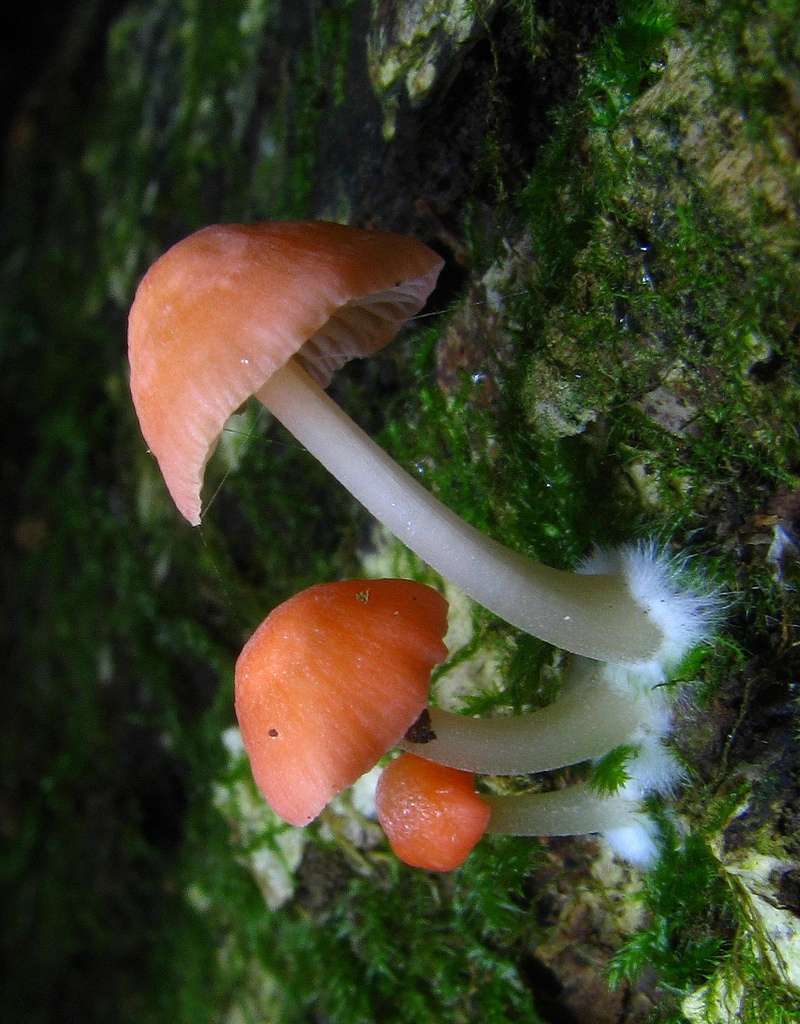
Scarlet Bonnet
Atheniella adonis
Atheniella is an agaric fungal genus that produces brightly colored (yellow, pink, orange, or red) mycenoid fruit bodies on small plant debris on forest floors, in fields and bogs. It is not a member of the Mycenaceae, and unlike most Mycenaceae, its basidiospores and tissues do not react with iodine. Atheniella species were most recently classified in Mycena because of their stature. However, they lack amyloid spores and tissues bewildering taxonomists, leading to temporary placements in...
From the article Atheniella adonis on Wikipedia (CC BY-SA), quoted section by section
Description
The cap initially has a sharply conic shape, but expands to a narrow bell-shape or a broad cone in maturity, typically reaching 0.5 to 1.2 cm (1⁄4 to 1⁄2 in) in diameter. It is scarlet red when young, becoming orange to yellowish. The cap margin, which is initially pressed against the stem, is opaque or nearly so at first. The mushroom is hygrophanous, and fades to an orange buff when dry. The flesh is thin, the same color as the cap, fragile, and without any distinctive taste or odor. The gills are ascending-adnate (attaching at much less than a right angle, appearing to curve upward toward stem) or attached by a tooth, subdistant to close, with 14–16 gills reaching the stem. Additionally, there are two or three tiers of lamellulae—short gills that do not extend fully from the cap edge to the stem. The gills are narrow, and yellowish or with a reddish tinge at first; the margins are paler and the same color as the faces. The stem is 2–4 cm (3⁄4–1+5⁄8 in) long and 1–2 mm (1⁄32–3⁄32 in) thick, and roughly equal in width throughout. It is tubular, fragile, initially pruinose (covered with a fine powder), polished and smooth with age, pale yellow, becoming whitish, with the base often dirty yellow or brownish.
Microscopic characteristics. The spores are narrowly ellipsoid, inamyloid, and measure 6–7 by 3–3.5 μm. …
Range & habitat
The fruit bodies of A. adonis grow solitarily or in groups in conifer forests and heaths, and appear in the spring and autumn. The fruit bodies grow in groups or scattered on needle beds under spruce and hemlock in wet coastal conifer forests, or in the higher mountains, where it is not uncommon in the spring and autumn months. The fungus is found in Europe and in western North America, where Mycena specialist Alexander H. Smith found the species in Washington, Oregon, and California. In 2007, it was reported from the valley of the Ussuri River in the northeast of China.
Wikipedia: “Habitat and distribution”
What it does
In one instance, fruit bodies were found growing on the deciduous trees Spanish Maple (Acer granatense) and willow (Salix alba) near Amsterdam. It was hypothesized that the bark of these trees had become more acidic in recent years because of increasing atmospheric pollution (specifically, increases in the levels of sulfuric and nitric acid from industrial smoke), providing a more suitable substrate for the fungus.
Wikipedia: “Ecology”
In human culture
The species epithet refers to the handsome youth Adonis in Greek mythology. Samuel Frederick Gray called it the "Adonis high-stool" in his 1821 Natural Arrangement of British Plants, while Mordecai Cubitt Cooke named it the "delicate Mycena".
Wikipedia: “Etymology”
Where it lives
Recorded sightings
—
geo-referenced records in GBIF, from museums, herbaria and field observers.
Drag the globe to turn it. Dots are where records exist, not a range map; darker means more records.
In the stacks
Searching the stacks…
Every page naming Atheniella adonis in the Biodiversity Heritage Library →
This page is assembled live from iNaturalist, GBIF, Wikipedia, the Source Library and the Internet Archive. It is not yet part of the hand-edited codex. iNaturalist taxon 485685.