- Fungi Including Lichens
- ›Basidiomycete Fungi
- ›Higher Basidiomycetes
- ›Mushrooms, Bracket Fungi, Puffballs, and Allies
- ›Agaricomycetidae
- ›boletes and allies
- ›Gomphidiaceae
- ›Gomphidius
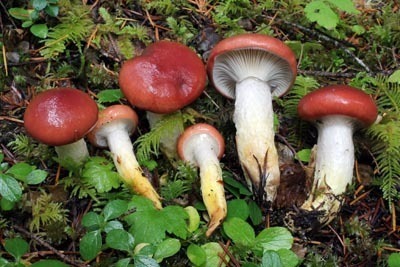
Rosy Slime Spike
Gomphidius subroseus
Gomphidius subroseus is a gilled mushroom found in Europe and North America. It was first described by Calvin Henry Kauffman in 1925. It was once thought to be mycorrhizal with Pinus sylvestris. However, Olson et al. (2002) found it to be more likely to be parasitic on Suillus bovinus, which is mycorrhizal with Pinus sylvestris, Pinus sylvestris or both.
From the article Gomphidius subroseus on Wikipedia (CC BY-SA), quoted section by section
Description
The cap is pinkish tan and up to 3–7 centimetres (1+1⁄4–2+3⁄4 in) wide. The stem is 3–7 cm long and about 1–2 cm wide. The veil may leave a ring. The gills are deeply decurrent and the spore print is dark gray to black.
Similar species. Gomphidius smithii has a less pink cap. The pink pigment of Hygrophorus caps is less defined and the gills are primarily adnate.
Range & habitat
It is found in Europe and North America. It appears from July to September in the Mountain states and September–November on the West Coast.
Wikipedia: “Distribution and habitat”
What it does
It was once thought to be mycorrhizal with Pinus sylvestris. However, Olson et al. (2002) found it to be more likely to be parasitic on Suillus bovinus, which is apparently mycorrhizal with P. sylvestris.
Wikipedia: “Ecology”
At the table
It is considered edible but of low quality. As with other species of the genus, removing the glutinous cuticle improves the taste. It is an accumulator of heavy metals.
Wikipedia: “Edibility”
Where it lives
Recorded sightings
—
geo-referenced records in GBIF, from museums, herbaria and field observers.
Drag the globe to turn it. Dots are where records exist, not a range map; darker means more records.
In the stacks
Searching the stacks…
Every page naming Gomphidius subroseus in the Biodiversity Heritage Library →
This page is assembled live from iNaturalist, GBIF, Wikipedia, the Source Library and the Internet Archive. It is not yet part of the hand-edited codex. iNaturalist taxon 48428.