- Fungi Including Lichens
- ›Basidiomycete Fungi
- ›Pucciniomycotina
- ›Pucciniomycetes
- ›rust fungi
- ›Uredinineae
- ›Pucciniaceae
- ›Puccinia
- ›Puccinia monoica
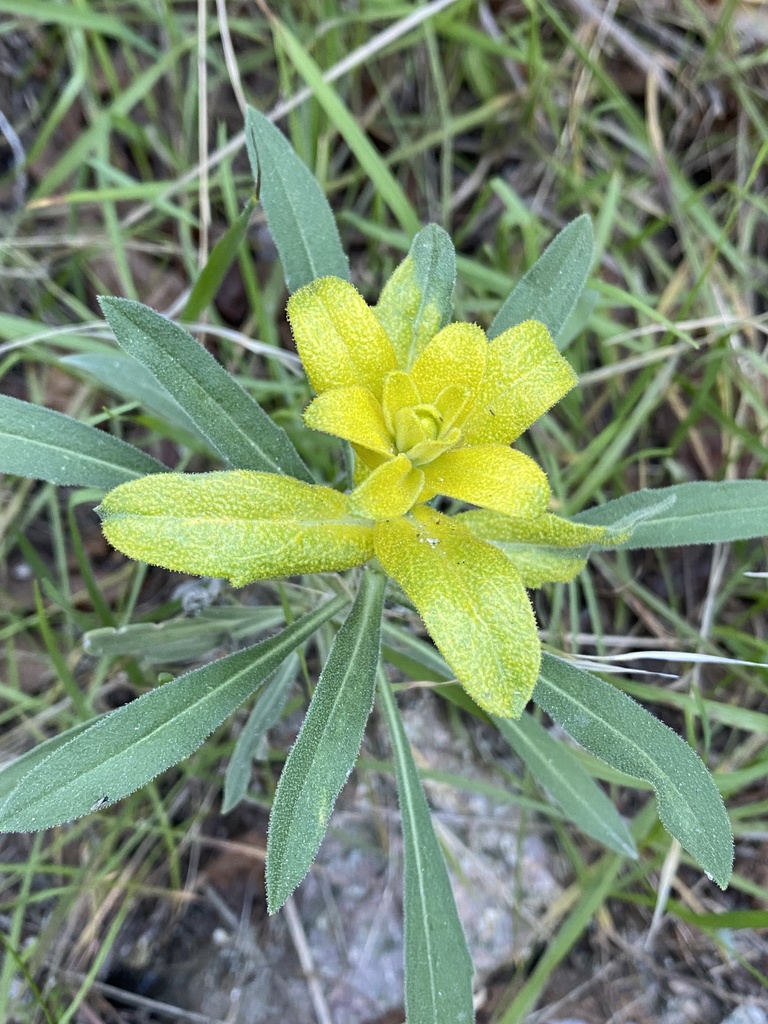
Mustard Flower Rust
Puccinia monoica
Puccinia monoica is a parasitic rust fungus of the genus Puccinia that inhibits flowering in its host plant (usually a Boechera species) and radically transforms host morphology in order to facilitate its own sexual reproduction by producing structures resembling flowers but containing fungal particles instead of pollen.
From the article Puccinia monoica on Wikipedia (CC BY-SA), quoted section by section
What it does
Infection of host plants (including Boechera and several other members of the mustard family) occurs via wind-borne basidiospores in late summer. Upon germination of the spores, fungal hyphae penetrate the stem of the mustard plant and siphon off nutrients. However, in order to reproduce sexually, the fungus must facilitate the transfer of spermatia from the spermatogonia on this plant to receptive hyphae borne in the spermatogonia on another infected mustard plant. To accomplish this, the fungus sterilizes the host plant, preventing it from producing true flowers. Instead, it forces the infected plant to grow clusters of leaves into brilliant yellow pseudoflowers bearing the fungal spermatogonia. Insects visiting the pseudoflowers transfer spermatia from one host plant to another, in the same way that pollinators transfer pollen between the true flowers of uninfected plants. Spermatia transferred in this way fuse with receptive spermatogonial hyphae on the recipient plant. The resulting hyphae subsequently form aecia. At this time, the pseudoflowers lose their green colour and stop producing nectar. Spores produced in the aecia, referred to as aeciospores, are responsible for infecting P. monoica's alternate host plant (a grass species of Koeleria, Trisetum, or Stipa). Upon germination hyphae produced by the aeciospores penetrate the grass, leading to the production of uredia. …
Wikipedia: “Life cycle”
In human culture
It was originally described and published by American mycologist Charles Horton Peck (1833–1917) as Aecidium monoicum in 1879. It was found on the leaves of Arabis retrofracta in Colorado, USA. Then in 1912, mycologist Joseph C. Arthur transferred it to the Puccinia genus, as Puccinia monoica.
Wikipedia: “History”
Where it lives
Recorded sightings
—
geo-referenced records in GBIF, from museums, herbaria and field observers.
Drag the globe to turn it. Dots are where records exist, not a range map; darker means more records.
In the stacks
Searching the stacks…
Every page naming Puccinia monoica in the Biodiversity Heritage Library →
This page is assembled live from iNaturalist, GBIF, Wikipedia, the Source Library and the Internet Archive. It is not yet part of the hand-edited codex. iNaturalist taxon 464167.