- Fungi Including Lichens
- ›Ascomycete Fungi
- ›Sac Fungi and Lichens
- ›Common Lichens
- ›Shield Lichens, Sunburst Lichens, Rosette Lichens, and Allies
- ›shield lichens, rim lichens, and allies
- ›shield lichens and allies
- ›typical shield lichens
- ›Punctelia
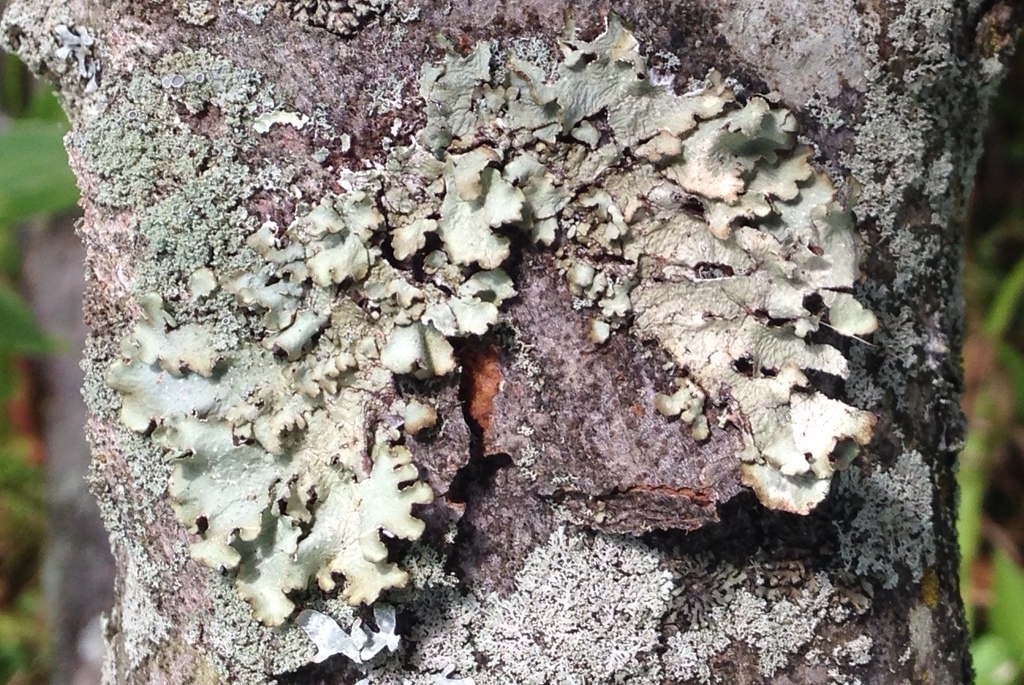
Punctelia graminicola
Punctelia graminicola is a species of foliose (leafy) lichen in the family Parmeliaceae. It grows on rocks, and, less frequently, on bark in North America, South America, and East Africa. It has a blue-grey thallus measuring up to about 15 cm (6 in), covered with tiny pores called pseudocyphellae. Sometimes the lichen forms small lobes that project out from the surface. Fruiting bodies are uncommon in this species; if present, they resemble small cups with a brown internal disc measuring 3–10 mm (0.1–0.4 in) in diameter. A lookalike species, Punctelia hypoleucites, is not readily distinguishable from Punctelia graminicola by appearance or habitat alone; these species can only be reliably differentiated by examining the length of their conidia (asexual spores).
First described in 1942 from specimens collected in New Mexico by Brother Arsène Brouard, the type specimen, stored in Dunkirk, was destroyed during World War II. After that, the name was relegated to synonymy with Punctelia subrudecta. In 1980, the species became known as Parmelia semansiana after studies published by William and Chicita Culberson; a couple of years later it was transferred to the new genus Punctelia, created to contain Parmelia-like species with pseudocyphellae on the thallus surface. Its name was changed again after, in 2001, some of Brouard's collections were rescued from disposal at a local landfill. Among this material were duplicates of the original collection that used the original epithet graminicola.
From the article Punctelia graminicola on Wikipedia (CC BY-SA), quoted section by section
Description
The thallus of Punctelia graminicola measures 3.0–14.5 cm (1.2–5.7 in) in diameter. It comprises irregularly branched lobes, often crowded or overlapping, measuring 2–4 mm (0.08–0.16 in) wide. The upper thallus surface is blue-grey to greenish-grey, often with brown margins, and usually smooth and without pruina. Herbarium specimens tend to turn brown. Pseudocyphellae on the thallus surface range in number from occasional to abundant. They are circular to irregularly shaped, measuring 0.03–0.6 by 0.03–0.4 mm. The medulla is white. Propagules such as isidia or soralia are absent in this species, but sometimes the lichen forms lobules – small lobes (lacinulae) on the lobe margins that project out from the surface. Adriano Spielmann and Marcelo Marcelli have noted that Punctelia graminicola has a broad species concept, as it include individuals both with and without lacinulae. The thallus undersurface ranges in color from pale tan to light to medium brown, with sparse, light-colored rhizines. These rhizines are completely covered by a cortex. The upper cortex is paraplenctenchymatous; this means that it is made of a type of tissue in which the hyphae are oriented in all directions, analogous to the parenchyma of plants. Depending on the dimensions of the thallus, the upper cortex is between 3 and 7 cells thick. …
Range & habitat
Punctelia graminicola grows on rocks, or on mosses that are on rocks. It has been recorded growing on a wide variety of rocks: basalt, conglomerate, granite, limestone, rhyolite, sandstone, schist, and volcanic. Much less frequently, it grows on bark. Recorded bark substrates include Fouquieria, Cupressus, and Quercus. In the United States, Punctelia graminicola occurs in the central US east to the Appalachians. It is common in the Great Plains region, extending to the southwestern part of the country. The Culbersons note that in the US, the lichen is only commonly found on trees in the centre of its range, while being largely confined to rock in the peripheries of its range. They suggest that the lichen "is primarily adapted to life on rock, extending substrate tolerance to bark only under the most favorable ecological conditions". In Mexico Punctelia graminicola is widely distributed across the northern and central parts of the country. Its range continues south into Central America. In South America, its distribution includes Argentina and Brazil. In East Africa (where it was recorded as P. semansiana), it is rare; it is known from Ethiopia, Kenya, and Tanzania.
Wikipedia: “Habitat and distribution”
Where it lives
Recorded sightings
—
geo-referenced records in GBIF, from museums, herbaria and field observers.
Drag the globe to turn it. Dots are where records exist, not a range map; darker means more records.
In the stacks
Searching the stacks…
Every page naming Punctelia graminicola in the Biodiversity Heritage Library →
This page is assembled live from iNaturalist, GBIF, Wikipedia, the Source Library and the Internet Archive. It is not yet part of the hand-edited codex. iNaturalist taxon 463919.