- Fungi Including Lichens
- ›Ascomycete Fungi
- ›Sac Fungi and Lichens
- ›Dothideomycetes
- ›Asterinales
- ›Melaspileellaceae
- ›Melaspileella
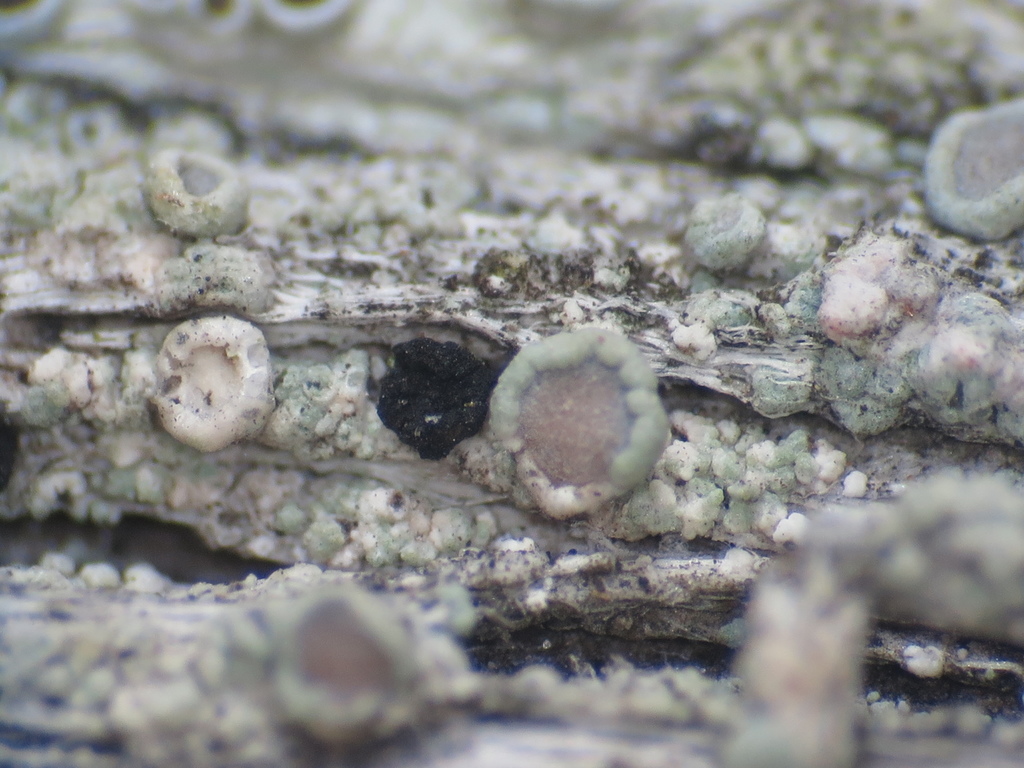
Melaspileella proximella
Melaspileella is an ascomycete genus in the family Melaspileellaceae, placed in the order Asterinales (class Dothideomycetes). The family was established in 2018 to accommodate the single genus Melaspileella, which contains only M. proximella, a species originally described in 1861. Long misclassified as a lichen and moved through various genera, molecular studies confirmed it is actually a non-lichenised saprophyte living on tree bark. The fungus is characterised by minute black fruiting bodies and distinctive ascospores bearing slender appendages that are visible when wet but disappear upon drying. Found across temperate and boreal regions of the Northern Hemisphere on both conifers and broad-leaved trees, it remains rarely encountered, likely due to its tiny size and inconspicuous appearance.
From the article Melaspileella on Wikipedia (CC BY-SA), quoted section by section
Description
Melaspileella produces tiny, black fruiting bodies that appear as solitary, rounded stromatic ascomata on the surface of bark. The outer wall (peridium) of each ascoma consists of two layers: an external layer of thick-walled, black cells and an inner layer of lighter brown to nearly hyaline cells of a Latin type. Inside the ascomata, numerous filamentous pseudoparaphyses (sterile filaments) are present; they are hyaline and mostly unbranched, but have brownish pigmented tips around the asci. The asci are eight-spored, bitunicate (having a double wall), and broadly club-shaped (clavate) to almost spherical in shape, with a rounded apex and a short stalk (pedicel). Each ascus contains eight ascospores that are hyaline, one-septate (two-celled), with the upper cell slightly larger than the lower cell. A distinctive feature of the spores is that they bear 2–3 slender appendages (setulae) at the poles; these appendages are visible in fresh or wet spores but tend to disappear when the spore dries. No asexual reproductive stage is known for Melaspileella (the fungus is only known from its sexual morph).
Range & habitat
Melaspileella proximella is a saprobic fungus that grows on the bark of living or dead woody plants. It does not form a lichen thallus (no photobiont is present), although it may superficially resemble a thin crust on bark (a "crustose, endophloedal" growth). This species has been recorded on the trunks and branches of a variety of trees and shrubs, including conifers like pine (Pinus) and juniper (Juniperus), as well as broad-leaved trees such as linden (Tilia). The species is interpreted as a saprobe of bark tissues rather than a pathogen of the host plant. In terms of distribution, Melaspileella proximella is known from temperate regions of the Northern Hemisphere. It has been documented in multiple parts of Europe (for example, Scandinavia and central Europe) and in eastern North America. Recent records also indicate its presence in Asia (e.g. Siberia, Russia), suggesting a broad boreal-temperate distribution across Eurasia and North America. However, it is generally considered a rarely encountered fungus, likely overlooked due to its minute size and inconspicuous appearance on bark.
== References ==
Wikipedia: “Habitat and distribution”
Where it lives
Recorded sightings
—
geo-referenced records in GBIF, from museums, herbaria and field observers.
Drag the globe to turn it. Dots are where records exist, not a range map; darker means more records.
In the stacks
Searching the stacks…
Every page naming Melaspileella proximella in the Biodiversity Heritage Library →
This page is assembled live from iNaturalist, GBIF, Wikipedia, the Source Library and the Internet Archive. It is not yet part of the hand-edited codex. iNaturalist taxon 463505.