- Fungi Including Lichens
- ›Ascomycete Fungi
- ›Sac Fungi and Lichens
- ›Common Lichens
- ›Shield Lichens, Sunburst Lichens, Rosette Lichens, and Allies
- ›shield lichens, rim lichens, and allies
- ›shield lichens and allies
- ›typical shield lichens
- ›Melanohalea
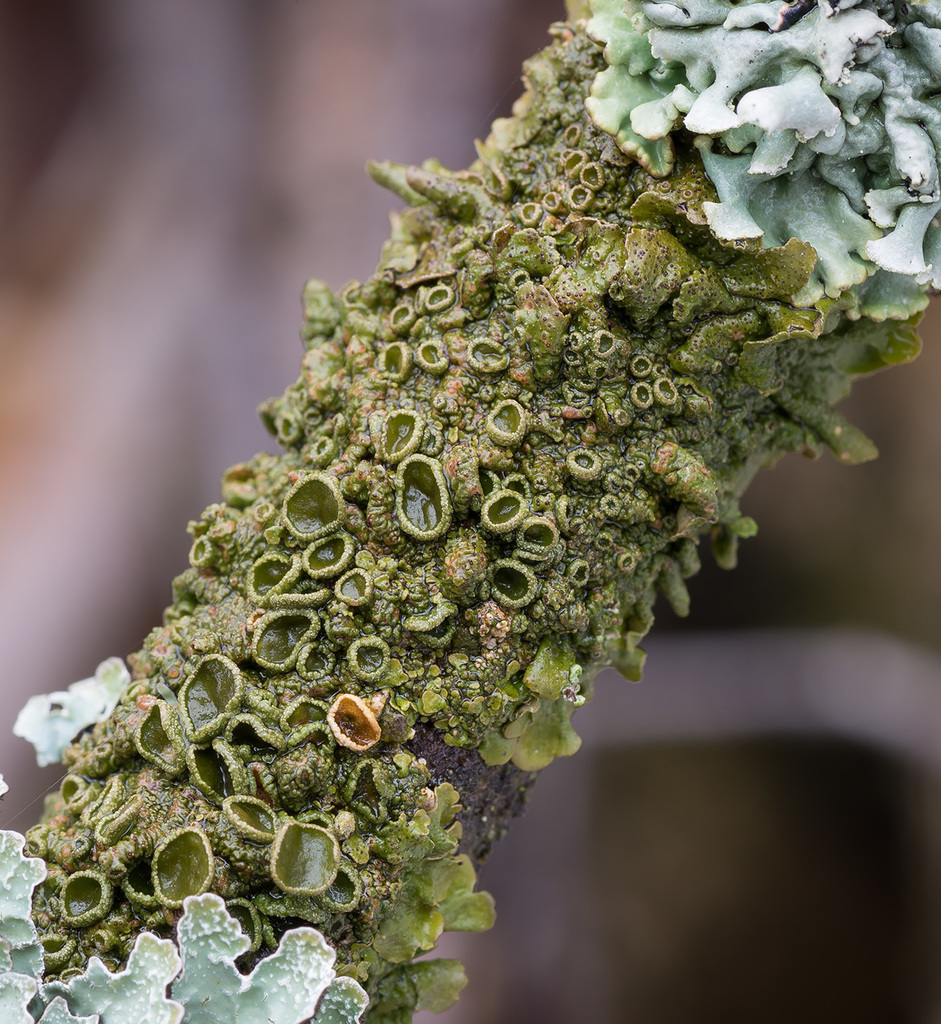
Spotted Camouflage Lichen
Melanohalea olivacea
Melanohalea olivacea, the spotted camouflage lichen or spotted brown shield, is a species of brown foliose lichen in the family Parmeliaceae. It forms rounded, olive-brown to dark brown patches (rosettes) that are typically 5–8 centimetres across on tree bark, particularly on birches in boreal forests and mountain woodlands. The lichen is distinguished by small pale spots called pseudocyphellae scattered across its upper surface and a black lower surface with dark rhizines (root-like attachment threads). Originally described by Carl Linnaeus in 1753 as Lichen olivaceus, the species was moved through several genera before DNA-based phylogenetic studies in 2004 placed it in the newly created genus Melanohalea. In that genus, it is recognized as distinct from similar brown species based on both genetic data and physical characteristics.
Melanohalea olivacea has an almost circumpolar distribution (around the high latitudes of the Northern Hemisphere) across the Northern Hemisphere's boreal zone, occurring throughout Scandinavia and other parts of northern Europe, as well as North America, and parts of Asia, though it becomes rare towards more southerly temperate regions. The species is known for forming a clear upper boundary on trunks, sometimes called the "olivacea line", which matches the maximum winter snow depth in subarctic birch forests, a pattern long used as a natural indicator of snow depth in Scandinavian mountains. Its height on the trunk is strongly controlled by how long snow covers the bark, and it is sensitive to prolonged ice encapsulation during mild winters.
From the article Melanohalea olivacea on Wikipedia (CC BY-SA), quoted section by section
Description
Melanohalea olivacea is a brown, foliose lichen that forms rounded rosettes, commonly about 5–8 cm across and sometimes reaching around 10 cm in diameter. The thallus is typically closely attached to the surface it grows on (the substrate) and divided into fairly broad lobes (the leaf-like divisions of the thallus), usually 2–5 mm wide, which can appear wavy or folded, especially towards the centre of older rosettes. Its upper surface ranges from olive-green to dark brown and is often dull in the central parts, while the outer lobes may look slightly shinier. The species typically lacks isidia and soredia (two common asexual propagules in lichens). Small, pale pseudocyphellae usually appear as small dot-like (punctiform spots, mainly on the lobe surface, and are easiest to see near the margins. The lower surface is typically black, with a narrow brown rim near the margins that lacks rhizines, and it bears dense, dark rhizines that are mostly simple (occasionally sparsely branched). Apothecia are common in mature thalli and are usually concentrated towards the centre rather than extending across the outer lobes. They are generally a few millimetres wide, with a dark brown disc and a raised margin that tends to become strongly crenulate and often pseudocyphellate as it ages. …
Range & habitat
Melanohalea olivacea is an epiphytic lichen (growing on plants, especially tree bark) that grows mainly on bark in cool, open, moderately humid habitats, particularly in boreal forests and montane birch woodlands. It is most often recorded from birch bark (Betula spp.), but also from other broadleaved trees and shrubs such as alder (Alnus) and rowan (Sorbus), and only occasionally on dead wood or rock. In Fennoscandia it is strongly associated with well-lit situations and can be especially abundant in mountain birch forests, where it tends to avoid the lower parts of trunks that remain under snow for long periods. In northern Norway, the species preferentially occupies the upper, snow-free parts of birch trunks, unlike some other epiphytic lichens that remain buried under snow for much of the winter. In subarctic birch forests, M. olivacea often forms a conspicuous lower limit on tree trunks, commonly known as the "olivacea line", which corresponds closely to the maximum depth of the winter snowpack. Below this level, prolonged snow cover and ice encapsulation reduce thallus vitality, whereas above it the species can dominate the bark surface and overgrow slower-growing epiphytes. The height of this boundary varies with habitat type and winter conditions and has long been used as a natural indicator of late-winter snow depth in Scandinavian mountain birch woodlands. …
Wikipedia: “Habitat and distribution”
What it does
The species is sensitive to prolonged ice encapsulation at mild subfreezing temperatures; increased winter icing events have been discussed as a potential risk to its vitality in boreal and subarctic regions. Across boreal birch forests, variation in epiphytic lichen composition has been shown to be influenced more strongly by factors on individual trees, especially height on the trunk, than by broader ecosystem-scale variables, a pattern that applies to M. olivacea and related species. Because epiphytic lichens respond to climatic gradients independently of ground-layer lichens, M. olivacea and similar canopy species are considered useful indicators of atmospheric and macroclimatic change in boreal forests.
Wikipedia: “Ecology”
Where it lives
Recorded sightings
—
geo-referenced records in GBIF, from museums, herbaria and field observers.
Drag the globe to turn it. Dots are where records exist, not a range map; darker means more records.
In the stacks
Searching the stacks…
Every page naming Melanohalea olivacea in the Biodiversity Heritage Library →
This page is assembled live from iNaturalist, GBIF, Wikipedia, the Source Library and the Internet Archive. It is not yet part of the hand-edited codex. iNaturalist taxon 463489.