- Fungi Including Lichens
- ›Ascomycete Fungi
- ›Sac Fungi and Lichens
- ›Collemopsidiomycetes
- ›Collemopsidiales
- ›Xanthopyreniaceae
- ›Collemopsidium
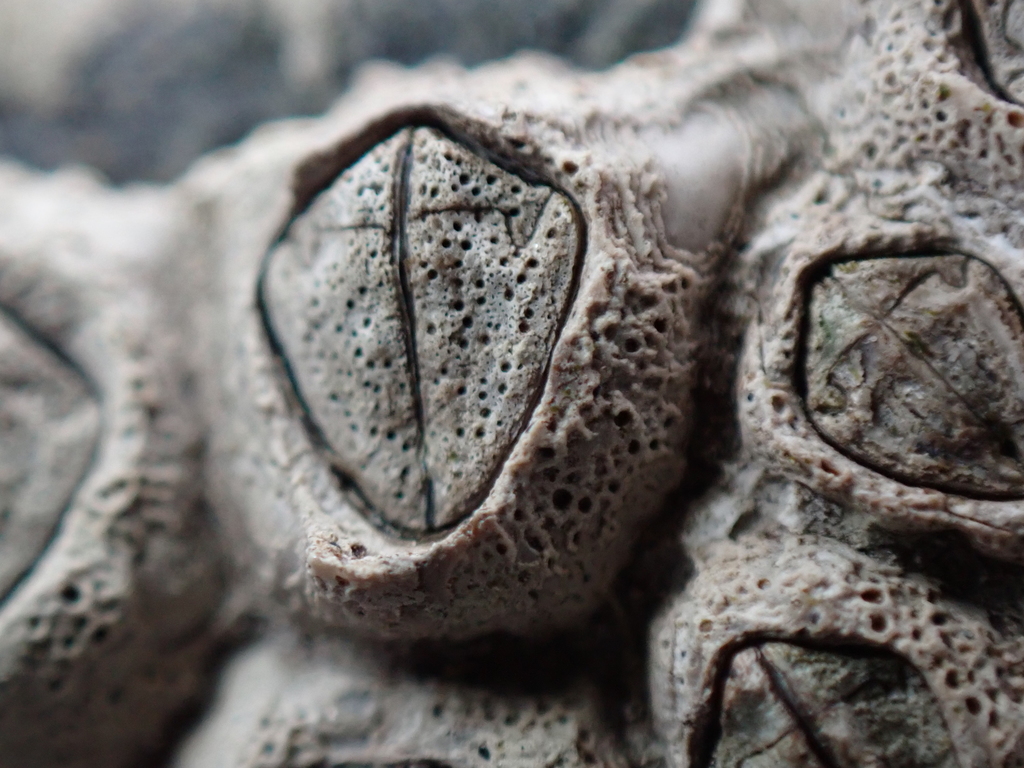
Collemopsidium foveolatum
Collemopsidium foveolatum is a species of lichen in the family Xanthopyreniaceae. It is a marine lichen that grows entirely embedded within calcareous substrates in the intertidal zone, particularly on limestone rocks and marine shells. The species is characterised by its minute, black, sunken reproductive structures (perithecia) that measure 0.10–0.24 mm in diameter and create small pits in the substrate. First described in 1911 from specimens collected in England, it has since been documented along coastlines in western Europe, North America and North Africa. The species can be distinguished from similar marine lichens by its consistently small, deeply embedded perithecia and its ability to maintain stable growth by keeping pace with natural substrate erosion.
From the article Collemopsidium foveolatum on Wikipedia (CC BY-SA), quoted section by section
Description
Collemopsidium foveolatum is a marine lichen that grows entirely embedded within its substrate. Its main body (thallus) is so deeply immersed that it is not visible on the surface. The species produces small reproductive structures called perithecia, which measure 0.10–0.24 mm in diameter and are also typically embedded in small pits within the substrate. Each perithecium is covered by a black, protective cap (involucrellum) that appears "lid-like" and lies either flat or slightly convex against the surface, with minimal lateral spread. The lichen reproduces through spores (ascospores) that measure 14–21 by 5–9 micrometres. It also commonly produces asexual reproductive structures called pycnidia, which appear as small black spots embedded in the substrate. Sometimes specimens may lack the characteristic black protective covering over their perithecia, representing a natural variation within the species. Collemopsidium foveolatum can be distinguished from similar species, particularly C. sublitorale, by its consistently smaller perithecia that remain deeply embedded in the substrate rather than protruding. While C. sublitorale often shows variation in perithecial size within a single specimen, C. …
Range & habitat
Collemopsidium foveolatum is a marine lichen that grows in the intertidal zone, specifically in the eulittoral zone (the area between high and low tides) and the littoral fringe (the area just above high tide). It shows a strong preference for calcareous substrates, growing primarily on limestone rocks and the shells of marine organisms. Research has confirmed the distinctive zonation patterns of marine lichens like C. foveolatum in the eulittoral zone, demonstrating that these species possess specific traits adapted to regular seawater immersion, including higher proportions of cyanobacterial photobionts and perithecioid fruiting bodies. The species has been documented along the coasts of western Europe, with confirmed populations in Ireland, Norway, and the United Kingdom. Environmental studies suggest it tends to be more common on shores with northerly aspects, though this observation may be influenced by sampling bias. Compared to other marine Collemopsidium species, C. foveolatum appears better adapted to drier conditions and can be found higher up on the shore than some of its relatives. When growing on limestone shores, C. foveolatum maintains its ability to grow by keeping pace with natural erosion of the substrate through its characteristic embedded growth pattern. …
Wikipedia: “Habitat and distribution”
Where it lives
Recorded sightings
—
geo-referenced records in GBIF, from museums, herbaria and field observers.
Drag the globe to turn it. Dots are where records exist, not a range map; darker means more records.
In the stacks
Searching the stacks…
Every page naming Collemopsidium foveolatum in the Biodiversity Heritage Library →
This page is assembled live from iNaturalist, GBIF, Wikipedia, the Source Library and the Internet Archive. It is not yet part of the hand-edited codex. iNaturalist taxon 462768.