- Fungi Including Lichens
- ›Basidiomycete Fungi
- ›Higher Basidiomycetes
- ›Mushrooms, Bracket Fungi, Puffballs, and Allies
- ›Agaricomycetidae
- ›Common Gilled Mushrooms and Allies
- ›Tricholomatineae
- ›Lyophyllaceae
- ›Calocybe
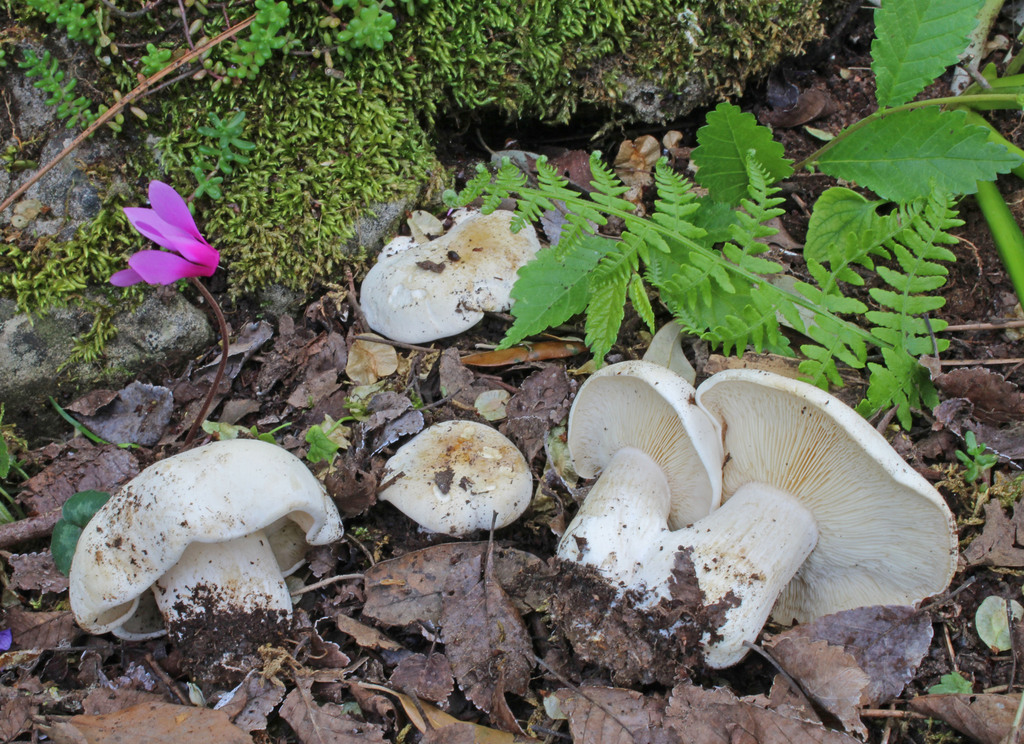
St. George's Mushroom
Calocybe gambosa
Calocybe gambosa, commonly known as St. George's mushroom, is an edible mushroom that grows mainly in fields, grass verges and roadsides. Deriving its common name from when it first appears in the UK, namely on St George's Day (23 April). It appears in March in Italy, a warmer country where it is also a popular mushroom to eat, and is known there as marzolino. It is also popular in Northern Spain and Southern France, in the...
From the article Calocybe gambosa on Wikipedia (CC BY-SA), quoted section by section
Description
The cap measures from 5–15 cm (2 to 6 inches) in diameter and has a smooth texture with ridges on it. The colour of the cap, stipe and flesh ranges from white to creamy. The sinuate gills are white and crowded. The stubby stipe is bulky at the base. The flesh is dense and soft, with a mealy or cucumber smell. The spore print is white.
Similar species. Care must be taken not to confuse it with the highly poisonous Inosperma erubescens, which grows in the same habitats. The latter has a more pungent fruity smell and bruises red. Entoloma sinuatum, also poisonous, has a rancid smell. Additionally, it may resemble the inedible Melanoleuca strictipes.
Range & habitat
Calocybe gambosa is common in grasslands in Europe, often in areas rich in limestone. It is common on the Swedish islands Öland and Gotland, both situated in the Baltic Sea. On the South Downs in southern England, it has formed huge fairy rings that appear to be several hundred years old. It is found from April to June in the United Kingdom, earlier in warmer countries and later in cooler ones. It appears in March in Italy, hence its regional name marzolino (also known as prugnolo).
Wikipedia: “Distribution and habitat”
At the table
The mushroom is best picked in dry weather. Although it resembles some poisonous species, it can be eaten cooked, pickled, and evidently raw. The species is imported in commercial quantities from Romania, Hungary, and Turkey. It was held in high esteem in medieval Italy, reported by Costanzo Felici in 1569 as the most expensive and highly regarded mushroom in Umbria and Marches in central Italy. It was also held in high esteem in the Apennine Mountains region—Liguria, Tuscany, and Emilia-Romagna)—by Giovanni Targioni Tozzetti in 1777. It is still locally eaten in Emilia-Romagna and Tuscany. St. George's mushroom is highly prized in the Basque Country of northern Spain, where it fetches very high prices. In Álava, it is traditionally eaten on the feast of Saint Prudentius (28 April), alongside snails. The mushroom is also a cornerstone of the gastronomy of Bilbao, where it is typically eaten in an omelette. The demand in the Basque Country is so high the mushroom has to be imported from Eastern Europe.
Wikipedia: “Uses”
Where it lives
Recorded sightings
—
geo-referenced records in GBIF, from museums, herbaria and field observers.
Drag the globe to turn it. Dots are where records exist, not a range map; darker means more records.
In the stacks
Searching the stacks…
Every page naming Calocybe gambosa in the Biodiversity Heritage Library →
This page is assembled live from iNaturalist, GBIF, Wikipedia, the Source Library and the Internet Archive. It is not yet part of the hand-edited codex. iNaturalist taxon 450829.