- Fungi Including Lichens
- ›Ascomycete Fungi
- ›Sac Fungi and Lichens
- ›Leotiomycetes
- ›Helotiales
- ›Vibrisseaceae
- ›Vibrissea
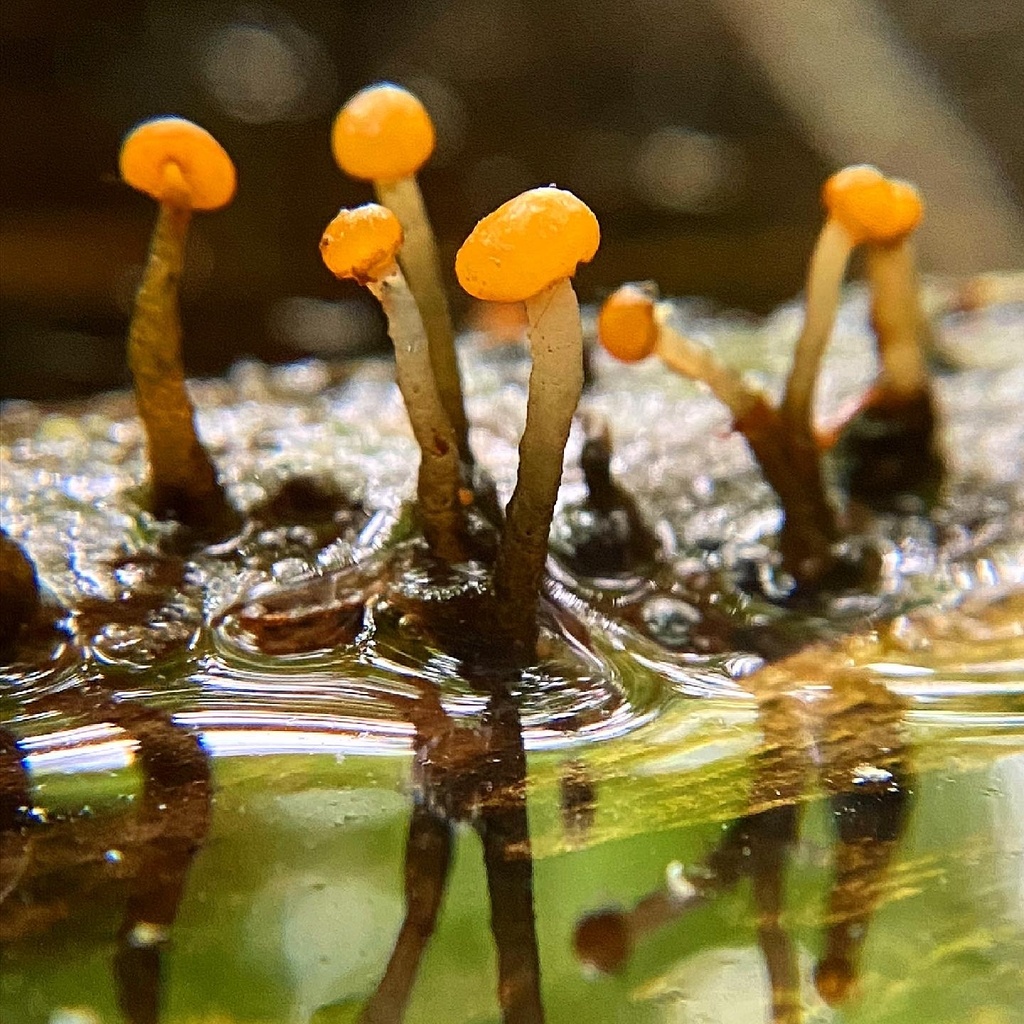
water club mushroom
Vibrissea truncorum
Vibrissea truncorum, the water club mushroom or aquatic earth-tongue, is a species of fungus in the family Vibrisseaceae. It is found throughout the Northern Hemisphere.
From the article Vibrissea truncorum on Wikipedia (CC BY-SA), quoted section by section
Description
Water club mushroom is a fungus that grows up to about 2 centimetres (3⁄4 inch) tall, with a cap 0.3–0.5 cm (1⁄8–1⁄4 in) wide. It is characterized by its yellow, orange, or reddish fruiting body, and white to bluish-gray stem, darkening to brown at the base.
Similar species. The heads of Leotia and Cudonia species are less yellow, while Vibrissea species can lack stems.
Range & habitat
Vibrissea truncorum is a cosmopolitan mushroom, found throughout the Northern Hemisphere, including North America (in the Pacific Northwest and the Atlantic Northeast), Europe, Japan, and rarely in eastern Russia and Chile. It is most heavily concentrated in Norway, Sweden, Finland, and Western Russia, though it appears also in the United Kingdom and Southwestern Europe. Water club mushroom often grows on partially or completely submerged wood in streams at higher elevations.
== References ==
Wikipedia: “Distribution and habitat”
Where it lives
Recorded sightings
—
geo-referenced records in GBIF, from museums, herbaria and field observers.
Drag the globe to turn it. Dots are where records exist, not a range map; darker means more records.
In the stacks
Searching the stacks…
Every page naming Vibrissea truncorum in the Biodiversity Heritage Library →
This page is assembled live from iNaturalist, GBIF, Wikipedia, the Source Library and the Internet Archive. It is not yet part of the hand-edited codex. iNaturalist taxon 434762.