- Fungi Including Lichens
- ›Ascomycete Fungi
- ›Sac Fungi and Lichens
- ›Common Lichens
- ›Shield Lichens, Sunburst Lichens, Rosette Lichens, and Allies
- ›shield lichens, rim lichens, and allies
- ›Sphaerophoraceae
- ›Leifidium
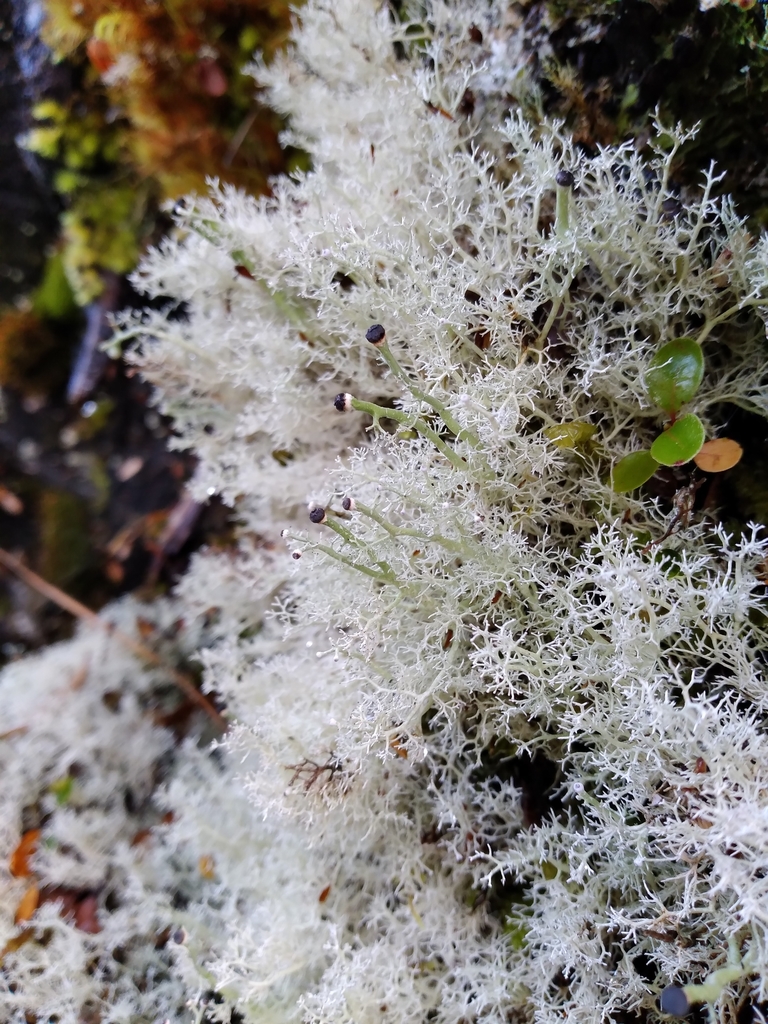
Leifidium tenerum
Leifidium is a fungal genus the family Sphaerophoraceae. The genus is monotypic, containing the single species Leifidium tenerum, a fruticose lichen. This lichen forms pale grey to whitish cushions made up of thin, flexible branches that divide repeatedly. It reproduces through small fruiting structures at branch tips that release powdery spore masses when mature. The species grows in diverse Southern Hemisphere environments, from cool rainforests to alpine areas, spanning from Chile and New Zealand to Australia and subantarctic islands.
From the article Leifidium on Wikipedia (CC BY-SA), quoted section by section
Description
Leifidium produces a pale grey-to-whitish thallus made up of very slender, round (terete) branches that divide repeatedly to form loose cushions or low mats on the substrate. Each branch is sheathed in an exceptionally thin cortex only about 30–45 μm thick—just two or three cell layers—so the branches remain flexible and often appear translucent at the tips. Beneath this skin lies a dense medulla of tightly packed fungal threads (hyphae). The combination of a thread-like, cushion-forming habit and the wafer-thin cortex readily separates Leifidium from its close relative Bunodophoron, whose branches are flatter and more thickly corticate. Reproductive structures sit at the very tips of stouter, upright side-branches. Each apothecium begins its development hidden beneath a cup-like wall (excipulum); when the spores are ripe this wall detaches in one piece "like lifting off a cap", exposing a powdery spore mass (the mazaedium) that faces upward. The spores themselves are tiny, almost smooth, globe-shaped bodies (6.5–8.5 μm in diameter) that start colourless and become faintly bluish-grey in alkaline solutions; any delicate surface ornament quickly dissolves in chemical tests. Minute flask-shaped pycnidia dot the branch tips, lining them with branched filaments that bud off single-celled, broadly ellipsoidal conidia about 3–4 × 1.5–2 μm. …
Range & habitat
Leifidium tenerum tolerates a broad range of Southern Hemisphere habitats, growing on alpine and subantarctic soil or rock as well as on the bark and twigs of trees, tree ferns, lianas and bamboo in cool-temperate rainforests. It is most vigorous in moist, well-lit sites; fertile branches become common at higher elevations and rainfall levels, while at low altitudes apothecia are typically produced beside spray zones near waterfalls. The species spans the southern temperate belt, from Cape Horn north to Temuco in Chile, through New Zealand, from Tasmania to central New South Wales in Australia, and across several subantarctic islands.
== References ==
Wikipedia: “Habitat and distribution”
Where it lives
Recorded sightings
—
geo-referenced records in GBIF, from museums, herbaria and field observers.
Drag the globe to turn it. Dots are where records exist, not a range map; darker means more records.
In the stacks
Searching the stacks…
Every page naming Leifidium tenerum in the Biodiversity Heritage Library →
This page is assembled live from iNaturalist, GBIF, Wikipedia, the Source Library and the Internet Archive. It is not yet part of the hand-edited codex. iNaturalist taxon 409237.