- Fungi Including Lichens
- ›Basidiomycete Fungi
- ›Higher Basidiomycetes
- ›Mushrooms, Bracket Fungi, Puffballs, and Allies
- ›Russulales
- ›Milkcaps, Brittlegills and Allies
- ›Lactarius
- ›Lactarius
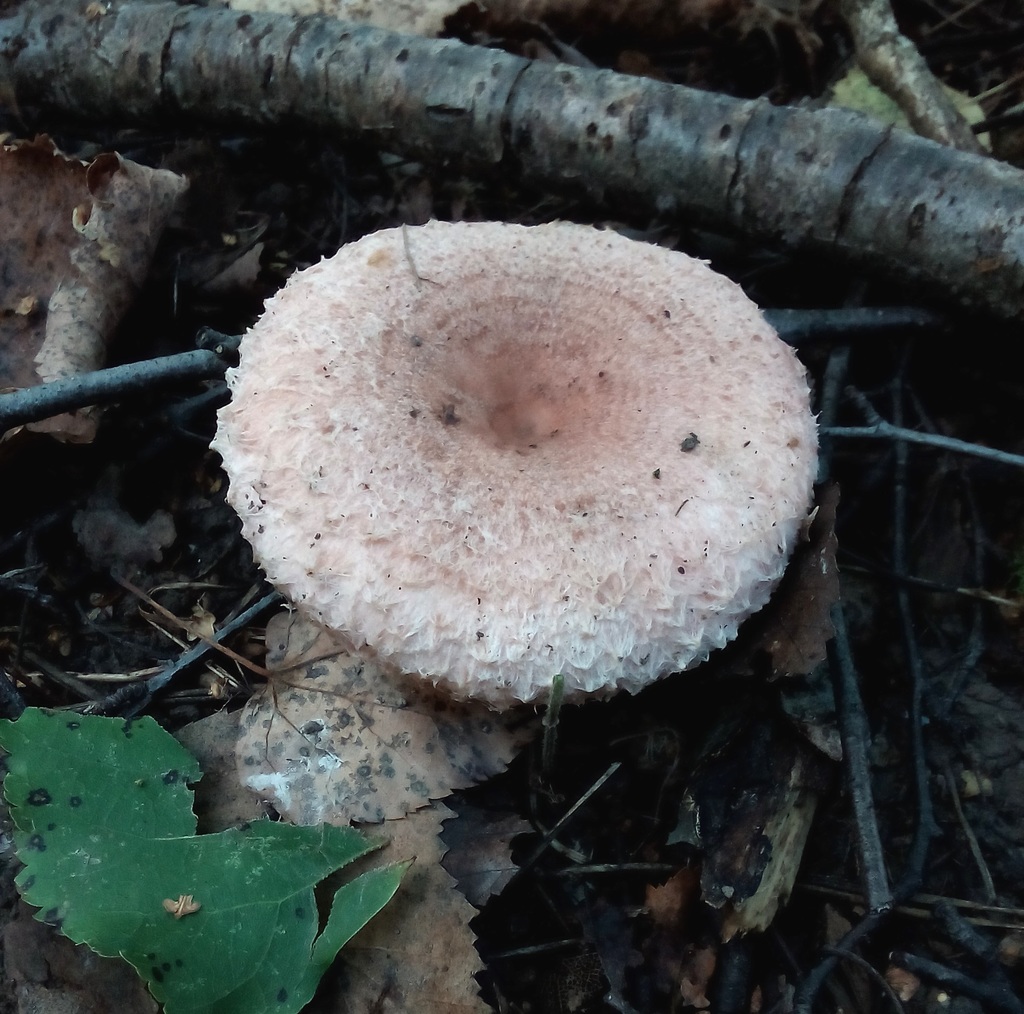
Downy milk cap
Lactarius pubescens
Lactarius pubescens, commonly known as the downy milk cap, is a species of fungus in the family Russulaceae. It is a medium to large agaric with a creamy-buff, hairy cap, whitish gills and short stout stem. The fungus has a cosmopolitan distribution, and grows solitarily or in scattered groups on sandy soil under or near birch.
In Russia, is consumed after prolonged boiling followed by a marinating process. However it is reported to have caused gastro-intestinal upsets. Therefore, its consumption should not be recommended and this species considered toxic.
From the article Lactarius pubescens on Wikipedia (CC BY-SA), quoted section by section
Description
The cap is 2.5–10 cm (1.0–3.9 in) wide, obtuse to convex, becoming broadly convex with a depressed center. The margin (cap edge) is rolled inward and bearded with coarse white hairs when young. The cap surface is dry and fibrillose except for the center, which is sticky and smooth when fresh, azonate, white to cream, becoming reddish-orange to vinaceous (red wine-colored) on the disc with age. The gills are attached to slightly decurrent, crowded, seldom forked, whitish to pale yellow with pinkish tinges, slowly staining brownish ochraceous when bruised. The stem is 2–6.5 cm (0.8–2.6 in) long, 6–13 mm (0.24–0.51 in) thick, nearly equal or tapered downward, silky, becoming hollow with age, whitish when young, becoming ochraceous from the base up when older, apex usually tinged pinkish, often with a white basal mycelium. The flesh is firm and whitish; the odor is faintly like geraniums or sometimes pungent, and taste is acrid. The latex is white upon exposure, unchanging, not staining tissues, taste acrid. The spore print is cream with a pinkish tint. The edibility of Lactarius pubescens has been described as unknown, poisonous, and even edible. The spores are 6–8.5 by 5–6.5 μm, elliptic, ornamented with warts and ridges that sometimes form a partial reticulum, prominences up to 1.5 μm high, hyaline (translucent), and amyloid. …
Range & habitat
The fruit bodies of L. pubescens are found scattered or in groups on the ground in wet areas under birch and other hardwoods from August to October. The fungus is common all over temperate Europe and has been reported from eastern North America, the Pacific Northwest, Arizona, California, Colorado, Idaho, and western Canada; its frequency of appearance is occasional. It is also found in Greenland, and was reported for the first time in Rome, Italy, in 1997.
Wikipedia: “Habitat and distribution”
Where it lives
Recorded sightings
—
geo-referenced records in GBIF, from museums, herbaria and field observers.
Drag the globe to turn it. Dots are where records exist, not a range map; darker means more records.
In the stacks
Searching the stacks…
Every page naming Lactarius pubescens in the Biodiversity Heritage Library →
This page is assembled live from iNaturalist, GBIF, Wikipedia, the Source Library and the Internet Archive. It is not yet part of the hand-edited codex. iNaturalist taxon 382882.