- Fungi Including Lichens
- ›Basidiomycete Fungi
- ›Higher Basidiomycetes
- ›Mushrooms, Bracket Fungi, Puffballs, and Allies
- ›Agaricomycetidae
- ›Common Gilled Mushrooms and Allies
- ›Marasmiineae
- ›Physalacriaceae
- ›Armillaria
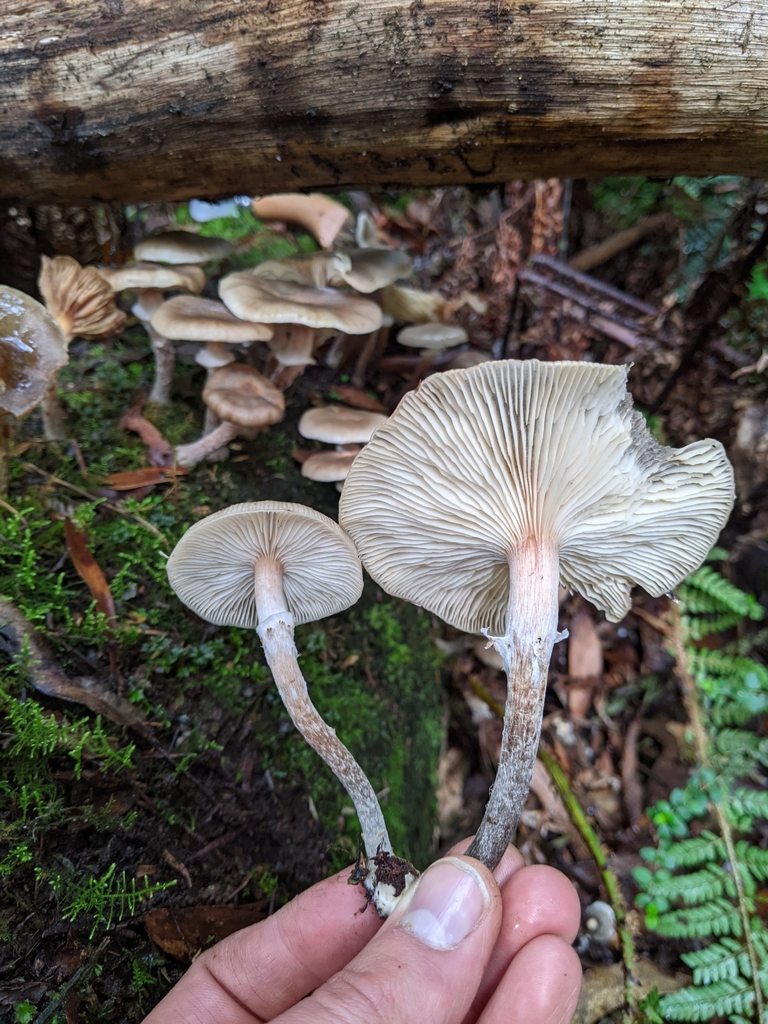
Austral Honey Mushroom
Armillaria novae-zelandiae
Armillaria novae-zelandiae is a species of mushroom-forming fungus in the family Physalacriaceae. This plant pathogen species is one of four Armillaria species that have been identified in Aotearoa New Zealand, alongside A. limonea, A. hinnulea, A. aotearoa.
In Aotearoa New Zealand the Te Reo name is harore, the English vernacular name is olive honeycap, and the diseases caused by Armillaria species are called root rot.
From the article Armillaria novae-zelandiae on Wikipedia (CC BY-SA), quoted section by section
Description
It was originally described as Armillariella novae-zelandiae by Greta Stevenson: "Pileus 3-8 cm diam., olive-buff to olive-brown, sprinkled at centre with very small dull brown scales, convex at first with a strongly down-rolled margin, becoming plane to shallow concave, moist when fresh with a conspicuously striate margin, drying matt; flesh creamy white. Gills decurrent to a most sinuate, creamy white becoming dull fawn, moderately crowded with many short members. Stipe 4–7 x 0.4–0.8 cm, fawn above evanescent ring, brown to dark purplish brown below, smooth or striate, tough, solid, bases swollen and united. Spores 8–9 x 5.5–6.5μm, non-amyloid rather thick-walled (Fig. 24). Spore print white". The pileus of A. novae-zelandiae can sometimes be bioluminescent.
Range & habitat
Armillaria novae-zelandiae is found in Australasia (New Zealand including the Chatham Islands, Tasmania, Eastern Australia, and Papua New Guinea), South America (Argentina and Chile), and Asia (Indonesia, Malaysia and Amami-Oshimi islands of Japan). Isolates from New Zealand and Australia are reciprocally monophyletic but considered conspecific by virtue of their similar basidiocarp morphology, vegetative growth characteristics and sexual compatibility. The South American lineage is sister to the Australasian clade, while isolates from Asia are a basal monophyletic lineage within A. novae-zelandiae.
Wikipedia: “Distribution”
In human culture
In Mātauranga Māori, the presence of harore in autumn forests is a signifier of the future, indicating either positive changes (such as a good fishing season) or a time of famine, depending on different regional traditions. Harore is a traditional Māori food source, a tradition which continues to this day, such as by Tūhoe, who continue to collect it as food in Te Urewera. Harore is edible providing it is cooked well before eating. Due to the mushroom disappearing soon after it arrives, this led to the whakataukī (proverb) "he harore rangitahi", or "one-day mushroom", as a phrase to describe transient aspects of life, or as an insult for people who only briefly contribute to work.
Wikipedia: “Māori cultural importance”
Where it lives
Recorded sightings
—
geo-referenced records in GBIF, from museums, herbaria and field observers.
Drag the globe to turn it. Dots are where records exist, not a range map; darker means more records.
In the stacks
Searching the stacks…
Every page naming Armillaria novae-zelandiae in the Biodiversity Heritage Library →
This page is assembled live from iNaturalist, GBIF, Wikipedia, the Source Library and the Internet Archive. It is not yet part of the hand-edited codex. iNaturalist taxon 381276.