- Fungi Including Lichens
- ›Ascomycete Fungi
- ›Sac Fungi and Lichens
- ›Sordariomycetes
- ›Sordariomycetidae
- ›Sordariales
- ›Chaetomiaceae
- ›Chaetomium
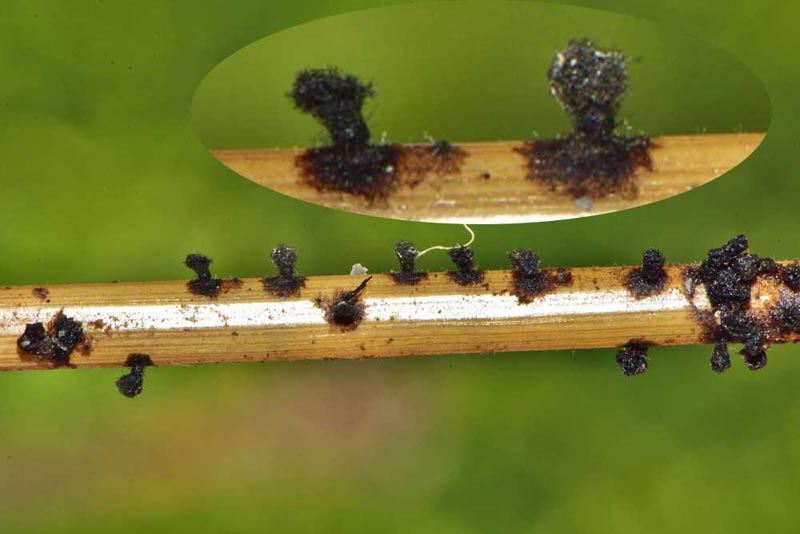
Chaetomium elatum
Chaetomium elatum is a very common and widely distributed saprotrophic fungus of the Chaetomiaceae family of molds which has been found to grow on many different substances all over the world. It was first established by Gustav Kunze after he observed it growing on dead leaves. Its defining features that distinguish it from other Chaetomium species are its extremely coarse terminal hairs and the lemon-shaped morphology of its ascospores. It produces many metabolites with potential biotechnology uses including one with promise against the rice blast disease fungus, Magnaporthe grisea. It shows very little pathogenic ability causing confirmed disease in only a few plant species.
From the article Chaetomium elatum on Wikipedia (CC BY-SA), quoted section by section
Range & habitat
Chaetomium elatum is a very common and widely distributed species of Chaetomium, with it being found all over the world. The species has been found in many areas of the United States, Canada, England, France, Russia, Switzerland, Germany, Scotland, the Galapagos Islands and many other localities. It is the most common species of fungi that grows on damp rotting straw, but has also been found and isolated from a variety of materials like rope, burlap, wood, paper, cellulose products, animal dung, seeds, barrel hoops, old brooms, Hordeum vulgare L, Triticum aestivum and the dead leaves of Typha and Sparganium. In general this species of Chaetomium mainly colonizes cereal, Alkali seepweed, True grasses, has been found to interact with Japanese yew, Alkali seepweed, European rabbit, Bread wheat, True grasses, Corn. It has also been associated with the mycobiota of Sugarcane as well as is known as a root-colonizing fungus in the avocado plant where it serves as both a rhizoplane and rhizosphere.
Wikipedia: “Habitat and ecology”
At the table
Chaetomium elatum has been isolated from different materials and its metabolic properties with potential biotechnology uses have been explored. In the presence of nitrocellulose (a very important cellulose derivative).C. elatum can break down nitrocellulose in liquid culture. Investigations into the types of metabolites produced by this fungus have found that it produces benzoquinone derivatives, tetra-S-methyl derivatives, anthraquinone-chromanone, orsellinic acid, globosumones, sterols Chaetoglobsins, Cochliodones 1–3 (azaphilone derivatives), azaphilones, chlorinated phenolic glycosides, and xanthoquinodins. Xanthoquinodins are fungal metabolites that have been found to have antibacterial, antifungal, anticoccidial, antiplasmodial, and cytotoxic activities. Azaphilones have antimicrobial, antifungal, antiviral, antioxidant, cytotoxic, nematicidal and anti-inflammatory properties, and the three metabolized by C. elatum have also been found to inhibit Caspase 3 which is involved in cell death. Phenolic compounds have shown to possess antimicrobial properties. Chaetoglobosins has been found to have anticancer activity, and benzoquinone derivatives have antibacterial properties. Nanoparticles harvested from crude extracts of the C. elatum exhibit antimicrobial activity against Magnaporthe grisea, the plant pathogen that causes rice blast disease.
Wikipedia: “Biotechnology uses”
In human culture
Gustav Kunze established the genus Chaetomium in 1817 after discovering a new species of fungus in dead stalks and leaves which he named C. globosum. In 1818, when observing the dead leaves of Typha and Sparganium in Germany, Kunze recognized a new fungus that looked like C. globosum but was darker in pigmentation, and after characterizing it named it Ch. elatum. In addition to Kunze's identification and characterization of the species (in which he failed to discern asci), Robert Greville created illustrations in 1826 to show the morphology of the species. Despite this, C. elatum has been confused by other mycologists many times and thus has been re-described more than any other Chaetomium species, leading to many obligate synonyms. It was during the creation of one of these synonyms, C. lageniforme, by August Corda in 1837 that asci were first recognized, thus identifying the defining feature that placed this fungus in the fungal division, Ascomycota.
Wikipedia: “History and taxonomy”
Where it lives
Recorded sightings
—
geo-referenced records in GBIF, from museums, herbaria and field observers.
Drag the globe to turn it. Dots are where records exist, not a range map; darker means more records.
In the stacks
Searching the stacks…
Every page naming Chaetomium elatum in the Biodiversity Heritage Library →
This page is assembled live from iNaturalist, GBIF, Wikipedia, the Source Library and the Internet Archive. It is not yet part of the hand-edited codex. iNaturalist taxon 381123.